Power Station for an Autumn Blackout: How Much Capacity a Home Really Needs
 16 min read
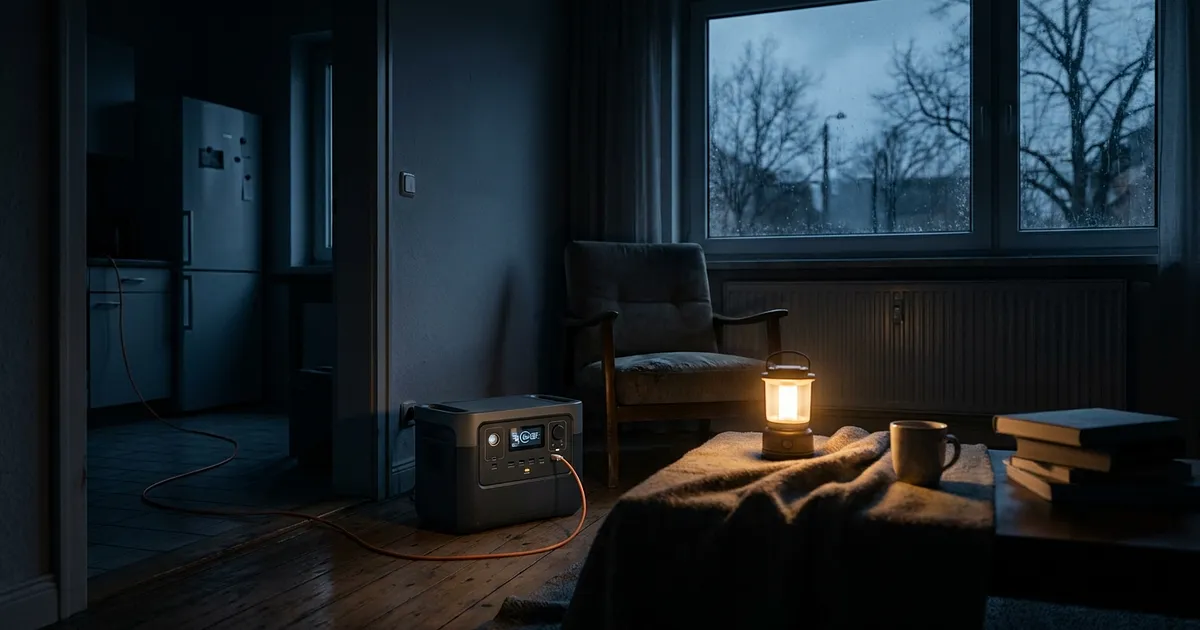
When the first autumn storm rolls through, the same question comes up in a lot of households: will a power station carry us if the electricity is gone for a few hours — or a few days? The answer turns on a single number, and it is not the one printed on the box. It is energy per day, and you can work it out from figures that are already stuck to appliances in your own flat.
This article runs the case Germany has actually had: a winter outage, an ordinary flat, a fridge, a router, one light and two phones. The general method for getting from watt-hours to runtime is laid out in our article on sizing a power station — what follows here is the concrete household over several days, and across that span one factor tips the arithmetic that barely registers over a single hour.
How long do German power cuts actually last?
Two numbers, and they only look contradictory.
The first: the Bundesnetzagentur puts average electricity unavailability per end consumer for 2024 at 11.7 minutes, down from 12.8 minutes in 2023. For that year 830 grid operators reported 164,645 supply interruptions in the low- and medium-voltage networks (Bundesnetzagentur press release, 09.10.2025). Nobody needs a power station for the statistically normal case. A torch covers it.
The second: at 06:13 on 03.01.2026 the power went out across south-west Berlin — Nikolassee, Zehlendorf, Wannsee, Lichterfelde, around 45,400 households and 2,200 commercial customers, caused by a fire on a cable bridge over the Teltowkanal. The last roughly 35,000 households only got power back on the afternoon of 08.01.2026. We wrote up the sequence in detail in Berlin Blackout.
For a buying decision that means you are not sizing against the average. You are sizing against a rare, multi-day winter event — and the honest conclusion is that a portable power station does not cover that event completely. It covers part of it, and which part is what you decide at purchase.
The four loads that matter — and where each number is written
The most common sizing mistake is guessing wattages. You do not have to guess. For three of the four relevant loads the figure is written down somewhere, and the fourth can be calculated.
The fridge. The right input is not the compressor rating but the annual consumption in kilowatt-hours from the EU energy label. The compressor cycles rather than running continuously, so anyone sizing from its connected load overstates the demand several times over. Annual consumption divided by 365 gives the daily figure. An appliance labelled at 150 kWh per year needs 411 Wh per day.
Router and modem. The power supply states maximum input, not actual draw. That is an upper bound, which makes it the safe side for an estimate. If you want it precisely, measure it with a plug-in energy meter before anything happens — during the outage itself is too late.
The light. The wattage is printed on the lamp. A 7 W LED over five hours is 35 Wh. In this calculation lighting is consistently the smallest line item and consistently the one people overestimate most.
The phones. Here the formula Wh = (V × mAh) ÷ 1000 does the work, with 3.7 volts as the standard value for lithium cells in consumer devices (Anker, as of 08.05.2026). A 5,000 mAh battery is therefore 18.5 Wh per full charge. Why the figure on the box and the energy actually delivered come apart is covered in our article on converting mAh to Wh.
And three loads come off the list immediately, because they do not belong to this device class: anything that heats. Kettle, hob, fan heater. A 1,500 W kettle drains this calculation's entire daily energy in a little over half an hour — and on many 1 kWh-class units it runs straight into a continuous output rating of typically 1,800 watts.
The daily figure, worked through
All values in watt-hours per day. The "where the number comes from" column is the actual content of this table — the assumed values are worked examples, not measurements taken on specific appliances.
| Load | Where the number comes from | Assumed | Wh/day |
|---|---|---|---|
| Fridge | EU energy label, kWh/year divided by 365 | 150 kWh/year | 411 Wh |
| Router + modem | Rating plate on the power supply | 10 W over 24 h | 240 Wh |
| LED light | Printed on the lamp | 7 W over 5 h | 35 Wh |
| Two phones | (3.7 V × mAh) ÷ 1000 | 2 × 18.5 Wh | 37 Wh |
| Total | 723 Wh |
Own calculation. The fridge value comes from an example energy label; the other three inputs are assumptions — put your own numbers in, they are all printed on a label somewhere.
Around 723 Wh per day. That is the figure a capacity rating has to be checked against. It is just not the complete one yet.
The line item that tips everything over several days
A power station never delivers its nameplate capacity. Two independent measurements quantify the deduction: the ADAC reports from its power station test of 11.06.2025 that genuinely usable capacity runs roughly 10 to 15 percent below the manufacturer figure, because the internal electronics consume part of it; heise measures round-trip efficiency across the tested fleet at 80 to 85 percent, and 96 percent usable capacity on the EcoFlow Delta Pro 3 at loads above 2,000 watts (heise, updated 30.12.2025).
The second deduction is the important one, and it is precisely the one an hourly calculation hides: the inverter draws power for as long as it is switched on, whether or not anything is plugged into it. Over a two-hour runtime that is a rounding error. Over a four-day outage it is the second-largest line item in the whole calculation.
Run the numbers: an idle draw of 10 to 30 watts, the order of magnitude used in our sizing article, comes to between 240 and 720 Wh over 24 hours. Against a useful demand of 723 Wh per day, the unfavourable end of that is a doubling.
| Operating pattern | Idle draw/day | Total/day |
|---|---|---|
| AC output on continuously, 10 W | 240 Wh | 963 Wh |
| AC output on continuously, 30 W | 720 Wh | 1,443 Wh |
| AC output on 8 h/day only, 10 W | 80 Wh | 803 Wh |
| AC output on 8 h/day only, 30 W | 240 Wh | 963 Wh |
Own calculation, based on the daily demand above and an assumed idle-draw range of 10 to 30 watts.
Which produces the one operating instruction this article gives: do not leave the inverter running through a multi-day outage. The fridge does not need continuous power, it needs cold — so cool it in intervals and switch the AC output off in between. The router and the phones run off the DC outputs anyway, USB-C and 12 volts, which bypass the inverter entirely.
How long a closed fridge holds its temperature without power is, admittedly, exactly the number you would need for that — more on it below, because we could not find a defensible German measurement of it.
Which capacity class fits which outage length
With a realistic daily demand between 800 and 1,000 Wh, the market sorts into three classes. Usable energy is taken here as 96 percent of nameplate, per the heise measurement above; the idle draw is already inside the daily figure.
Around 300 Wh: one night, no fridge
This class carries light, router and phones through a night, which covers the outage that statistically almost every outage is. It will not run a fridge, and units without an inverter have no 230-volt output at all. That is not a shortcoming but the reason they are small, light and cheap — and the reason the idle draw that tips the calculation above does not apply to them.
The Anker SOLIX C300 DC Anker SOLIX C300 DC Powerstation 288 Wh (LiFePO4, ohne Wechselrichter) at 288 Wh is one example of that design: LiFePO4 cells, no inverter, everything over USB and 12 volts.
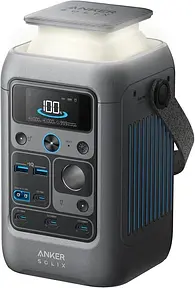
Anker SOLIX C300 DC Powerstation 288 Wh (LiFePO4, ohne Wechselrichter)
View at Amazon (as of Aug 11)Affiliate link. Buying through it earns us a commission; the price stays the same for you.
Around 1 kWh: one day with the fridge
The most common class and the right one for most households. Roughly 1,000 Wh of nameplate capacity is about 983 Wh usable — near enough exactly one day under the calculation above if the inverter is not left running, and considerably less if it is.
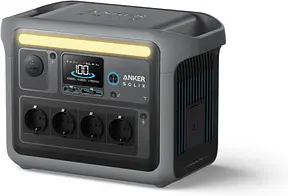
The Anker SOLIX C1000 Anker SOLIX C1000 Powerstation 1056 Wh (1800 W) mit Tragetasche sits in this class at 1,056 Wh; its sibling model, the C800 Plus, appeared in the ADAC test of 11.06.2025 with a grade of 2.5. The EcoFlow Delta 3 Plus EcoFlow Delta 3 Plus Powerstation, 1024 Wh at 1,024 Wh scored 2.1 in the same test.
Not available in your region — closest match
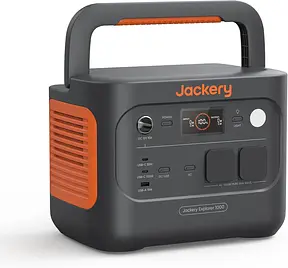
Jackery E1000 v2 Tragbare Powerstation, 1070Wh, 1500W AC-Ausgang, LiFePO4
View at Amazon (as of Aug 11)Affiliate link. Buying through it earns us a commission; the price stays the same for you.
Not available in your region — closest match
Anker SOLIX C1000 Powerstation, LiFePO4, 1800 W
View at Amazon (as of Aug 11)Affiliate link. Buying through it earns us a commission; the price stays the same for you.
Around 2 kWh: two days, and that is the end of it
Double the capacity, double the weight, double the price — and roughly 1,966 Wh usable, so about two days. Against Berlin's January 2026 outage that would have been about half of it. This is the point where the honest answer is that buying more capacity does not scale indefinitely, and from here the question that decides things is whether you can recharge.
The EcoFlow Delta 3 Max EcoFlow DELTA 3 Max Tragbare Powerstation 2048 Wh (LiFePO4, 2400 W X-Boost) at 2,048 Wh represents this class.
Not available in your region — closest match
Jackery E1000 v2 Tragbare Powerstation, 1070Wh, 1500W AC-Ausgang, LiFePO4
View at Amazon (as of Aug 11)Affiliate link. Buying through it earns us a commission; the price stays the same for you.
Why heating is the real sticking point
In autumn and winter, heat is what is missing — and heat is exactly what a power station does not supply.
A gas or oil boiler needs electricity for its controls, its fan and its circulation pump. Cut the power and the burner stops. For the pump alone the Umweltbundesamt gives an order of magnitude: a new high-efficiency pump uses around 40 kWh of electricity a year in a single-family house, an old unregulated one over 200 kWh (Umweltbundesamt, as of 08.11.2023). The pump is only one part of the system — we could not find an independent German measurement of a complete boiler's total electrical demand, and we are not going to estimate it.
More important than the wattage, though, is the connection question. A heating system is normally hard-wired or on its own circuit, not on a standard socket. Hooking it to a power station is electrical work on a fixed installation, not a plug-in job. Anyone planning it plans it with a qualified installer, in advance rather than during the outage.
The Berlin case adds a further point: district heating failed along with the power, because its pumps need electricity. So a household on district heating has the same problem without owning a boiler at all.
Germany's federal civil-protection authority, the BBK, accordingly does not answer the heat question electrically at all: it recommends warm clothing and blankets, plus wood, briquettes or coal where a stove exists. On power supply itself the BBK writes, verbatim: "Solarbetriebene Batterieladegeräte oder eine Powerbank können bei Stromausfall eine Hilfe sein" — solar-powered battery chargers or a power bank can help during an outage. That is a statement about light, communication and phones, not about heating.
Recharging: the question that decides day three
As soon as the outage outlasts the capacity you bought, capacity stops being the variable and resupply takes over.
With a solar panel
The obvious route, and the weakest one in winter. A solar array's yield is at its lowest in the dark months — which is exactly when multi-day outages happen. In December a panel does not replace a mains charge, it extends the range. How panel voltage and charge input relate to each other is covered at length in the sizing article.
Bundles of unit plus panel remove the compatibility question; the BLUETTI Elite 100 V2 BLUETTI Elite 100 V2 Powerstation, 1024 Wh, mit 200-W-Solarpanel is sold together with a 200 W panel.
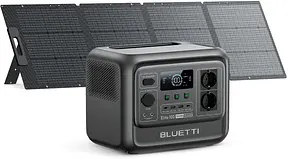
BLUETTI Elite 100 V2 Powerstation, 1024 Wh, mit 200-W-Solarpanel
View at Amazon (as of Aug 11)Affiliate link. Buying through it earns us a commission; the price stays the same for you.
From the car, or from a socket
The car is the more realistic fallback, and there is a safety finding here that lands squarely in this scenario. On 11.06.2025 the ADAC tested eight compact power stations; two failed with a grade of 5.0 — the Ective BlackBox 10 and the Jackery Explorer 1000 v2. The stated reason: their DC inputs are not decoupled from one another, so charging simultaneously from a vehicle and a solar panel risks overvoltage that can damage the vehicle — and the affected units warned of this neither on the device nor in the manual. The test winner was the Bluetti AC180P at 2.0.
That is an ADAC finding about those specific units on the test bench on that date, not a general statement about the brands, and no manufacturer response to it is available to us. The practical consequence applies to every unit regardless: during an outage, charge from one source, not two at once. What each of the various tests actually measured is separated out in our article on the 2026 power station tests.
And the third source gets forgotten: the socket at a neighbour's, at the office, or in a relative's flat two streets over. An outage almost always has a boundary, and fast-charging units like the EcoFlow Delta 3 Plus EcoFlow Delta 3 Plus Powerstation, 1024 Wh are built for exactly that.
Not available in your region — closest match
Anker SOLIX C1000 Powerstation, LiFePO4, 1800 W
View at Amazon (as of Aug 11)Affiliate link. Buying through it earns us a commission; the price stays the same for you.
Two numbers nobody can substantiate
Finally, the honest gap, because both of these would matter more for this scenario than any runtime table.
How much a power station self-discharges over months. This is the number that decides how full the unit is when the outage arrives — and for the German market nobody publishes it as a measurement. heise gives idle noise figures for power stations but no idle watts. We are not estimating it. The practical answer is a fixed date instead: check the charge level when the clocks change. Twice a year, in the calendar, done.
How long a closed fridge holds its temperature. The hour figures circulating on this question come overwhelmingly from manufacturer blogs. We could not find an independent German measurement, and without one the cooling interval from the section above cannot be quantified honestly. What remains: keep the door shut, open it as rarely as possible, and when in doubt cool once more rather than once less.
The decision in three sentences
Work out your daily demand from the labels already in your flat rather than from guessed wattages — with a fridge, a router, a light and phones, most households land between 700 and 1,000 Wh per day. Then buy the capacity class that matches the outage length you actually want to cover, and count the inverter's idle draw in, because over several days it becomes the second-largest line item. And plan heat separately, because it is the part of the problem no portable unit in this class solves.
As of 07.08.2026. Every figure carries its source and date in the text; anything without a substantiated measurement is marked as such.
All products from this post
The ones we named above are marked; the rest are alternatives in the same category.
Not available in your region — closest match
Jackery E1000 v2 Tragbare Powerstation, 1070Wh, 1500W AC-Ausgang, LiFePO4
View at Amazon (as of Aug 11)
Not available in your region — closest match
Anker SOLIX C1000 Powerstation, LiFePO4, 1800 W
View at Amazon (as of Aug 11)
Not available in your region — closest match
Jackery E1000 v2 Tragbare Powerstation, 1070Wh, 1500W AC-Ausgang, LiFePO4
View at Amazon (as of Aug 11)
Affiliate notice: As an Amazon Associate, we earn from qualifying purchases. Product prices and availability are subject to change.
Frequently Asked Questions
How much capacity do I need for a power cut at home?
That depends on your daily demand, not on a general recommendation. For a fridge, a router, one LED light and two phones, the calculation in this article comes to about 723 Wh per day, before the inverter's idle draw. A power station rated around 1,000 Wh covers roughly one day of that, one rated around 2,000 Wh roughly two. Redo it with your own figures from the energy label and the rating plate.
Can I run my heating from a power station?
Usually not straightforwardly. A gas or oil boiler needs electricity for its controls, fan and circulation pump, but it is normally hard-wired or on its own circuit rather than plugged into a socket. That makes it electrical work on a fixed installation and a job for a qualified installer, planned before an outage rather than during one. The BBK answers the heat question with warm clothing, blankets and stove fuel instead.
Should the power station stay switched on throughout the outage?
Better not. The inverter draws power for as long as it is on, even with nothing plugged in. Over 24 hours an idle draw of 10 to 30 watts comes to between 240 and 720 Wh — against a daily demand of about 723 Wh, that is up to a doubling. Cool the fridge in intervals and switch the 230-volt output off in between. The router and phones run over USB and 12 volts, bypassing the inverter.
How do I recharge if the power is out for days?
Three routes, none of them convenient in winter. A solar panel yields least in the dark months and extends your range rather than replacing a full charge. The car is the more realistic source. And often the nearest working socket is only a few streets away, because an outage almost always has a boundary.
Can I charge from the car and a solar panel at the same time?
Not without checking. On 11.06.2025 the ADAC graded two of eight tested units 5.0 because their DC inputs are not decoupled from one another: charging simultaneously from a vehicle and a solar panel risks overvoltage that can damage the vehicle, according to the ADAC, and the units warned of it neither on the device nor in the manual. The safe practice is to charge from one source.
How often should I check the charge level?
Twice a year is enough if the date is fixed. How much a power station self-discharges over months is not published as a measurement for the German market, and an estimate here would be worthless. Hence the pragmatic substitute: check the charge level when the clocks change. A unit that is half empty when the outage starts has already answered the capacity question.