Glass-Glass or Glass-Backsheet: Which Solar Panel Is Actually Worth It for Balcony Solar
 18 min read
As of: 07/08/2026
The one hard difference between glass-glass and glass-backsheet that you can actually look up in a datasheet is the product warranty: Trina gives its glass-glass Vertex S+ TSM-NEG9RC.27 25 years product and 30 years power warranty, while the glass-backsheet Vertex S TSM-DE09R.05 gets 12 years product and 25 years power warranty. Both figures come straight from the manufacturer's own sheets. The usual counter-argument — that glass-glass is too heavy for a balcony railing — is not supported by those same sheets: the glass-glass module weighs 21.0 kg, the glass-backsheet one 21.8 kg. With JA Solar the relationship flips (22.0 kg against 19.5 kg), and that is precisely the point: weight is a property of the model, not of the construction.
Almost every balcony solar product page lists "glass-glass" as a quality marker, usually right next to "bifacial" and a number with a lot of years after it. What rarely appears: what actually differs between the two builds, which of the claimed advantages shows up in the datasheet — and which one lives only in the marketing copy.
This piece works the question through the datasheets. Every figure below comes from manufacturer documentation or from research and standards bodies, and carries its source right next to the number. Ampcarry does not run its own tests and has not had any of these modules in hand; where a figure could not be substantiated, that is stated plainly.
One boundary: this is not about wattage. Which module rating suits your balcony or your power station is a separate question, covered in "Solar Panel Wattage: Balcony Solar or Power Station?". This piece is strictly about how the module is built.
What glass-glass and glass-backsheet actually mean
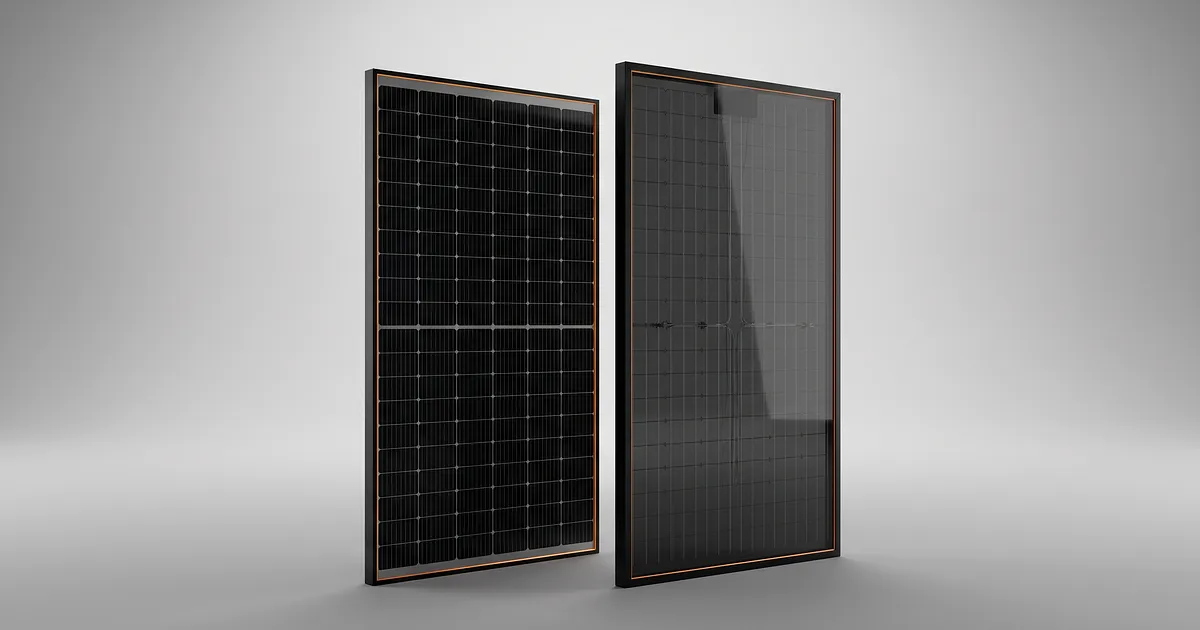
A solar module is a sandwich. Glass at the front, solar cells behind it, embedded in a plastic encapsulant. The difference sits in the rear face.
In a glass-backsheet module, the rear is a multi-layer plastic sheet. Trina specifies the Vertex S TSM-DE09R.05 with 3.2 mm front glass, EVA/POE encapsulant and a white backsheet (Vertex S DE09R.05 datasheet). JA Solar lists the JAM54S31 MR with 2.8 mm front glass and a "Glass-Backsheet" build (JAM54S31 MR product page).
In a glass-glass module, the rear is glass too. Both manufacturers solve it the same way: two thinner panes instead of one thick one. Trina specifies 1.6 mm front glass (AR coated, heat strengthened) and 1.6 mm rear glass for the Vertex S+ TSM-NEG9RC.27 (Vertex S+ NEG9RC.27 datasheet), and JA Solar states "Front Glass/Back Glass: 1.6mm/1.6mm" for the JAM54D40 LB BF (JAM54D40 LB BF product page).
Which leads to a point product pages tend to blur: 2 × 1.6 mm adds up to 3.2 mm — exactly as much glass as the glass-backsheet module carries at the front alone. The glass-glass module does not have more glass, it has the glass distributed differently. The real change is that the rear face is no longer plastic.
And because the rear is glass, it can be transparent. That is why glass-glass modules are often — but not necessarily — bifacial. There is a separate section on that below, because the two terms get used almost interchangeably in retail and they are not the same thing.
The weight myth: two manufacturer pairs, two opposite results
"Glass-glass is heavier" is the most common argument against the build on a balcony. The datasheets do not support it.
| Module | Build | Weight | Dimensions | Glass |
|---|---|---|---|---|
| Trina Vertex S+ TSM-NEG9RC.27 | Glass-glass, bifacial | 21.0 kg | 1762 × 1134 × 30 mm | 1.6 + 1.6 mm |
| Trina Vertex S TSM-DE09R.05 | Glass-backsheet | 21.8 kg | see datasheet | 3.2 mm |
| JA Solar JAM54D40 LB BF | Glass-glass, bifacial | 22.0 kg | 1762 × 1134 × 30 mm | 1.6 + 1.6 mm |
| JA Solar JAM54S31 MR | Glass-backsheet | 19.5 kg | 1722 × 1134 × 30 mm | 2.8 mm |
All four values appear in the manufacturer documents linked above. With Trina, the glass-glass module is 0.8 kg lighter than the glass-backsheet module from the same catalogue; with JA Solar it is 2.5 kg heavier. The build does not predict the weight.
Two caveats, so the table does not claim more than it can. First, the two Trina sheets are of different vintages — the glass-backsheet one carries the year 2022, the glass-glass one 2024. That is not a same-generation comparison. Second, the JA Solar modules are different sizes: the glass-glass one is 4 cm longer. Normalised to area — 1.998 m² against 1.953 m², my own arithmetic from the datasheet dimensions — that leaves roughly 11.0 against 10.0 kg/m², so about one kilo per square metre.
The usable conclusion: the whole class sits between 19.5 and 22 kg. If your balcony bracket carries that range, it carries both builds. If it does not, the bracket is the constraint, not the build — and then the question is which specific model fits the bracket manufacturer's rating, not which label is on the box. That rating is in your bracket's installation instructions; do not substitute a rule of thumb from a buying guide.
Warranty is the only difference that holds up
Here the comparison becomes unambiguous, and it stays inside one manufacturer's catalogue.
| Trina glass-glass (NEG9RC.27) | Trina glass-backsheet (DE09R.05) | |
|---|---|---|
| Product warranty (workmanship) | 25 years | 12 years |
| Power warranty | 30 years | 25 years |
| First-year degradation | max. 1 % | datasheet gives no single figure |
| Degradation from year 2 | max. 0.4 % per year | datasheet gives no single figure |
| Output at end of term | 87.4 % after 30 years | datasheet gives no end figure |
| Mechanical test load | 5,400 Pa snow / 4,000 Pa wind | 6,000 Pa positive / 4,000 Pa negative |
The first row is the one that matters. The product warranty is the one that actually pays out when something breaks — delamination, a failed junction box, a cracked rear face. The power warranty only bites when the module still works but measurably underdelivers, and the burden of proof is yours. Trina doubles the product warranty on the glass-glass module from 12 to 25 years. That is not a marketing line, it is the commitment that gets enforced when it matters.
With JA Solar the same comparison cannot be drawn cleanly. The glass-glass product page carries "15Y" in the model designation and states 1 % first-year and 0.4 % annual degradation over 30 years, but the page text does not clearly separate the product and power warranty terms. For the glass-backsheet JAM54S31 MR the manufacturer states 25 years power warranty at 0.55 % annual degradation. Both figures are on the pages linked above; the missing separation on the glass-glass variant is not being papered over with an assumption here.
What those degradation figures mean in percentage points
A calculation, explicitly flagged as my own, using the datasheet values as inputs:
Trina glass-glass after 25 years: 100 % − 1 % (year 1) − 24 × 0.4 % = 89.4 %
JA Solar glass-backsheet after 25 years at 0.55 % annually: 100 % − 25 × 0.55 % = 86.25 %
About three percentage points after a quarter century. That is real, and it is small. On a balcony system with an 800 W inverter we are talking about a fraction of the annual yield — how much exactly depends on location, orientation and shading, and a defensible euro figure would need a yield value this piece cannot substantiate. The two calculations also compare two manufacturers and two cell technologies (N-type TOPCon against P-type PERC), not just two rear faces.
If you want the difference reduced to one line: degradation is not the argument for glass-glass. The product warranty is.
Where glass-backsheet genuinely wins
Two points that rarely make it into comparisons, because they argue against the pricier build.
The mechanical test load. Trina rates the glass-backsheet module at "up to 6,000 Pa positive load and 4,000 Pa negative load", and the glass-glass module at "5,400 Pa snow load and 4,000 Pa wind load (test loads)". The higher positive test load belongs to the glass-backsheet module. That does not prove glass-backsheet is mechanically superior — the figures are labelled differently and come from sheets of different vintages — but it does refute the blanket claim that glass-glass is automatically the tougher module. On a balcony, snow load barely matters anyway; wind does, and there both state 4,000 Pa.
Price. Glass-glass modules generally cost more, and that premium is why the question gets asked at all. Concrete prices move weekly and current listings are further down; a fixed percentage for the premium would be wrong within a few weeks.
There is a third, unglamorous point on top: glass-backsheet is the default. Replacement sourcing, bracket approvals and the second-hand market are all broader for it.
Bifacial is not the same thing as glass-glass
These two terms get used almost interchangeably in retail, and on a balcony that leads to an expensive false assumption.
Glass-glass describes the build. Bifacial describes the module converting light from the rear as well. Glass-glass is the precondition for bifacial — no light gets through a white backsheet — but not every glass-glass module is run bifacially, and above all: bifacial only helps if light actually reaches the back.
Trina models the effect in its datasheet with reference bins of 5 % and 10 % backside power gain and states bifaciality of "up to 85 %". Under the BNPI conditions listed there, the 425 W module rises to 471 W and the 450 W module to 499 W (Vertex S+ NEG9RC.27 datasheet). Those are test conditions with defined rear-side irradiance, not a balcony forecast.
On a balcony the rear face is typically:
mounted flat against a dark railing panel — effectively no light reaches it,
flat against the building wall — similarly poor,
or free-standing above a bright surface — then it contributes.
Buy a bifacial module and bolt it flat against a sheet-metal railing, and you have paid for a property that delivers nothing in that position. Reliable measurements of bifacial gain specifically in balcony mounting could not be found for this piece; the ranges circulating online come from buying guides with no traceable measurement, so they are not reproduced here.
The catch no warranty table shows
A 30-year warranty is a claim against a company. It is worth exactly as much as that company still existing in 30 years.
This is not a theoretical worry. Meyer Burger — the best-known German module manufacturer, which marketed long warranties on glass-glass modules — filed for insolvency on 31 May 2025 for Meyer Burger (Industries) GmbH and Meyer Burger (Germany) GmbH. Affected were the cell plant in Thalheim with 331 employees and the Hohenstein-Ernstthal site with 289, around 620 people in total (pv magazine, 02/06/2025).
What a manufacturer warranty is practically worth in insolvency depends on the proceedings and cannot be quantified responsibly here — the recovery rates circulating online have no traceable source. The point that stands independently is simpler: your statutory warranty rights run against your seller, not against the module manufacturer. They are unaffected by the manufacturer's situation, but they are considerably shorter.
Practical consequence for the purchase: the glass-glass premium buys a longer manufacturer commitment. Whether it holds is not settled by the datasheet but by who holds the contract with you and how solid the manufacturer is. A set from a retailer with a domestic presence is a different proposition from a direct import when a claim arises.
Balcony railings, building law and glass
A point regularly overlooked with glass modules on balconies, and it has nothing to do with glass-glass versus glass-backsheet — it is about how the module is mounted.
As long as the module hangs in front of an existing railing that is adequate in its own right, it is equipment. The moment the module replaces the railing — becoming the fall protection itself — it turns into fall-protection glazing. That brings DIN 18008-4 in its 2024-12 edition into play (standard entry at baunormenlexikon.de), and Germany's Institute for Building Technology lists fall-protection glazing as its own construction-product group (DIBt product information portal). Ultimately your federal state's building code governs, and those differ.
For the normal case — module on the outside of an existing railing, railing stays a railing — this is a non-issue. Anyone planning to replace the railing with modules, or to mount a module above a trafficked area, should clear that with the local building authority beforehand rather than with a buying guide.
The carbon figures
One argument for glass-glass that is measurable and rarely mentioned. Fraunhofer ISE compared the manufacturing emissions of both builds and gives the following (kg CO₂ equivalent per kilowatt peak):
| Manufacturing location | Glass-backsheet | Glass-glass |
|---|---|---|
| China | 810 | 750 |
| Germany | 580 | 520 |
| EU | 480 | 420 |
The institute puts the production advantage at 7.5 to 12.5 percent and writes that frameless glass-glass modules cause 22 to 27 percent less CO₂ per kilowatt-hour over their lifetime (Fraunhofer ISE press release). Most of that advantage comes from frameless modules needing no energy-intensive aluminium — though all four modules compared above carry a 30 mm aluminium frame, so for them the advantage is smaller.
As for why the backsheet is a weak point in the first place: Fraunhofer ISE examined backsheets from 26 power plants and names chalking, cracks in various layers and chemical changes in composition as the damage patterns (Markert et al., "Advanced Analysis of Backsheet Failures from 26 Power Plants", 2020, publication entry). How often this occurs is not stated in the abstract, so no failure rate can be derived from it — only that this is a known, studied failure mode that glass-glass modules structurally cannot have.
Current modules and complete kits
The items below cover both builds. Prices and availability move; the product page at the time of purchase is what counts.
Individual glass-glass modules
If you are retrofitting an existing bracket or replacing a failed module, you buy singly. The Kleines Kraftwerk 480 Wp Solarmodul SunPro TOPCon – bifazial, Glas-Glas, Full Black carries 480 Wp with N-type TOPCon cells and sits at €199.00 — the cheapest glass-glass single module in this selection. The Solakon Solarpanel 500 W, bifazial Glas-Glas N-Type Solarmodul, Full Black at 500 W comes in at €209.99, essentially level on a per-watt basis. Well above both sits the Solarway 500 W Solarpanel Full Black bifazial Glas/Glas PV-Panel at €399.99 for the same 500 W; worth checking what else is in the box before reading that premium as a quality signal.
All three prices were read from the product pages on 07/08/2026. Star ratings are deliberately omitted here: they could not be read reliably at fetch time, and an estimated rating is worse than none.
Kleines Kraftwerk 480 Wp Solarmodul SunPro TOPCon – bifazial, Glas-Glas, Full Black
View at AmazonAffiliate link. Buying through it earns us a commission; the price stays the same for you.
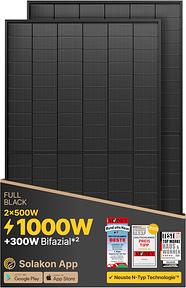
Solakon Solarpanel 500 W, bifazial Glas-Glas N-Type Solarmodul, Full Black
View at AmazonAffiliate link. Buying through it earns us a commission; the price stays the same for you.
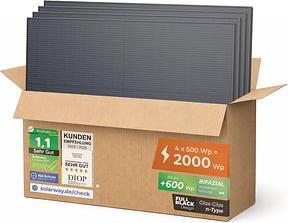
Solarway 500 W Solarpanel Full Black bifazial Glas/Glas PV-Panel
View at AmazonAffiliate link. Buying through it earns us a commission; the price stays the same for you.
Complete kits
For a first system, a kit is usually cheaper than the parts. The SUNNIVA 920 W Balkonkraftwerk bifazial Full Black Komplettset mit DEYE 800 W Wechselrichter pairs 920 W of bifacial modules with a DEYE 800 W inverter at €239.00. Similarly built is the 1000 W Balkonkraftwerk Komplettset – 800 W MARSTEK Mikrowechselrichter mit 2 × 500 W bifazialen Glas-Glas-Modulen with 2 × 500 W glass-glass modules and a MARSTEK inverter at €289.00. If you want to back that 800 W of inverter capacity with substantially more module area — sensible with east-west orientation or partial shading — the Kleines Kraftwerk 2000 W Balkonkraftwerk XL Komplettset – 800 W Wechselrichter, 4 × 500 W bifazial puts four bifacial 500 W modules on the same 800 W inverter for €539.00.
As the counterpoint to the glass-glass camp there is the SCHWAIGER Balkonkraftwerk Slim-Line 2er-Set, 400 Wp, 2 × 200 Wp monokristallin, ultraflach at €229.00: two ultra-flat 200 Wp modules, engineered for low depth rather than maximum output. On tight balconies or railings with a load limit, build depth is sometimes the binding constraint, not wattage.
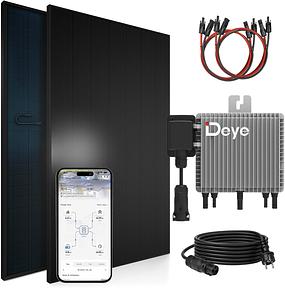
SUNNIVA 920 W Balkonkraftwerk bifazial Full Black Komplettset mit DEYE 800 W Wechselrichter
View at AmazonAffiliate link. Buying through it earns us a commission; the price stays the same for you.
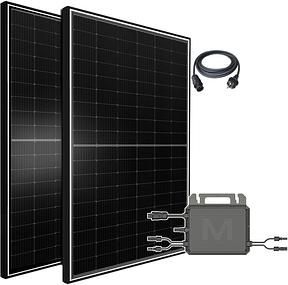
Affiliate link. Buying through it earns us a commission; the price stays the same for you.
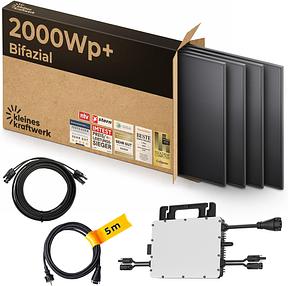
Kleines Kraftwerk 2000 W Balkonkraftwerk XL Komplettset – 800 W Wechselrichter, 4 × 500 W bifazial
View at AmazonAffiliate link. Buying through it earns us a commission; the price stays the same for you.
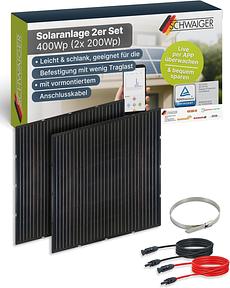
SCHWAIGER Balkonkraftwerk Slim-Line 2er-Set, 400 Wp, 2 × 200 Wp monokristallin, ultraflach
View at AmazonAffiliate link. Buying through it earns us a commission; the price stays the same for you.
Brackets
The bracket decides which module weight is even on the table, which is why it belongs in the same purchase decision. The SCHWAIGER Balkonkraftwerk Halterung für Geländer, Montageset für 2 Solarmodule is rated for two modules and, at €29.94, is the budget option. More solidly built and priced accordingly at €66.90 is the Avoltik 2 × Balkonkraftwerk Halterung für Balkongeländer, für alle Solarpanel-Größen, which the manufacturer states fits all common panel sizes. In both cases the load rating in the installation instructions governs, not the product description.
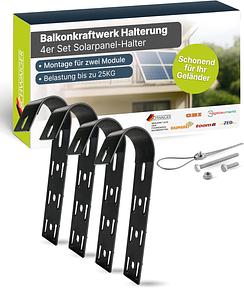
SCHWAIGER Balkonkraftwerk Halterung für Geländer, Montageset für 2 Solarmodule
View at AmazonAffiliate link. Buying through it earns us a commission; the price stays the same for you.
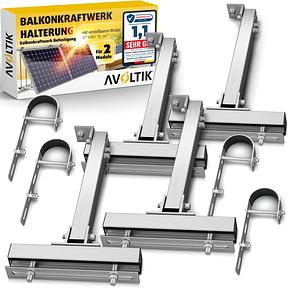
Avoltik 2 × Balkonkraftwerk Halterung für Balkongeländer, für alle Solarpanel-Größen
View at AmazonAffiliate link. Buying through it earns us a commission; the price stays the same for you.
What we could not substantiate
So it is clear where this piece ends:
No reliable measurement of bifacial gain in balcony mounting. The circulating ranges come from buying guides with no traceable measurement series.
No figure for how often backsheets fail. The Fraunhofer study names damage patterns; the accessible abstract gives no rate.
No recovery rate for warranty claims in insolvency. The percentages quoted online could not be traced to an official source.
No consistent same-generation comparison at Trina. The two datasheets carry different years.
No euro figure for the output difference. That would need a substantiated yield value for a specific location.
The short version
The decision reduces to three questions:
- How long is the system staying? Past ten years, the doubled product warranty argues clearly for glass-glass. As a stopgap in a rental, that argument falls away.
- What does your bracket carry? Across the four modules compared, both builds fall between 19.5 and 22 kg. Check your bracket's approval for the specific model, not for the build type.
- Does light reach the back? If not, the bifacial share of the premium is wasted — you are then buying glass-glass purely for the warranty, which is a legitimate but smaller reason.
What does not decide it: degradation. Three percentage points of remaining output after 25 years is not a purchase argument at 800 watts.
All products from this post
The ones we named above are marked; the rest are alternatives in the same category.
Affiliate notice: As an Amazon Associate, we earn from qualifying purchases. Product prices and availability are subject to change.
Frequently Asked Questions
Is a glass-glass module heavier than a glass-backsheet module?
Not necessarily. Trina's glass-glass Vertex S+ NEG9RC.27 weighs 21.0 kg per its datasheet, against 21.8 kg for the glass-backsheet Vertex S DE09R.05. With JA Solar it is the other way round: 22.0 kg for the glass-glass JAM54D40 LB BF against 19.5 kg for the glass-backsheet JAM54S31 MR. Both builds land in the same range. Weight follows the specific model, not the construction type.
How much extra warranty does glass-glass buy?
With Trina the product warranty more than doubles: 25 years on the glass-glass module against 12 years on the glass-backsheet one. The power warranty rises from 25 to 30 years. The product warranty is the important one, because it covers defects such as delamination or a failed junction box. The power warranty only applies when underperformance is demonstrated.
Is a bifacial module worth it on a balcony railing?
Only if the rear face gets light. Mounted flat against a dark railing panel or directly against the wall, the bifacial capability goes essentially unused. Trina models the effect in its datasheet with reference values of 5 and 10 percent backside gain under defined test conditions. Reliable measurements specific to balcony mounting could not be found.
Is glass-glass mechanically tougher?
The datasheets do not say so. Trina rates the glass-backsheet module at up to 6,000 Pa positive load and the glass-glass module at 5,400 Pa snow load; wind load is 4,000 Pa for both. The higher positive test load therefore belongs to the glass-backsheet module. On a balcony, wind is the relevant load case anyway, and there the two figures do not differ.
Do I need a permit for a glass module on a balcony?
That depends on the mounting, not the module type. Hung in front of an existing railing, it is equipment. Replacing the railing, it becomes fall-protection glazing, governed by DIN 18008-4 in its 2024-12 edition, for which the DIBt maintains its own construction-product group. Your federal state's building code has the final say. Clear it with the building authority in advance.
What happens to the warranty if the manufacturer goes insolvent?
A manufacturer warranty is a claim against that company and is therefore tied to its survival. Meyer Burger filed for insolvency for its two German entities on 31 May 2025. Separately from that, your statutory warranty rights run against your seller, not the manufacturer. Those are considerably shorter but unaffected by the manufacturer's situation.
How big is the output difference after 25 years?
Extrapolating the datasheet values leaves the Trina glass-glass module at roughly 89.4 percent after 25 years (1 percent in year one, then 0.4 percent annually) and the JA Solar glass-backsheet module at roughly 86.25 percent (0.55 percent annually). That is a little over three percentage points. The calculation does compare two manufacturers and two cell technologies, though, not just two rear faces.
Sources
- Vertex S DE09R.05 datasheet static.trinasolar.com
- JAM54S31 MR product page jasolar.eu
- Vertex S+ NEG9RC.27 datasheet vertexsplus.trinasolar.com
- JAM54D40 LB BF product page jasolar.eu
- pv magazine, 02/06/2025 pv-magazine.de
- standard entry at baunormenlexikon.de baunormenlexikon.de
- DIBt product information portal dibt.de
- Fraunhofer ISE press release ise.fraunhofer.de
- publication entry publica.fraunhofer.de