Solar Power Bank Test: Real Charging or Just Decoration?
 12 min read
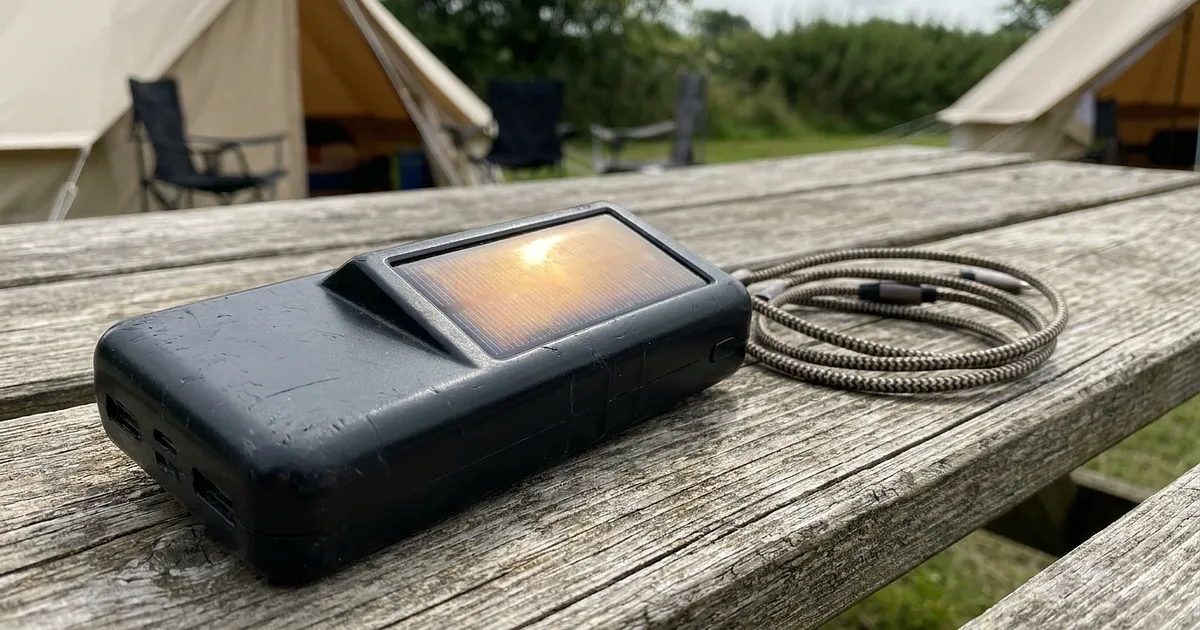
A solar power bank test almost always ends the same way: pretty cell, sobering numbers. The built-in solar cell isn't fake. Real silicon, real charging electronics. The physics just refuse to cooperate, and that's exactly what those product shots in the sun never tell you.
As of 20 Aug 2026. Every performance and price figure below is tagged with its source and date. There are no first-hand measurements here, we reconcile what others have measured.
Solar Power Bank Test: What the Built-In Solar Cell Actually Delivers
Let's start with the number that never makes it onto the packaging: real wattage.
Per menshealth.de (15 June 2026), a typical compact solar cell has roughly 120 cm² of surface area and 20 to 22 percent cell efficiency. In practice that yields only 1 to 2.5 watts. Enough to charge a 20,000 mAh power bank once in 12 to 20 days of full sun. Not hours. Days.
To feel how little that is, do the math: 20,000 mAh × 3.7 V ÷ 1000 comes to about 74 Wh of rated capacity, with maybe 60 to 66 Wh actually usable. The 5 V printed on the USB port, by the way, is the classic trap here. You calculate with the 3.7 V cell voltage, not the 5 V at the output. If you want to work through the math yourself, how to convert mAh to Wh walks through the short formula in full.
And the manufacturer specs? Based on calculations by mobilepowertest.de from published specs, a solar module rated around 1 watt, like the one in the EasyAcc PB15000SP, needs roughly 75 hours for a full solar charge under optimal conditions. That's a spec-derived figure using standard test conditions, not an independent measurement. Worth saying out loud.
Germany's highest authority in consumer testing is blunter still. In a reader response, Stiftung Warentest (9 Feb 2026) writes that the solar modules on power banks have only a very small area and can't be used to charge in any meaningful way. At best they slow self-discharge. For more, see our breakdown of the Stiftung Warentest safety test. One caveat: Stiftung Warentest did not run solar power banks through its main lab test, that covered classic wired power banks. The solar verdict is a reader response, not a lab result. It still lands.
So what does this mean for the cheap solar power banks you see all over the shops? They work perfectly well as power banks. The solar cell on top is a nice add-on, not a reason to buy. Price-wise these models usually sit around €25 to €30 (as of 08/2026, per Amazon.de), and that's the whole point: you don't pay much of a premium, but you don't get much solar either.
Power Bank USB C 26800mAh, Solar Powerbank PD 3.0A Schnellladung
A ADDTOP Solar Power Bank 20000mAh kabelloses PowerBank mit USB C
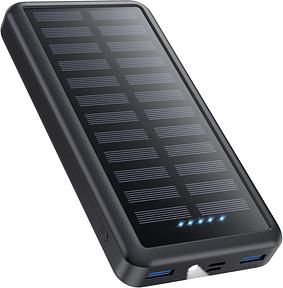
Power Bank USB C 26800mAh, Solar Powerbank PD 3.0A Schnellladung
View at AmazonAffiliate link. Buying through it earns us a commission; the price stays the same for you.
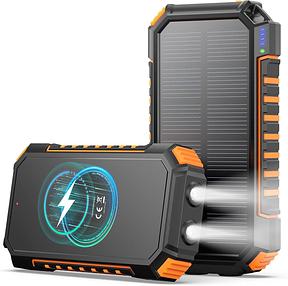
A ADDTOP Solar Power Bank 20000mAh kabelloses PowerBank mit USB C
View at AmazonAffiliate link. Buying through it earns us a commission; the price stays the same for you.
Solar power bank, or a normal power bank plus a foldable panel?
This is where it gets interesting, because hardly anyone lines this comparison up cleanly. Two ways to get real sunlight into your phone. Either a power bank with solar built right in, or a normal power bank plus a separate panel. Which one is worth it?
You know the built-in cell now: 1 to 2.5 watts, all in one housing, no extra weight. The other path is a normal power bank plus a separate foldable solar panel. A 28 watt foldable panel like the one from BigBlue delivers many times what the tiny cell can, even when it never quite hits its rating.
And it doesn't hit it. In the hands-on comparison by berghuhn.de (field-tested June 2024), even a foldable 21 watt Anker panel failed to reach its stated output. Small deviations from the ideal sun angle were enough for noticeable losses. One user measured, in a field test on the Ultraleicht-Trekking forum (2023, cited only as an anecdote, not a lab value), roughly 8 watts from exactly that 21 watt panel under near-ideal desert sun in Namibia. About 38 to 40 percent of the rated number.
Hold onto that figure anyway: 8 real watts is still three to eight times what the built-in cell manages. That's the whole difference.
| Criterion | Solar power bank (built-in cell) | Normal power bank + foldable panel |
|---|---|---|
| Real solar output | 1 to 2.5 W (menshealth.de, 15 June 2026) | approx. 8 W from a 21 W panel even in ideal sun (field measurement, Ultraleicht-Trekking forum, 2023) |
| Solar charge time, 20,000 mAh | 12 to 20 days of full sun (menshealth.de) | far faster, but still hours per phone charge |
| Price | approx. €25 to €30 (as of 08/2026, per Amazon.de) | approx. €30 power bank + approx. €70 panel (as of 08/2026, per Amazon.de) |
| Weight / pack size | none extra, all in one housing | a separate panel with its own pack size |
| Best for | emergency reserve, everyday use with no real solar ambition | multi-day trips, genuine top-ups on the move |
The table says it honestly: the moment you actually want to pull power from the sun on the move, the separate panel wins. It costs more, weighs more, takes up space. But it charges. The built-in cell, by contrast, is a bonus you get for free and mostly never need.
BigBlue 28W Tragbares Solar-Ladegerät mit Digital Amperemeter, faltbares Solarpanel
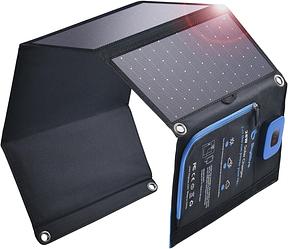
BigBlue 28W Tragbares Solar-Ladegerät mit Digital Amperemeter, faltbares Solarpanel
View at Amazon (as of Aug 21)Affiliate link. Buying through it earns us a commission; the price stays the same for you.
Why the solar cell barely charges in the sun
"Leave it in the sun, it'll be full by evening." If only. That's the single most common mistake, and alpacacamping.de (30 June 2026) names it directly: fully charging an empty power bank from sunlight alone takes several days depending on weather and model. A pace almost every buyer underestimates.
So what's going on? Several things at once.
Clouds. Under cloud cover, output drops by more than 70 percent per menshealth.de. A hazy "well, it's still bright out" day just doesn't cut it. And in berghuhn.de's field comparison, some panels go essentially dead under cloud while others keep slow-charging. That comes down to panel design, not just the weather.
The angle. The sun needs to hit the cell as close to head-on as possible. Lay the power bank flat on your backpack while the sun sits low, and you already lose a good chunk. berghuhn.de measured that even small deviations from a 90 degree angle cost noticeable output.
The heat. And here's the part hardly anyone works out: direct sun on the power bank itself harms it. Per menshealth.de, the battery ages about 30 percent faster at 40 °C than at 20 °C. For more on how heat shortens a power bank's lifespan, see our charge-cycle guide. Cell in the sun, housing in the shade would be ideal. With a built-in solar power bank you can't do that, because they're the same part.
The marketing. alpacacamping.de also warns about inflated capacity claims. There's no such thing as 100,000 mAh in a palm-sized device, physically. If the number looks too good, it isn't real.
In short: the solar cell doesn't "not charge," it just charges so slowly that in daily life you never notice.
Who a solar power bank is genuinely worth it for
Now the real question. Not "which one is best," but "do you even need one." Let's go through it by type.
The commuter and everyday user
You charge your power bank at the wall overnight and carry it in a bag all day. There's no sun in a bag. And even in blazing sun the cell would need 12 to 20 days for one charge. For you, honestly, the solar function is pure decoration. Buy a normal, good power bank that charges fast and holds up. Not sure which one? Take a look at our power bank test-winner roundup. The Anker Zolo with 20,000 mAh, for instance, is that kind of honest standard: plenty of capacity, built-in USB-C cable, no solar gimmick. By the way: 20,000 mAh is about 74 Wh, under the 100 Wh line and therefore allowed in carry-on on practically every airline. We've broken down the airline rules in detail separately.
The day-tripper and occasional hiker
The odd day outdoors, phone needs to last. Here the built-in cell is a pleasant free extra. It won't replace a wall socket, but it keeps your charge level stable a little longer. If a solar power bank appeals to you anyway and costs barely more, there's little reason not to. Just expect nothing.
The multi-day trekker
Several days off-grid, real charging needs. For you the built-in cell is too weak. For multi-day trekking, prooutdoor.ch (18 May 2026) recommends a separate 18 watt foldable panel plus a mid-size power bank over any integrated solar cell anyway. There, the cell is a backup reserve at best.
The emergency and blackout kit
For the "in case the power goes out" drawer, what counts is capacity and reliability, not solar. A 20,000 to 30,000 mAh power bank that's always sitting fully charged does more for you in an emergency than a tiny solar cell that needs days even in sun. A separate foldable panel as a supplement makes sense, the cell in the housing doesn't.
See the pattern? There's exactly one group the built-in solar cell is a real plus for, and it's the smallest one: occasional day-trippers who get it for free. For everyone else it's either redundant or too weak.
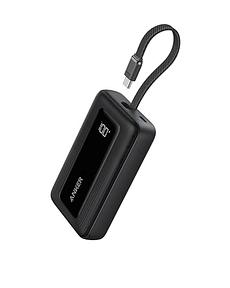
Affiliate link. Buying through it earns us a commission; the price stays the same for you.
How to get the most out of the solar cell
Say you already own a solar power bank or a foldable panel. How do you squeeze out the maximum? A few things probably help more than you'd think.
Aim the surface as square to the sun as you can, and re-adjust it every 20 to 30 minutes. A panel lying flat on your backpack throws away output the moment the sun moves. Keep the surface clean, since dust and fingerprints cost yield. And charge under a clear sky around midday, when the sun sits highest.
One thing matters a lot, and it runs against instinct: keep the power bank itself in the shade if you can. Stiftung Warentest advises exactly that, putting only the panel in the sun and keeping the battery cool. With a built-in cell you can't, because everything heats up together. Another reason the separate panel is the technically cleaner solution.
And then the most honest tip of all: don't count the solar charge as your power supply, count it as a small bonus on top. Charge fully at the wall whenever you can. The sun is the reserve, not the plan.
Conclusion
This solar power bank test lands on a clear verdict. The solar cell on a solar power bank isn't a lie, but it isn't a charging solution either. The solid numbers are clear: 1 to 2.5 watts, days instead of hours, over 70 percent loss under cloud, and no amount of marketing gloss changes that. For the vast majority that makes it exactly what it looks like, a pretty extra.
If you genuinely want power from the sun on the move, take a separate foldable panel and a solid power bank. If you just want a reliable power bank, buy one without solar and save yourself the disappointment. And if a solar power bank still appeals to you because it's barely more expensive, go ahead and buy it. Just not for the sun.
All products from this post
The ones we named above are marked; the rest are alternatives in the same category.
Affiliate notice: As an Amazon Associate, we earn from qualifying purchases. Product prices and availability are subject to change.
Frequently Asked Questions
Does a solar power bank really charge from the sun?
Yes, but very slowly. Per menshealth.de, a typical built-in cell delivers only 1 to 2.5 watts, enough for a full charge of a 20,000 mAh power bank in 12 to 20 days of full sun. So the cell works, but in daily use it's an emergency reserve, not a real charging source.
How long does it take to charge a solar power bank in the sun?
For an empty 20,000 mAh power bank, menshealth.de estimates 12 to 20 days of continuous sun. Under cloud, output drops by more than 70 percent, which stretches it further. Rule of thumb: think in days, not hours.
Is a solar power bank worth it for camping?
For a short trip, the built-in cell is a nice free bonus. For multi-day tours with real charging needs, prooutdoor.ch recommends a separate 18 watt foldable panel plus a mid-size power bank. The integrated cell is only a backup reserve there.
Solar power bank or power bank with a foldable panel: which is better?
For real charging on the move, the foldable panel. A 21 watt panel delivers about 8 real watts even in ideal sun, many times the 1 to 2.5 watts of a built-in cell. The solar power bank only wins on compactness and price, not on charging power.
Why won't my solar power bank charge in the sun?
Usually it's clouds, the wrong angle, or heat. Even slightly hazy weather costs over 70 percent of output, an off angle costs more, and the warmth harms the battery. It is charging, just so slowly that you barely notice.
Is there a solar power bank test winner?
No. Neither Stiftung Warentest nor other major consumer-testing bodies have run a dedicated solar power bank test with a declared winner. The reason: the built-in solar cell's output is too weak on practically every model to compare meaningfully against another. A declared winner would imply a real gap between models that, in practice, barely differ.