
Convert mAh to Wh: What the Power Bank Says, and What Actually Arrives
 14 min read
Last checked: 18 February 2026
Most power banks already carry the answer on the casing. Turn the thing over and look for a line reading 74Wh or Rated Energy. Manufacturers print it because aviation rules are written in watt-hours rather than milliamp-hours, not out of generosity. If you're trying to convert mAh to Wh and the number's already printed, you don't need to do any maths at all.
When it's missing, things get murky fast. In its 14 September 2025 explainer, nextpit works the same conversion at both 3.7 V and 7 V without saying which one applies to an ordinary power bank. The same 20,000 mAh comes out as roughly 74 Wh in one line and 148 Wh in the next. A factor of two, on precisely the number that decides things at the gate.
Read the casing before you reach for the calculator
The printed figure is the better source, for a genuinely practical reason. It comes from the manufacturer, who knows the actual cell voltage of that pack. Your calculation doesn't know it. Your calculation guesses it with a standard value.
Usually the two land close together. Sometimes they don't.
The 25,000 mAh class shows this nicely. Run 25,000 mAh at 3.7 V and you get 92.5 Wh. Anker's own product listing on amazon.de states 90 Wh for its 25,000 mAh unit, and UGREEN states 90 Wh for its 25,000 mAh model too. That gap isn't sloppiness: 25,000 mAh at 3.6 V comes to exactly 90 Wh (our own maths, same formula). Those packs are specified at 3.6 V, not 3.7 V. The UGREEN Nexode with 25,000 mAh and 145 W UGREEN Nexode Power Bank 25000mAh 145W, 2X USB-C+1x USB-A publishes two figures in its spec sheet: 88.2 Wh minimum capacity and 90 Wh typical capacity. Every battery varies: the minimum is the guaranteed floor, the typical value what a production run averages.
So if there's a watt-hour figure on the casing, use it. Everything below is the fallback for when there isn't one, or when you can no longer read it.
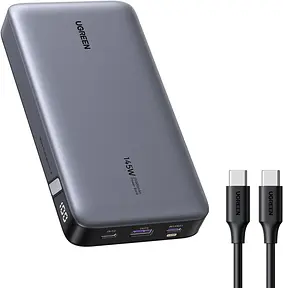
UGREEN Nexode Power Bank 25000mAh 145W, 2X USB-C+1x USB-A
View at Amazon (as of Aug 10)Affiliate link. Buying through it earns us a commission; the price stays the same for you.
The formula: Wh = (V × mAh) ÷ 1000
The formula itself is trivial. The argument is over the V.
Anker sets it out on its own conversion page as Wh = (mAh × V) ÷ 1,000, and in reverse as mAh = (Wh × 1,000) ÷ V. Anker works the borderline case explicitly: 100 Wh at 3.7 V is roughly 27,027 mAh. That's the number where airports start paying attention, and what individual carriers make of it is covered in the airline rules in detail.
And 3.7 V isn't a rounded invention. The nominal cell voltage of lithium-ion is 3.6 V per cell, as Battery University explains in its primer on battery voltages. Some manufacturers mark cells 3.70 V or higher, and Battery University names the reason without flinching: the higher voltage boosts the watt-hours on paper. That's why you see both numbers in circulation. For a rough estimate the difference barely matters. For the "under or over 100 Wh" question on a large pack, it very much does.
The 5-volt mistake costs you a third
Your power bank's USB port says 5 V. That figure is correct, it just describes the output side after the converter rather than the cells behind it. Calculate with it and your answer comes out far too big.
| Rated capacity | at 3.7 V (correct) | at 5 V (wrong) | Difference |
|---|---|---|---|
| 10,000 mAh | 37 Wh | 50 Wh | +35 % |
| 20,000 mAh | 74 Wh | 100 Wh | +35 % |
| 26,800 mAh | 99.2 Wh | 134 Wh | +35 % |
Every value in that table is a sum we did ourselves using the formula cited above, not a measurement.
The third row is why this is more than a rounding quirk. A 26,800 mAh power bank holds 99.2 Wh and goes into your carry-on with no questions asked. Calculated at 5 V it looks like 134 Wh, which puts the identical device in approval territory. You either carry paperwork you never needed, or you leave a perfectly legal power bank at home.
The error runs the other way too. Writing on 19 June 2022, techtest.org describes the reverse case: measure at 5 V yourself while the manufacturer rates at 3.7 V, and your reading lands about 26 % below the rated figure. Opposite sign, same cause.
So when does a different voltage apply? On multi-cell packs wired in series, say 7.4 V for two cells or 11.1 V for three. Power stations are built that way. Pocketable power banks generally aren't, and when one is, the voltage is printed on the casing.
Conversion table: 5,000 to 30,000 mAh
Here's the arithmetic for the capacity classes you actually meet in shops. Every watt-hour value is calculated here at 3.7 V using Anker's formula, not measured, rounded to one decimal place.
| Rated capacity | Rated energy at 3.7 V | Typical form factor |
|---|---|---|
| 5,000 mAh | 18.5 Wh | credit-card size, MagSafe puck |
| 10,000 mAh | 37.0 Wh | pocket class |
| 20,000 mAh | 74.0 Wh | travel standard |
| 25,000 mAh | 92.5 Wh (manufacturers often state 90 Wh) | laptop-capable |
| 26,800 mAh | 99.2 Wh | just under the 100 Wh line |
| 30,000 mAh | 111.0 Wh | over the line |
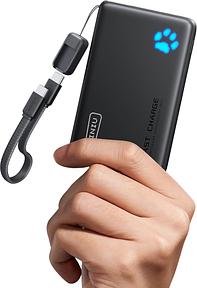
Two rows are worth memorising. 10,000 mAh is 37 Wh, the cleanest sum in the whole table and the reason you see that number on so many casings. A typical example of the class is the INIU with 45 W and a built-in USB-C cable INIU Power Bank, Kleiner 45W Schnellladen 10000mAh Powerbank mit Abnehmbar USB C Kabel, Flugtauglich & Reise-Essential, Externe Handyakkus: 10,000 mAh, so 37 Wh, so nowhere near any limit.
And 27,027 mAh is the ceiling below which you're guaranteed to stay under 100 Wh at 3.7 V. Anything above that, check before you pack it.
Affiliate link. Buying through it earns us a commission; the price stays the same for you.
Why less arrives than the box promises
Now the part almost nobody works out. The watt-hour figure on the casing describes what sits inside the cells. It does not describe what comes out of the USB port.
In between sits a converter, stepping the cells' 3.6 to 3.7 V up to 5 V, or to 9, 15, or 20 V under USB-PD. Every conversion costs energy, and the electronics draw some for themselves on top. That isn't a fault. That's physics.
heise online measured 66.32 Wh of usable energy from the Anker Zolo Powerbank 20k, rated at 74 Wh. heise itself puts the efficiency at 89 percent and calls it the best result in its own test field so far (last updated 16 January 2026). Best result. Not average.
So roughly 8 Wh vanish between cell and cable, on the class leader.
What Stiftung Warentest found across 24 units
One device isn't a pattern. On 7 January 2026, German consumer body Stiftung Warentest tested 24 power banks priced from just under €30 to around €100. The publicly readable figures:
| Class | Rated energy at 3.7 V (calculated here) | Measured usable energy |
|---|---|---|
| 10,000 mAh | 37.0 Wh | 28.5 to 35.8 Wh |
| 20,000 mAh | 74.0 Wh | 58.3 to 69.9 Wh |
The full report sits behind a €4.90 paywall at test.de; the two ranges above come from the free portion. We're deliberately not reproducing rankings or the score table.
The spread is the interesting bit. In the 10,000 mAh class the weakest unit delivers 28.5 Wh and the strongest 35.8 Wh, a difference of about a quarter between two devices carrying identical labels. So the mAh figure on the box doesn't just overstate. It also tells you nothing about the variation. Which models exist in which class is sorted out in the comparison by capacity class.
The Anker Zolo with 20,000 mAh and 45 W Anker Zolo Powerbank 20.000 mAh, 45 W Max is the faster-charging variant of the same range heise measured in its 30 W form. Its amazon.de listing carries no watt-hour figure at all; the 74 Wh is a figure we calculated from 20,000 mAh at 3.7 V, not a manufacturer statement for this specific model. The UGREEN Nexode with 20,000 mAh falls in the same class and therefore the same sum.
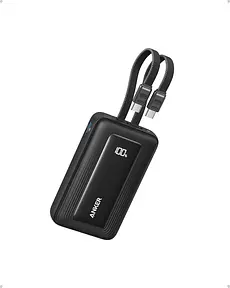
Anker Zolo Powerbank 20.000 mAh, 45 W Max
View at Amazon (as of Aug 11)Affiliate link. Buying through it earns us a commission; the price stays the same for you.
How many phone charges is that, really?
"Charges your smartphone up to five times" appears on a lot of packaging. Let's run it with real numbers.
A modern phone battery is bigger than the marketing arithmetic assumes. The certified battery in the Samsung Galaxy S26 Ultra holds 4,855 mAh at 3.9 V, which is 18.94 Wh, according to notebookcheck.com on 26 August 2025. The marketed capacity is 5,000 mAh.
That lets us finish the chain:
| Step | Value | Where it comes from |
|---|---|---|
| Power bank rated capacity | 20,000 mAh | printed on the casing |
| Rated energy at 3.7 V | 74 Wh | calculated here |
| Actually delivered | 66.32 Wh | heise, measured, 16 January 2026 |
| Galaxy S26 Ultra battery | 18.94 Wh | notebookcheck, 26 August 2025 |
| Charges | about 3.5 | our own maths: 66.32 ÷ 18.94 |
And even that 3.5 is optimistic. The sum assumes every watt-hour leaving the power bank ends up in the phone battery. It doesn't, because the charging circuit inside the phone has losses of its own. Nobody publishes a measurement of those for this pairing, which is why there's no number for it here. Treat 3.5 as a ceiling rather than an expectation.
The same chain applies to any unit in this class, such as the UGREEN Nexode with 20,000 mAh and 45 W UGREEN Nexode Power Bank 20000mAh 45W mit integriertem USB-C Kabel: same rated capacity, same 74 Wh, same gap.
For the small class the result is suitably sobering. Using the 28.5 to 35.8 Wh Warentest measured across the 10,000 mAh units, you get 1.5 to 1.9 charges of that battery (our own reckoning). Not three. Not two. One and a half to just under two.
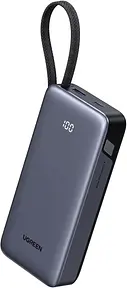
UGREEN Nexode Power Bank 20000mAh 45W mit integriertem USB-C Kabel
View at Amazon (as of Aug 11)Affiliate link. Buying through it earns us a commission; the price stays the same for you.
The airline verdict: 100 Wh, 160 Wh and the band between
This is where the arithmetic pays for itself, because the rules are written in watt-hours rather than milliamp-hours.
Germany's Luftfahrt-Bundesamt, the federal civil aviation authority, gives 100 Wh of rated energy as the standard allowance for lithium-ion batteries. Above that, a battery "may exceed 100 Wh with the operator's approval, but no more than 160 Wh", and in that case you're limited to "a maximum of two spare batteries per person". Above 160 Wh, no.
Two caveats before you treat that as complete trip preparation. The LBA page carries no date of its own, and it says nothing whatsoever about whether you may use or recharge a power bank in flight. Carriers now answer that question individually, and they don't agree. What each airline permits is set out there with a checked-on date per row.
Mapped onto the capacity classes:
| Rated capacity | Energy at 3.7 V | Verdict against the LBA thresholds |
|---|---|---|
| 5,000 mAh | 18.5 Wh | free, no approval needed |
| 10,000 mAh | 37.0 Wh | free, no approval needed |
| 20,000 mAh | 74.0 Wh | free, no approval needed |
| 25,000 mAh | 90 to 92.5 Wh | free, but close to the line |
| 26,800 mAh | 99.2 Wh | free, very close |
| 27,027 mAh | 100.0 Wh | exactly the threshold |
| 30,000 mAh | 111.0 Wh | operator approval required |
| from approx. 43,250 mAh | over 160 Wh | not permitted |
| 50,000 mAh | 185.0 Wh | not permitted |
The watt-hour column is worked out throughout using Anker's formula, not measured. The verdict column restates the thresholds published by the Luftfahrt-Bundesamt. The 50,000 mAh row is a pure boundary illustration: it just runs 50,000 mAh × 3.7 V ÷ 1000 through, nothing more.
The 90 Wh class is the interesting one
Power banks built for laptops almost all sit just under 100 Wh, and that's no accident. Manufacturers build right up to the line and not a millimetre past it.
The Anker with 165 W and 25,000 mAh Anker Laptop Powerbank 25.000 mAh, 165 W states 90 Wh in its amazon.de product details, and says there in as many words that it belongs in your carry-on. That's what a good spec looks like: the number is there, there's nothing to guess.
The UGREEN Nexode with 25,000 mAh and 145 W states the same 90 Wh, as above. At the check-in counter, the printed number is the one that counts.
Both stay under 100 Wh and therefore in approval-free territory. Whether you may use them in flight is a separate question, and it depends on your carrier.
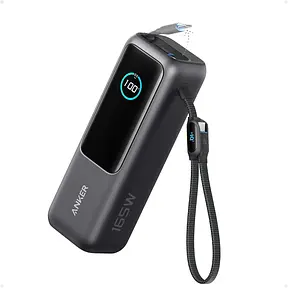
Anker Laptop Powerbank 25.000 mAh, 165 W
View at Amazon (as of Aug 11)Affiliate link. Buying through it earns us a commission; the price stays the same for you.
The short version
The printed figure beats the sum, the sum beats a hunch, and a measurement beats both. If there's a watt-hour number on your power bank, use it. If there isn't, multiply the mAh by 3.7 and divide by 1000. Then knock a good ten percent off in your head, and you're near what actually reaches the cable.
Stay under 27,000 mAh and the airport question is settled before it starts. Above that it becomes a matter of approval, and that's when the airline table with its checked-on dates earns its keep.
All products from this post
The ones we named above are marked; the rest are alternatives in the same category.
Affiliate notice: As an Amazon Associate, we earn from qualifying purchases. Product prices and availability are subject to change.
Frequently Asked Questions
Is mAh the same as Wh?
No. mAh (milliamp-hours) is a charge rating, and Wh (watt-hours) is an energy rating, and only the second one lets you compare across different devices, because it already factors in voltage. Watts are a third quantity: the charging power of a device, for example 45 W, not its stored energy. So the mAh figure on the box tells you neither how many Wh are inside nor how fast the unit charges.
How many Wh is 20000 mAh?
74 Wh, calculated at the 3.7 V cell voltage using Wh = (V × mAh) ÷ 1000. That's calculated, not measured. What actually reaches your cable is less: heise measured 66.32 Wh of usable energy from an Anker Zolo 20k rated at 74 Wh. heise itself puts that efficiency at 89 percent. If your unit carries its own watt-hour figure, that one wins over the sum.
How many Wh is 10000 mAh?
37 Wh at 3.7 V, again our own reckoning with the same formula, not measured. Usable output is lower: on 7 January 2026, Stiftung Warentest measured between 28.5 and 35.8 Wh across this class. For flying it's a non-issue either way, since the class sits far below the 100 Wh threshold published by the Luftfahrt-Bundesamt.
Why calculate with 3.7 V instead of the 5 V on the USB port?
Because the capacity rating describes the cells, not the output. Lithium-ion cells run at a nominal 3.6 V according to Battery University, and some manufacturers state 3.7 V. The 5 V only appears after the converter. Calculate at 5 V and your answer comes out roughly 35 percent too high, which makes a perfectly legal power bank look like it needs approval.
How many phone charges does a 20,000 mAh power bank give?
About 3.5, using the 66.32 Wh heise measured on 16 January 2026 and the 18.94 Wh of the certified Galaxy S26 Ultra battery reported by notebookcheck. That's our own sum, and it's a ceiling: the charging circuit inside the phone loses energy too, and no published measurement exists for that.
At what mAh does a power bank become an airline problem?
At roughly 27,027 mAh, which is where the Luftfahrt-Bundesamt's 100 Wh threshold falls at 3.7 V. Between 100 and 160 Wh you need your carrier's approval and may take at most two spare batteries. Above 160 Wh it isn't permitted at all. The watt-hour figure is what counts, never the milliamp-hour figure.
What's the difference between rated capacity and usable energy?
Rated capacity is the manufacturer's figure for the energy held in the cells, usually in mAh and often in Wh as well. Usable energy is what survives voltage conversion and the electronics' own consumption. heise has measured 89 percent as its best result so far, and Stiftung Warentest showed a wide spread on 7 January 2026.