Berlin Blackout: 45,400 Homes, 100 Hours – and What Germany's BBK Recommends
 14 min read
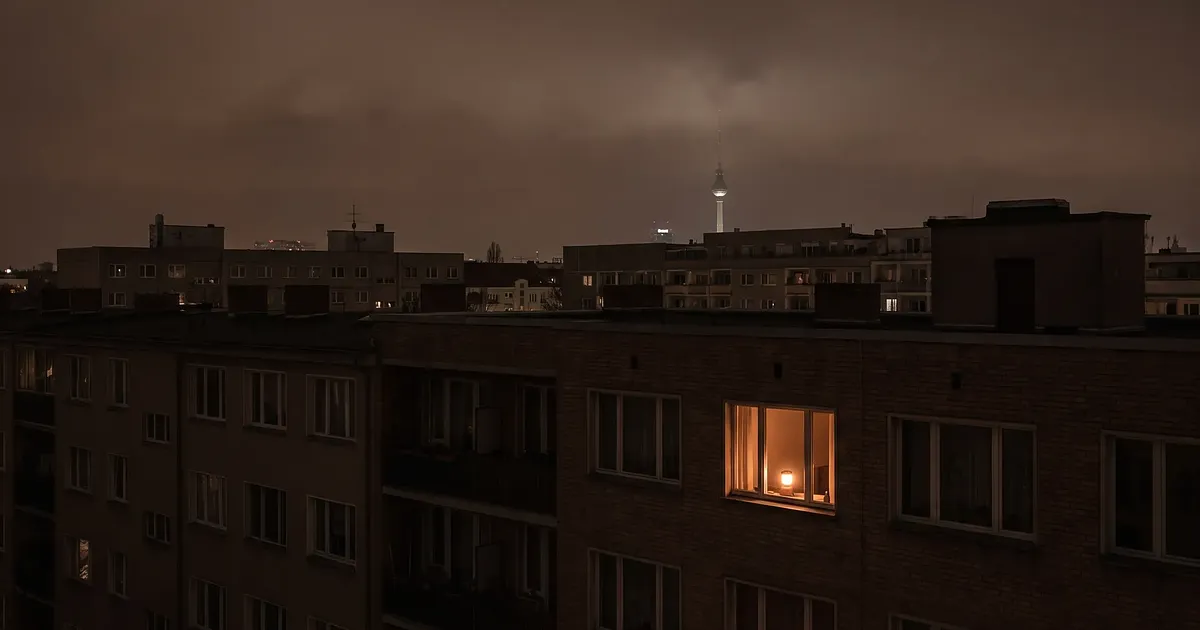
On the morning of 3 January 2026, a cable bridge over the Teltowkanal in south-west Berlin caught fire. Five 110 kV high-voltage cables and ten 10 kV medium-voltage cables were damaged beyond repair. What followed was, in the Berlin Senate's own description, the city's longest power outage since 1945 – and because it happened in January, it took the district heating with it.
As of 12.01.2026. Every figure below comes from the primary sources linked inline and carries its own date.
What happened on 3 January 2026
The Senate press release of 03.01.2026 puts the start at 06:13 and the scale at 45,400 households and 2,200 commercial customers. Four localities in the Steglitz-Zehlendorf borough were hit: Nikolassee, Zehlendorf, Wannsee and Lichterfelde.
The cause was not a technical fault. Unknown persons set fire to the cables on the bridge over the Teltowkanal, next to the Lichterfelde heating plant. A claim of responsibility reached the state criminal police office; it appeared on the Indymedia platform and is attributed there to a "Vulkangruppe".
| Point in time | State of supply | Source |
|---|---|---|
| 03.01.2026, approx. 06:13 | Outage begins, 45,400 households + 2,200 commercial customers off supply | Senate administration, 03.01.2026 |
| Night of 03./04.01.2026 | approx. 7,000 households reconnected | Stromnetz Berlin |
| 04.01.2026, midday | approx. 10,000 households and 300 commercial customers reconnected | Stromnetz Berlin |
| 05.01.2026, 19:30 | 27,200 households and 1,425 commercial customers still without power | Stromnetz Berlin |
| 07.01.2026, 14:10 | full restoration reported | Economics senator Giffey |
Germany's federal technical relief agency, the THW, records at least 971 volunteer responders for the operation in Steglitz-Zehlendorf – staffing emergency call points, shelters, warming rooms and backup generators.
The number the sources disagree on
This one is worth slowing down for, because two different durations are circulating.
On 03.01.2026 the Senate administration wrote that the remaining roughly 35,000 connections were not expected back on supply until Thursday afternoon, 08.01.2026. That was a day-one forecast. The all-clear actually came a day earlier, at 14:10 on 07.01.2026.
Anyone quoting "four and a half days" is quoting the forecast. Measured against the reported end, the outage ran 4 days and roughly 8 hours. Stromnetz Berlin itself frames it as around 100 hours for about 47,600 customers. We use the network operator's 100-hour figure here, because it describes what actually happened rather than what was announced.
For the preparedness question the difference barely matters. Both numbers sit far beyond what a typical household is equipped for.
Why district heating was the real winter factor
The heating plants themselves were undamaged. Even so, the Senate administration reported that "district heating supply is impaired" – because the pumps that move hot water to connected buildings run on electricity. No power, no circulation. No circulation, no heat in the flat.
This is the part most preparedness checklists underrate. A power cut in July is a comfort problem. A power cut in January that takes the heating with it is a different event, which is exactly why the borough opened warming rooms.
The second cascade hit communications. According to the operators involved, mobile sites across the affected area went down: O2 reported 18 of its own transmitters, Vodafone 39 sites (29 of them back in service by Monday, 05.01.2026), and Telekom had 19 of 29 affected stations running again that same Monday.
A charged power bank like the Anker Nano Powerbank 10.000 mAh, 30 W does not replace a cell tower. It does decide whether your phone is still alive when the network comes back.
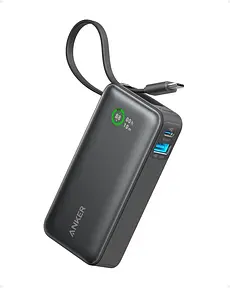
Anker Nano Powerbank 10.000 mAh, 30 W
View at Amazon (as of Aug 11)Affiliate link. Buying through it earns us a commission; the price stays the same for you.
What the BBK actually recommends
Germany's Federal Office of Civil Protection and Disaster Assistance (BBK) carries a line on its page "Vorsorge und Handeln bei Stromausfall" that is unusually specific for this kind of guidance:
"Solarbetriebene Batterieladegeräte oder eine Powerbank können bei Stromausfall eine Hilfe sein."
("Solar-powered battery chargers or a power bank can be a help during a power outage.")
— BBK, "Vorsorge und Handeln bei Stromausfall"
A solar power bank such as the BLAVOR Solar-Powerbank 20.000 mAh mit 4 Solarpanels covers exactly that: it pairs a battery with its own charging panel, instead of carrying the two separately.
On the same page the BBK names candles as an alternative light source and explicitly warns to ventilate regularly while using them. For food, it advises shelf-stable items "that can be eaten cold".
More important than any single sentence is something many preparedness sites have not caught up with yet: the guide was replaced. On 13.10.2025, the International Day for Disaster Risk Reduction, the BBK presented its comprehensively revised guide "Vorsorgen für Krisen und Katastrophen". It supersedes the older "Ratgeber für Notfallvorsorge" and adds chapters on disinformation, psychological stability in crises and seeking shelter.
The stockpiling recommendation inside it is blunter than public discussion usually suggests:
"Sie sollten sich für möglichst zehn Tage selbst versorgen können." ("You should be able to sustain yourself for ten days if possible.") And, in addition: "Aber auch ein Vorrat für zumindest drei Tage hilft schon sehr." ("But even a three-day supply helps a great deal.")
That is notable, because the European level works with a different number. The EU Preparedness Union Strategy of 26.03.2025 recommends 72 hours of household self-sufficiency; the then crisis-management commissioner, Hadja Lahbib, publicly listed water, food, a torch, a radio, cash, medication – and a power bank.
| Recommendation | Period | Date | Issued by |
|---|---|---|---|
| "Vorsorgen für Krisen und Katastrophen" | ideally 10 days (minimum 3 days) | 13.10.2025 | BBK |
| EU Preparedness Union Strategy | 72 hours | 26.03.2025 | European Commission |
| Actual Berlin outage duration | approx. 100 hours | 03.–07.01.2026 | Stromnetz Berlin |
The third row is why 72 hours would not have covered this one. The Berlin outage landed between the two recommendations – closer to the EU figure, but past it.
Not available in your region — closest match
View at Amazon (as of Aug 15)Affiliate link. Buying through it earns us a commission; the price stays the same for you.
What a device has to deliver to cover this
From here on it is arithmetic, and it uses independently measured numbers rather than spec sheets.
The calculation starts with the loads, not the device
For roughly 100 hours, three broad demand classes separate out:
| Demand | What it covers | Order of magnitude |
|---|---|---|
| Communication | charging a phone several times, torch, radio | 30–80 Wh |
| Communication + work | plus a laptop, tablet, small LED lighting | 100–300 Wh |
| Household load | plus fridge, router, small medical devices | from approx. 1,000 Wh |
A phone battery holds a few watt-hours depending on the model; a laptop battery typically a few dozen. The classes above are orientation figures, not measurements – if you want to run the numbers exactly, the conversion is in our piece on converting mAh to Wh.
For that third class, a unit like the EcoFlow Delta 3 Plus Powerstation, 1024 Wh, rated at 1,024 Wh, is a plausible fit – the usable capacity sits below that figure, as the next section shows.
Not available in your region — closest match
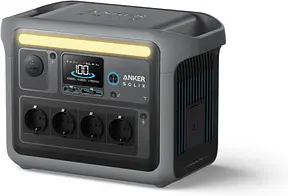
Anker SOLIX C1000 Powerstation, LiFePO4, 1800 W
View at Amazon (as of Aug 11)Affiliate link. Buying through it earns us a commission; the price stays the same for you.
The deduction almost nobody applies
On 11.06.2025, the ADAC tested eight portable power stations and measured something that appears on no box:
"Die wirklich im Alltag nutzbare Nettokapazität war bei den getesteten Geräten im Schnitt gut 10 bis 15 Prozent geringer als die von den Herstellern genannte Bruttokapazität."
("The genuinely usable net capacity of the tested devices was on average a good 10 to 15 percent lower than the gross capacity stated by the manufacturers.")
The ADAC attributes this to the electronics' own consumption plus a deliberately withheld share of energy that protects the cells. In practice: a unit rated 1,024 Wh delivers more like 870 to 920 Wh. Build your runtime estimate on the nameplate and you plan too optimistically – systematically, not occasionally.
The test winner in that same ADAC test (11.06.2025) was the Bluetti AC180P, graded 2.0. Two of the eight failed with a grade of 5.0 – the Ective BlackBox 10 and the Jackery Explorer 1000 v2, both for unprotected DC inputs that allowed voltage to travel between charging sources.
Anyone who builds that deduction into their planning should treat a unit like the Anker SOLIX C1000 Powerstation, LiFePO4, 1800 W the same way, planning around the lower real-world figure rather than the number on the box.
Anker SOLIX C1000 Powerstation, LiFePO4, 1800 W
View at Amazon (as of Aug 11)Affiliate link. Buying through it earns us a commission; the price stays the same for you.
What the other test bodies measured – and what they did not
Germany's three independent testing bodies do not measure in the same capacity class, which makes cross-comparison harder than it looks:
| Test body | Published | Class tested | Winner public? |
|---|---|---|---|
| Stiftung Warentest (power banks) | 07.01.2026 | 24 models, approx. 10,000 and 20,000 mAh, just under €30 to around €100 | winner paywalled |
| Stiftung Warentest (power stations) | 20.07.2023 | 11 models, 400–644 Wh, €470 to over €800 | winner paywalled (€4.90) |
| ADAC (power stations) | 11.06.2025 | 8 models, approx. 1 kWh and up, winner just under €1,500 | winner named freely |
One detail from the Warentest power-bank test of 07.01.2026 belongs here, because it addresses the most common worry directly: "Erfreulich: Unsere Sicherheitstests überstanden alle Modelle ohne Brände oder Explosionen." ("Encouragingly, every model came through our safety tests without fires or explosions.") Individual units did take damage in the drop test, though – one "did not function at all afterwards".
The Warentest power-station test dates from July 2023 and covers 400–644 Wh, a markedly smaller class than the ADAC test. So anyone shopping for a 1 kWh power station in 2026 will find no matching Warentest measurement at all. That is not a criticism, it is a gap worth knowing about.
Anyone wanting a capacity class above that finds a unit like the Anker SOLIX C2000 Gen 2 Powerstation, 2048 Wh, 2400 W among the larger options on the market – and Germany's test landscape currently has no dedicated measurement for that size either.
One number is missing from the German-language test landscape entirely: standby self-discharge over months. That is precisely the figure that decides whether a device is still charged when an outage arrives. We know of no independently measured German value for it, and we are deliberately not estimating one. The practical consequence, without a number: check the state of charge quarterly.
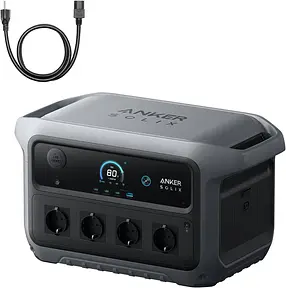
Anker SOLIX C2000 Gen 2 Powerstation, 2048 Wh, 2400 W
View at Amazon (as of Aug 11)Affiliate link. Buying through it earns us a commission; the price stays the same for you.
Three tiers, three jobs
| Tier | Device type | Covers | Limit |
|---|---|---|---|
| 1 | Power bank, 10,000–20,000 mAh | phone, torch, radio | no 230 V socket |
| 2 | Solar power bank | as tier 1, plus recharging off-grid | on-case solar output is small; recharging takes days, not hours |
| 3 | Power station from approx. 1,000 Wh | plus laptop, router, fridge intermittently | weight, price, charge-state upkeep |
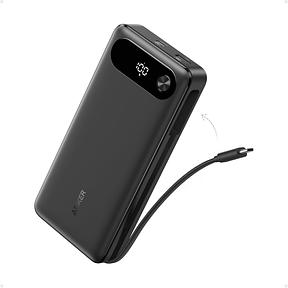
Anyone who would rather start tier 1 with a larger unit is set up for several charge cycles with the Anker Powerbank, 20.000mAh tragbares Ladegerät mit integriertem USB-C-Kabel, 87W Max Schnellladung, kompatibel mit MacBook, iPhone, Samsung und mehr.
The tier 2 solar power bank is exactly the device the BBK means by "solar-powered battery chargers". An honest caveat belongs with it: a phone-sized solar panel delivers very little in a Berlin winter. It is a fallback, not a charging solution. Anyone who genuinely wants to recharge in winter needs a separate folding panel and a power station – sizing for that is covered in our piece on sizing a power station properly.
Affiliate link. Buying through it earns us a commission; the price stays the same for you.
The honest framing: this was not a grid problem
It would be easy to turn this event into a story about a crumbling power grid. The numbers do not support that.
On 09.10.2025 the Bundesnetzagentur published the SAIDI figure for 2024: 11.7 minutes of average unavailability per end consumer, down from 12.8 minutes in 2023. A total of 830 network operators reported 164,645 supply interruptions in low and medium voltage to produce it. The regulator ranks the German grid among the most reliable in Europe on that basis.
An average of 11.7 minutes a year against roughly 100 hours for these households is not a statistical trend. It is a single event with a cause that sits outside grid engineering: the outage followed an arson attack, not wear and tear.
So the right conclusion is not "the grid is about to fail everywhere". It is that a very reliable system can be taken down locally and deliberately for several days, and that preparing for that is a household decision rather than a grid question. The BBK has recommended ten days since 13.10.2025. Berlin needed roughly four.
In Short
A targeted arson attack cut power to 45,400 households and 2,200 commercial customers in south-west Berlin on 03.01.2026 – for roughly 100 hours, in winter, taking district heating and parts of the mobile network with it.
That is not an argument against the German grid, whose average outage time in 2024 was 11.7 minutes. It is an argument that the BBK's recommendation of 13.10.2025 – ten days if possible, three at minimum – is sized more realistically than the 72 hours in the EU strategy of 26.03.2025.
In practice that means three things. A charged power bank keeps communication alive for as long as the mobile network stands. A power station from about 1,000 Wh nameplate – one with its own solar input, like the BLUETTI Elite 100 V2 Powerstation, 1024 Wh, mit 200-W-Solarpanel – covers a laptop, a router and a fridge intermittently – calculated on the net figure, so 10 to 15 percent below the label. And neither is any use unless it is charged: since no independently measured German figure exists for standby self-discharge, a quarterly look at the state of charge remains the only reliable rule.
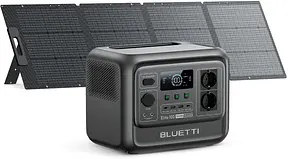
BLUETTI Elite 100 V2 Powerstation, 1024 Wh, mit 200-W-Solarpanel
View at Amazon (as of Aug 11)Affiliate link. Buying through it earns us a commission; the price stays the same for you.
All products from this post
The ones we named above are marked; the rest are alternatives in the same category.
Not available in your region — closest match
Anker Powerbank, 20.000mAh tragbares Ladegerät mit integriertem USB-C-Kabel, 87W Max Schnellladung, kompatibel mit MacBook, iPhone, Samsung und mehr
View at Amazon (as of Aug 15)
Not available in your region — closest match
Anker SOLIX C1000 Powerstation, LiFePO4, 1800 W
View at Amazon (as of Aug 11)
Affiliate notice: As an Amazon Associate, we earn from qualifying purchases. Product prices and availability are subject to change.
Frequently Asked Questions
Exactly how long did the January 2026 Berlin power outage last?
The outage began at around 06:13 on 03.01.2026 according to the Senate administration's press release. Economics senator Franziska Giffey reported full restoration at 14:10 on 07.01.2026. That is 4 days and roughly 8 hours. Stromnetz Berlin frames the event as around 100 hours for about 47,600 customers. Figures of "four and a half days" refer to the 03.01.2026 forecast, which had announced restoration by Thursday afternoon, 08.01.2026.
How many households were affected?
The Senate administration's press release of 03.01.2026 names 45,400 households and 2,200 commercial customers in the localities of Nikolassee, Zehlendorf, Wannsee and Lichterfelde. Stromnetz Berlin totals this as roughly 47,600 affected customers.
Does the BBK really recommend a power bank?
Yes, in so many words. Its page "Vorsorge und Handeln bei Stromausfall" states: "Solarbetriebene Batterieladegeräte oder eine Powerbank können bei Stromausfall eine Hilfe sein." The EU Preparedness Union Strategy of 26.03.2025 also lists a power bank in the publicly communicated 72-hour kit.
How many days should I prepare for?
The BBK guide "Vorsorgen für Krisen und Katastrophen", presented on 13.10.2025, recommends: "Sie sollten sich für möglichst zehn Tage selbst versorgen können" – you should be able to sustain yourself for ten days if possible. It adds that "even a three-day supply helps a great deal". The EU recommendation of 26.03.2025 names 72 hours.
Why did district heating fail too?
The heating plants themselves were undamaged. The pumps that move heated water to connected buildings need electricity, however, so without power there is no circulation. The Senate administration therefore described district heating supply as impaired, and the borough opened warming rooms.
How large does a power station need to be?
That depends on your loads, not on the outage. The deduction is what matters: on 11.06.2025 the ADAC measured usable net capacity averaging a good 10 to 15 percent below the gross capacity stated by manufacturers. A 1,024 Wh unit therefore delivers closer to 870 to 920 Wh. Plan with the net figure, not the label.
Has the German grid become unreliable?
Not according to the official metrics. On 09.10.2025 the Bundesnetzagentur reported a 2024 SAIDI figure of 11.7 minutes per end consumer, down from 12.8 minutes the year before, and ranks the German grid among the most reliable in Europe. The Berlin outage followed an arson attack, not technical wear.
Sources
- Stromnetz Berlin stromnetz.berlin
- BBK bbk.bund.de
- Senate press release of 03.01.2026 berlin.de
- operation in Steglitz-Zehlendorf berlin.de
- comprehensively revised guide **"Vorsorgen für Krisen und Katastrophen"** bbk.bund.de
- stockpiling recommendation bbk.bund.de
- **EU Preparedness Union Strategy** commission.europa.eu
- the **ADAC** tested eight portable power stations adac.de
- Stiftung Warentest (power banks) test.de
- Stiftung Warentest (power stations) test.de
- **Bundesnetzagentur** published the SAIDI figure for 2024 bundesnetzagentur.de