Sizing a Power Station: From Watt-Hours to Real Runtime
 17 min read
As of: 2 July 2026
There is one big number on the box: 1,024 Wh, 2,048 Wh, 3,840 Wh. Almost every buying guide online turns it into the same calculation — capacity divided by appliance wattage equals hours. That calculation is convenient, it is memorable, and it falls apart in exactly the cases where it matters: small continuous loads over many hours. Anyone buying a power station for the router during an outage, for a CPAP machine or for a fridge will be out by a factor of two.
The reason is no secret; it just never gets carried through to the end. The printed number is a manufacturer specification of the cells, not a measurement at the socket. Between cell and plug sit electronics and an inverter, and both cost energy — the inverter even when nothing is plugged in at all.
The number on the box is a specification, not a measurement
Two independent German test organisations have measured the same gap, separately, using different methods.
The ADAC tested eight portable power stations on 11 June 2025 and states the result plainly: "Die wirklich im Alltag nutzbare Nettokapazität war bei den getesteten Geräten im Schnitt gut 10 bis 15 Prozent geringer als die von den Herstellern genannte Bruttokapazität" — real-world usable net capacity ran a good 10 to 15 percent below the manufacturers' gross figure. The cause it names is the built-in electronics, above all "der integrierte Wechselrichter", the integrated inverter converting DC to AC.
heise online maintains a ranking drawn from close to 60 individual tests (page last updated 30 December 2025). On the first-placed EcoFlow Delta Pro 3 the editors measured: "Die nutzbare Kapazität liegt bei den Messungen bei satten 96 Prozent bei einer Leistung über 2000 Watt. Bei der Nutzung von Verbrauchern mit 500 Watt sind noch rund 95 Prozent nutzbar. In unseren Praxistests mit gemischten Verbrauchern liegt die nutzbare Kapazität mit rund 88 Prozent nur leicht darunter." — 96 percent above 2,000 watts, about 95 percent at 500 watts, around 88 percent with mixed loads.
Stiftung Warentest names the effect too, though without a free figure. The publicly visible introduction to its power station test of 20 July 2023 says "Die nutzbare Energiemenge ist immer geringer, da die Geräte selbst Strom verbrauchen" — usable energy is always lower because the devices consume power themselves. The rest sits behind a paywall.
These figures must not be stacked. That is the most common error in the calculations circulating online. The ADAC's 10 to 15 percent and heise's 88 to 96 percent measure the same thing: what arrives at the output, against what is printed on the case. Applying both deductions in sequence subtracts the same loss twice and lands on a number no instrument has ever recorded.
If you are wondering how the Wh figure is arrived at in the first place, and why power banks are so often calculated with the wrong voltage, that is covered in converting mAh to Wh. Power stations at least state watt-hours directly — nobody needs the detour through milliamp-hours here.
One deduction scales with the load. The other does not.
The interesting thing about heise's series is not any single percentage but its direction: 96 percent above 2,000 watts, 95 percent at 500 watts, 88 percent with mixed consumers. Efficiency falls as the load gets smaller. That is the signature of a fixed baseline draw, which weighs relatively heavier the less is being taken alongside it.
The ADAC puts a number on precisely that fixed component: "Aktiviert man den verbauten Wechselrichter, gehen teils schon 30 Watt verloren" — activate the built-in inverter and as much as 30 watts is lost. That describes the unit switched on with nothing drawing from it.
So the model splits cleanly, and both halves come from a measurement:
Usable energy   =  nameplate Wh × 0.96          (heise, Delta Pro 3, high load)
Runtime (AC)    =  usable ÷ (load + E)           E = 10 to 30 W inverter
Runtime (DC)    =  usable ÷ load                 no inverter in the path
E is an assumption, not a measured value for your unit. The ADAC gives 30 watts as an observed ceiling ("as much as"), not an average. The lower bound of 10 watts is derived here: only with it does the model reproduce heise's measured 95 percent at 500 watts — 1,024 Wh × 0.96 ÷ 510 W gives 1.93 hours, so 964 Wh at the output, 94 percent of nameplate. With 30 watts the same arithmetic lands on 90 percent. A well-built unit therefore sits at the bottom of the range and a worse one at the top. To pin it down for your own device, put an energy meter on it and read what it draws at idle with the inverter switched on.
The EcoFlow Delta 3 Plus EcoFlow Delta 3 Plus Powerstation, 1024 Wh is one of the eight units in the ADAC test — it scored 2.1 there on 11 June 2025 at a then-RRP of 999 euros, and at 1,024 Wh it sits in exactly the capacity class the calculations below use.
Not available in your region — closest match
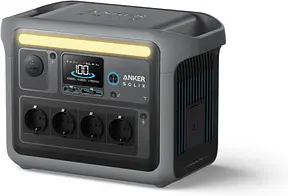
Anker SOLIX C1000 Powerstation, LiFePO4, 1800 W
View at Amazon (as of Aug 11)Affiliate link. Buying through it earns us a commission; the price stays the same for you.
AC or DC: same battery, two completely different runtimes
The fixed surcharge leads to a rule that appears in almost no buying guide: at small loads it is not capacity that determines runtime but which output you use.
A router with a fibre modem draws roughly 20 watts. Via the 230-volt socket the inverter's 10 to 30 watts land on top of those 20 — meaning the device you actually want to power is two-thirds of the total draw at best and two-fifths at worst. Via a USB-C or 12-volt output the inverter drops out of the path entirely, and the same power station lasts substantially longer.
| 20-watt continuous load on 983 Wh usable | Runtime |
|---|---|
| naive calculation (1,024 Wh ÷ 20 W) | 51.2 h |
| DC output (12 V or USB-C) | 49.2 h |
| AC socket, E = 10 W | 32.8 h |
| AC socket, E = 30 W | 19.7 h |
Own calculation using the model above; usable energy 1,024 Wh × 0.96 = 983 Wh per the heise measurement, inverter surcharge per the ADAC. Not a first-hand measurement.
Between the headline figure and the worst realistic case lies a factor of 2.6. Anyone buying a power station as an outage reserve for router and phone should therefore check first whether the unit has enough DC outputs at all — and whether they carry enough power.
That is exactly what the Anker SOLIX C300 DC Anker SOLIX C300 DC Powerstation 288 Wh (LiFePO4, ohne Wechselrichter) is built for: 288 Wh in a case that deliberately ships without a 230-volt inverter. For a laptop, phone, camera and 12-volt cool box that is the more efficient design; for a coffee machine it is useless. It is not a stripped-down version but a different answer to the same question.
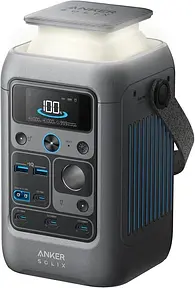
Anker SOLIX C300 DC Powerstation 288 Wh (LiFePO4, ohne Wechselrichter)
View at Amazon (as of Aug 11)Affiliate link. Buying through it earns us a commission; the price stays the same for you.
Calculate from the appliance, not from the power station
The second half of the problem is not in the power station at all but in the load. For anything that runs continuously, the wattage on the rating plate is the wrong number, because it states power while running and says nothing about what fraction of the time the device actually runs.
A fridge is the textbook case. Its compressor cycles rather than running flat out, and how often it does depends on ambient temperature, door openings and how full it is. The dependable figure is therefore not connected load but annual consumption from the EU energy label. ENTEGA publishes comparison values sourced from ecotopten (information as of February 2024, data source ecotopten as of 2021): a fridge-freezer up to 300 litres sits at 149 kWh per year in class C and 168 kWh in class D.
149 kWh a year is 408 Wh a day (own conversion, 149,000 ÷ 365). And here is the part that flips the purchase decision:
| Fridge on a 1,024 Wh power station | Consumption per day | Range |
|---|---|---|
| naive calculation, fridge only | 408 Wh | 2.5 days |
| AC operation, inverter E = 10 W | 408 + 240 Wh = 648 Wh | 1.5 days |
| AC operation, inverter E = 30 W | 408 + 720 Wh = 1,128 Wh | 0.9 days |
Own calculation. Assumption: the inverter runs 24 hours a day, because the compressor has to be able to start at any moment — 10 W × 24 h = 240 Wh, 30 W × 24 h = 720 Wh. The fridge figure comes from the EU label; it is not a measurement of any specific appliance.
In the worse of the two cases the inverter consumes more energy than the fridge it is powering. That is not a footnote, it is the largest single item, and none of the usual range figures includes it.
The ADAC works a comparable example in its own test, for a load that does not cycle: "Mit einer 1000-Wh-Powerstation kann zum Beispiel eine Kühlbox (50 W) beim Camping für circa 20 Stunden betrieben und ein Smartphone (15 Wh) bis zu 66 Mal geladen werden" — a 1,000 Wh station runs a 50-watt cool box for about 20 hours or charges a phone up to 66 times.
A third case does not even get off the ground. A 2,000-watt kettle exceeds the continuous AC output of many 1 kWh units, which typically sits at 1,800 watts. At that point the runtime question is moot — the unit cuts out before it starts. For anything that heats, check wattage against continuous output first and capacity second.
Runtime table: what 1,024 Wh actually carries
Everything assembled, for the most common capacity class. All values in hours.
| Load | Draw | naive | AC, E = 10 W | AC, E = 30 W | DC |
|---|---|---|---|---|---|
| Router + modem | 20 W | 51.2 h | 32.8 h | 19.7 h | 49.2 h |
| CPAP machine, no humidifier | 40 W | 25.6 h | 19.7 h | 14.0 h | 24.6 h |
| Compressor cool box | 60 W | 17.1 h | 14.0 h | 10.9 h | 16.4 h |
| Fridge, compressor running | 100 W | 10.2 h | 8.9 h | 7.6 h | not stated |
| Microwave | 500 W | 2.0 h | 1.9 h | 1.9 h | not stated |
| Kettle | 1,500 W | 0.7 h | 0.7 h | 0.6 h | not stated |
Own calculation using the model above, usable energy 983 Wh. The load figures are typical magnitudes, not measurements of specific appliances — substitute the wattage of your own device. "Not stated" appears where there is no sensible DC path for that load.
Two patterns fall out. First: the smaller the load, the wider the spread between the columns — and the more it matters how well the unit is built. At 1,500 watts every column is nearly identical; at 20 watts a factor of 2.6 separates them. Second: for small continuous loads the DC path always beats the AC path, and by a wide margin.
The Anker SOLIX C1000 Anker SOLIX C1000 Powerstation 1056 Wh (1800 W) mit Tragetasche at 1,056 Wh sits squarely in this class; its sibling, the C800 Plus, appeared in the ADAC test of 11 June 2025 with a score of 2.5. The 1,800 watts of continuous AC output is the figure you check your kettle against.
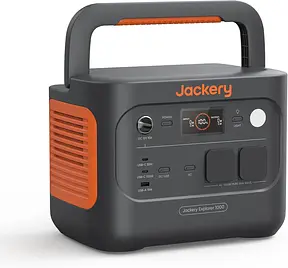
Not available in your region — closest match
Jackery E1000 v2 Tragbare Powerstation, 1070Wh, 1500W AC-Ausgang, LiFePO4
View at Amazon (as of Aug 11)Affiliate link. Buying through it earns us a commission; the price stays the same for you.
LiFePO4 or NMC: the difference only shows up years later
For the runtime of a single charge the cell chemistry barely matters. For what the unit can still do in five years it decides everything.
heise quantifies the gap: "LiFePO4-Akkus sollen diese Kapazität auch nach 3000 bis 3600 Zyklen bieten" — LiFePO4 cells are claimed to still deliver that capacity after 3,000 to 3,600 cycles — while "eine Lithium-Ionen-Batterie mindestens noch 80 Prozent der Nennkapazität nach etwa 500 bis 1000 Ladezyklen" promises at least 80 percent of nominal after roughly 500 to 1,000. A factor of three to seven on cycle life, on devices costing high three or four figures, is the real price comparison. Both figures are manufacturer claims that heise reports, not a long-term measurement by the editors.
In the cold the picture inverts, and it does so for both chemistries alike. Battery University states the limit clearly: "Li-ion can be fast charged from 5°C to 45°C […] Below 5°C, the charge current should be reduced, and no charging is permitted at freezing temperatures", because charging below freezing plates metallic lithium onto the anode — "a permanent degradation in performance and safety". Discharging, by contrast, works down to roughly −20 °C.
In practice: a power station in an unheated cellar or on a winter trip will give power out but may refuse to take any in. heise draws the consequence for high loads: "Wer solch hohe Leistungen bei niedrigen Temperaturen benutzen will, muss den ausgekühlten Akku der Powerstation im Zweifel kurz vorwärmen" — a chilled pack may need warming up first. So store an outage reserve somewhere that stays above freezing in January, and do not plan winter solar charging for a frosty morning.
In the 2 kWh class the EcoFlow Delta 3 Max EcoFlow DELTA 3 Max Tragbare Powerstation 2048 Wh (LiFePO4, 2400 W X-Boost) with 2,048 Wh of LiFePO4 is a typical representative. Note that doubling capacity does not halve the relative inverter loss at small loads — the fixed surcharge stays fixed, it merely spreads across more watt-hours.
Not available in your region — closest match
Jackery E1000 v2 Tragbare Powerstation, 1070Wh, 1500W AC-Ausgang, LiFePO4
View at Amazon (as of Aug 11)Affiliate link. Buying through it earns us a commission; the price stays the same for you.
Solar follows different rules again
The charging side has a figure of its own. heise measured on the top-ranked unit: "Beim Nachladen an der Steckdose ist der Wandlungsverlust dann etwas höher. Hier liegt die Effizienz im Test bei rund 82 Prozent" — recharging from the wall runs at about 82 percent efficiency. Putting 983 Wh back into the pack therefore takes roughly 1,200 Wh: at the wall that is a question of your electricity bill, on a solar panel a question of panel area.
Whether those 82 percent carry over unchanged to the solar input is not established: heise explicitly measured mains recharging, and solar charging runs through a different converter. Treat the figure as an order of magnitude for the charging side, not as a measured solar efficiency.
The same caution applies to the wattage printed on a panel. It is a laboratory figure under standard test conditions, not the yield on your balcony in October. No measured German real-world yield figure from an independent test could be found for this article — which is why no percentage appears here. If you buy a bundle, read the panel rating as a ceiling rather than a planning value.
One such bundle is the BLUETTI Elite 100 V2 with a 200-watt panel BLUETTI Elite 100 V2 Powerstation, 1024 Wh, mit 200-W-Solarpanel: 1,024 Wh of LiFePO4 plus panel in one package. More important than panel wattage at purchase is whether open-circuit voltage and connector type match the station's MPPT input — a matched bundle guarantees that, freely combined parts are where most bad purchases come from.
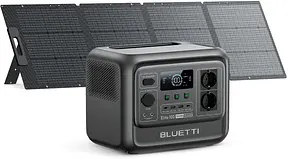
BLUETTI Elite 100 V2 Powerstation, 1024 Wh, mit 200-W-Solarpanel
View at Amazon (as of Aug 11)Affiliate link. Buying through it earns us a commission; the price stays the same for you.
What cannot honestly be quantified
One number is deliberately missing from this article, and it happens to be the one that decides the emergency: self-discharge over months. A power station kept in a cupboard as outage insurance is not drained in hours but in weeks, through standby electronics, the BMS and cell self-discharge.
The ADAC's 30 watts describes the inverter switched on, not the unit sitting powered down on a shelf. For that powered-down state no published measurement from an independent testing body could be found for the German market. An estimate would be especially damaging here, because it would feed straight into a preparedness decision. Until a dependable measurement exists, the practical answer stands: check the charge level every few months and top it up, rather than relying on a number nobody has measured.
The bottom line
Nameplate capacity is the starting point of a calculation, not its result. Know the three quantities — roughly 96 percent usable energy, a fixed inverter surcharge of 10 to 30 watts, and the actual draw of your own appliance rather than a rating-plate number — and you arrive at runtimes that hold up when it counts.
Two rules of thumb survive. At small continuous loads the output matters more than the capacity: a DC path often replaces the next size up. For anything that heats, continuous output matters more than everything else: capacity that cannot start the appliance is worth nothing.
And one number stays open. How long a power station holds its charge sitting in a cupboard has not been publicly measured for the German market. For a device bought as insurance that is the most relevant unanswered question there is — and the reason no estimate appears here.
All products from this post
The ones we named above are marked; the rest are alternatives in the same category.
Not available in your region — closest match
Anker SOLIX C1000 Powerstation, LiFePO4, 1800 W
View at Amazon (as of Aug 11)
Not available in your region — closest match
Jackery E1000 v2 Tragbare Powerstation, 1070Wh, 1500W AC-Ausgang, LiFePO4
View at Amazon (as of Aug 11)
Not available in your region — closest match
Jackery E1000 v2 Tragbare Powerstation, 1070Wh, 1500W AC-Ausgang, LiFePO4
View at Amazon (as of Aug 11)
Affiliate notice: As an Amazon Associate, we earn from qualifying purchases. Product prices and availability are subject to change.
Frequently Asked Questions
How many watt-hours do I actually need?
Work from the load: watts multiplied by hours of operation gives your demand in watt-hours. Divide that by 0.96 to offset the capacity deduction, and for 230-volt operation add 10 to 30 watts of inverter draw for every hour. A 20-watt router over 24 hours therefore needs roughly 750 to 1,200 Wh rather than the 480 Wh the naive calculation suggests.
Why does a 1,024 Wh power station not deliver 1,024 Wh?
Because the figure describes cell capacity, not what arrives at the output. The ADAC measured on 11 June 2025 that usable net capacity averages 10 to 15 percent below the gross figure, and heise measures 96 percent at high load and around 88 percent with mixed consumers on its top-ranked unit. The cause is the internal electronics, above all the inverter.
Does a power station really last longer on the USB output?
Yes, substantially so at small continuous loads. The 230-volt inverter draws up to 30 watts in the ADAC test simply for being switched on. Against a 20-watt load that fixed component is larger than the appliance itself. Via 12 volts or USB-C it disappears, because the inverter is not in the path.
Can I run a fridge for days?
Usually not. A fridge-freezer up to 300 litres in energy class C uses about 149 kWh a year, roughly 408 Wh a day. Because the inverter has to run continuously, another 240 to 720 Wh a day lands on top. A 1,024 Wh station therefore carries it for about 0.9 to 1.5 days on paper, not the 2.5 the naive calculation gives.
Is LiFePO4 worth the extra cost?
For regular use, yes. heise cites 3,000 to 3,600 cycles to 80 percent remaining capacity for LiFePO4 against 500 to 1,000 for conventional lithium-ion cells. Those are manufacturer claims rather than a long-term measurement. Anyone using the station twice a year for a camping trip will never encounter the difference.
Can I charge a power station in freezing weather?
No. Battery University states that below 5 degrees Celsius the charge current should be reduced and that no charging is permitted at freezing temperatures, because metallic lithium plates onto the anode and permanently damages the cell. Discharging works down to around minus 20 degrees. Good units block cold charging themselves, but that is not something to rely on.