Retrofit Balcony Solar Storage: Does Adding a Battery to Your Existing System Pay Off?
 13 min read
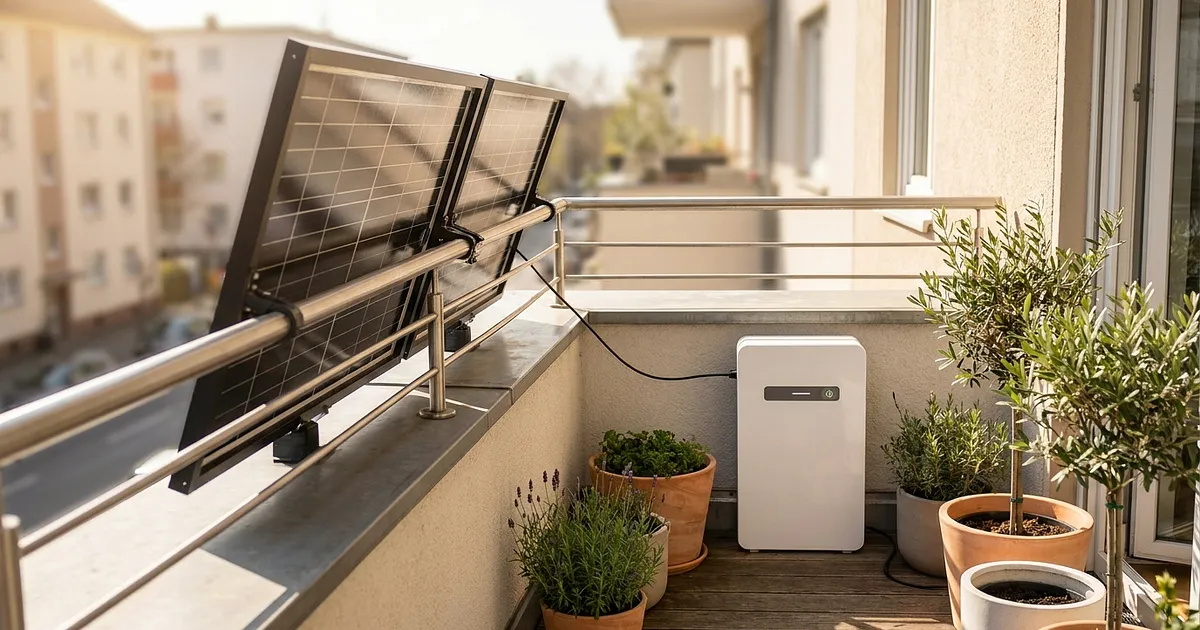
You already run a balcony solar system, the panels are up, the inverter is feeding in, and now the battery is tempting you. Retrofitting balcony solar storage is usually the easy part, technically speaking. Whether it pays for itself is the far more awkward question. So we answer that one first, not at the end.
As of: 20.08.2026
One thing up front: this is about the retrofit case. You already own the system, the panels and the inverter are paid for. So the question isn't whether a balcony solar system with storage pays off from scratch, but the sharper one: does the extra battery pay for itself on its own, even though you financed most of the system long ago? That's a different calculation, and it's exactly the one most guides skip.
This is also the difference from the "buy a system with storage from day one" question, which is its own topic with its own bundle math. Here we isolate the battery's incremental cost against the incremental benefit of a system you already own.
Compatibility check first: does a battery even fit your system?
Before you think about cost, sort out the technical side, since not every balcony power plant battery retrofit is plug-and-play. Otherwise you buy a €700 battery that won't connect. Three things to check.
Plug type: Schuko or Wieland?
Your existing system runs either on a standard Schuko socket or on a Wieland feed-in socket. That's not a detail. A retrofit battery has to match the existing plug and cable type. On the Photovoltaikforum, one user reports that his new storage unit ships with no Wieland cable option at all, leaving him to either rig up his own cable or stay non-compliant above the permitted module output (source). Check this before you buy, not after. If you're unsure which standard is actually mandatory at your module output, our Schuko vs Wieland VDE standard comparison breaks it down.
Module output: are you under 960 Wp?
Up to 960 Wp of module output, a Schuko socket is the usual route in practice. Between 960 and 2,000 Wp, a VDE-compliant Wieland socket becomes mandatory according to priwatt, and only a certified electrician may install it (source). So if your balcony system already runs at the upper edge, the retrofit is less relaxed than the "plug-ready" marketing suggests.
Inverter: will it cooperate?
Not every micro-inverter works with every add-on battery. AC-coupled storage sidesteps most of that, because it sits after the inverter and only feeds into the household grid. Even so, read your inverter's datasheet and the battery's datasheet before you order. Manufacturer specs are your most important source here, and they cost nothing. Only once the plug type, module output, and inverter line up does it actually make sense to retrofit balcony solar storage.
AC or DC: which storage should you retrofit onto balcony solar?
This is the central technical decision, and for a retrofit it's quickly settled. AC-coupled storage is the practical route for retrofitting, according to the Balkonkraftwerk-Kompendium, because the existing inverter and panels stay unchanged. DC coupling, by contrast, is "barely suitable for retrofitting," because the inverter and battery have to be matched from the start (source).
The price for that convenience: an AC battery converts the power more often (DC to AC to DC to AC), which costs roughly 5 to 10 percent more loss than DC coupling, per the same source. For most people retrofitting, that's still the only sensible path.
| Feature | AC-coupled | DC-coupled |
|---|---|---|
| For retrofitting | practical, battery sits after the inverter | barely suitable, effectively a new system |
| System rebuild | no, panels and inverter stay | yes, inverter must match |
| Efficiency | approx. 5 to 10% loss from double conversion | slightly higher, less conversion |
| Installation | plug-and-play, Schuko or Wieland | professional installation |
Put simply: if you're retrofitting, you want an AC-coupled battery. Anything else is really an argument for a whole new system.
What does the retrofit cost, and what does it actually deliver?
Now for the calculation almost nobody does cleanly when they retrofit balcony solar storage. A battery-only retrofit unit costs €300 to €1,000 according to the ADAC (as of 22.07.2026), depending on capacity and features (source). The market average for storage fell to around €315 per kilowatt-hour in the first half of 2026. That's one side.
The other side is the benefit. A retrofitted battery lifts your system's self-consumption noticeably. Per the ADAC, it rises from 33 to 73 percent for a single-person household, and from 51 to 88 percent for a three-person household. Those are model figures by household size, not one fixed number. Where you land depends on how much power you draw in the evening and at night, when the panels deliver nothing.
The actual retrofit math
The thinking error in almost every comparison: they calculate payback for the whole system, panels plus inverter plus battery. But your panels and inverter are already paid for. What counts for you is only whether the extra battery cost earns itself back through the extra self-consumption.
Here's the logic: every kilowatt-hour you use yourself thanks to the battery, instead of feeding it in, saves you the gap between your electricity price (roughly 35 ct/kWh) and the meager feed-in tariff (around 8 ct/kWh, per infranken.de). That's about 27 cents saved per shifted kilowatt-hour (our own calculation based on those prices). How much power you're even allowed to feed in depends on the 800-watt inverter cap, which, contrary to a persistent rumor, has not been lifted, as our 800-watt limit fact-check shows. Divide the battery price by your yearly saving, and you have your rough payback time.
And factor in the battery's own consumption. If the unit draws around 4 to 5 W in standby, that adds up to roughly 39 kWh over a year (our own calculation: 4.5 W × 8,760 h). What the standby draw truly is sits in your specific model's datasheet, not in this calculation. But don't ignore it, it eats back part of the saving.
The uncomfortable truth
Here's the honest part. The Stiftung Warentest test of 19.03.2026 reaches a blunt verdict: storage is financially not advisable for most mini-PV households, and it does little for the climate either. Three of the five tested units failed outright, due to excessive electromagnetic interference such as TV flicker, humming, and Wi-Fi dropouts (source).
You shouldn't skip past that. Payback runs around 4 years (three-person household) to 8 years per the ADAC, calculated over 15 years at 35 ct/kWh with 1 percent annual price growth. infranken.de, on the other hand, arrives at 2 to 3 years. Two credible sources, two very different results. We don't average them into one tidy number, because that would be false precision. Run the numbers with your own consumption, and you'll know more than any blanket guide.
Add storage to balcony solar: which models fit?
If, after the compatibility and cost check, you say "yes, this works for me," here are a few AC-coupled batteries built for retrofitting. All capacity figures are manufacturer specs, not independent measurements. Prices and ratings are Amazon snapshots from 20.08.2026 and change constantly.
| Model | Rated capacity (manufacturer spec) | Price (as of 20.08.2026) | Amazon rating |
|---|---|---|---|
| Anker SOLIX Solarbank E1600 | 1,600 Wh | approx. €399.99 | 4.5 / 5 (354) |
| Anker SOLIX 2 Plus Solarbank | 1,600 Wh | approx. €449.00 | 4.6 / 5 (158) |
| Marstek B2500D | 2,240 Wh | approx. €339.33 | 4.2 / 5 (205) |
| Growatt NOAH 2000 | 2,048 Wh | approx. €389.00 | 4.6 / 5 (176) |
Anker SOLIX: a tidy ecosystem
Anker is regarded as one of the more established names in the balcony-storage market. App polish and build quality get mentioned positively in user reviews fairly consistently, though that's no substitute for independent measurement. The Anker SOLIX Solarbank E1600 Balkonkraftwerk-Speicher, 1,6 kWh, fuer 600/800-W-Wechselrichter is rated at 1,600 Wh by the maker and designed as a plug-and-play unit. If you want a bit more equipment and the newer generation, look at the Anker SOLIX 2 Plus Solarbank (1,6 kWh), also 1,600 Wh by the manufacturer's spec. Both sit toward the upper price end of retrofit batteries, but the review picture is solid.

Not available in your region — closest match
View at Amazon (as of Aug 15)Affiliate link. Buying through it earns us a commission; the price stays the same for you.
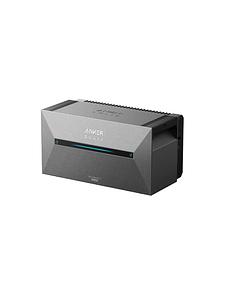
Anker SOLIX 2 Plus Solarbank (1,6 kWh)
View at AmazonAffiliate link. Buying through it earns us a commission; the price stays the same for you.
Marstek and Growatt: more capacity for the money
If the raw kilowatt-hour matters more to you than the brand, look further down. The Marstek B2500D Speicher 2240Wh für Balkonkraftwerke, LiFePO4 Akku, erweiterbar carries 2,240 Wh, the largest rated capacity in this group and expandable per the maker, while being the cheapest here. The Growatt NOAH 2000 Batteriespeicher 2,048 kWh für Balkonkraftwerke sits just below at 2,048 Wh by manufacturer spec and earns similarly strong reviews from Amazon buyers, though that's a sentiment read, not an independent test either. Both are explicitly designed as balcony storage, which makes them relevant for retrofitting.
One note that belongs to honesty: capacity on the box is not the same as usable energy at the socket. What actually arrives depends on efficiency, and none of these makers measures that independently. Our guide to sizing a power station for real runtime walks through how to judge rated capacity against what you'll actually get. The figures above are what's printed on the label.
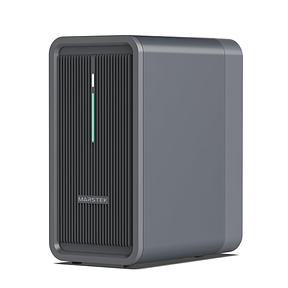
Marstek B2500D Speicher 2240Wh für Balkonkraftwerke, LiFePO4 Akku, erweiterbar
View at AmazonAffiliate link. Buying through it earns us a commission; the price stays the same for you.
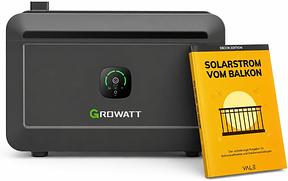
Growatt NOAH 2000 Batteriespeicher 2,048 kWh für Balkonkraftwerke
View at AmazonAffiliate link. Buying through it earns us a commission; the price stays the same for you.
Marktstammdatenregister: registering the battery after the fact
The part many people planning a pv battery retrofit overlook. You may have registered your balcony system two years ago, without a battery. A retrofitted battery is a separate technical unit and needs its own entry in the Marktstammdatenregister, within one month of commissioning.
Skip it, and you risk a fine of up to €50,000 according to the Bundesnetzagentur (source). The Verbraucherzentrale confirms the one-month deadline from commissioning (as of 23.07.2026) and points to the link with the EnWG (source). No need to panic, the registration is free and takes a few minutes. But you can't forget it.
One more point from the community: once a battery is in the system, it structurally no longer counts as the fully simplified "plug-in solar device" you originally registered. That surprises many who bought their battery-less system under the easy rules.
Do you need an electrician?
Whether your balcony solar battery retrofit needs an electrician depends on your module output. If your system stays under 960 Wp and runs on a Schuko socket, retrofitting an AC battery is usually plug-and-play. Plug it in, set it up via the app, done. No electrician needed.
Above 960 Wp it changes. Then a Wieland socket becomes mandatory per priwatt, and only a certified electrician may install it. In that case, fold the installation cost into your payback, because it shifts the math noticeably. A small side note that often gets lost: Schuko was never truly VDE-compliant above that threshold, even though it was long treated as a tolerated grey zone.
Is retrofitting worth it for you?
Honestly? It depends, and that's not a dodge, it's the only correct answer. Technically, retrofitting an AC battery is usually straightforward. Financially, it's a borderline case that Stiftung Warentest actually rejects for most households.
The battery is most likely to pay off if you draw a lot of power in the evening and at night, your system runs under 960 Wp, and you land a unit with low standby draw. It barely pays off if your consumption falls during the day, if you feed in a lot anyway, or if you also have to pay an electrician above the Wieland threshold.
My advice: take the compatibility check above, then the model table, and run the numbers with your real electricity consumption instead of trusting someone else's payback figure, if you're weighing whether to retrofit balcony solar storage at all. That's the part nobody does for you. And it's the only one that counts.
All products from this post
The ones we named above are marked; the rest are alternatives in the same category.
Not available in your region — closest match
Anker Powerbank, 20.000mAh tragbares Ladegerät mit integriertem USB-C-Kabel, 87W Max Schnellladung, kompatibel mit MacBook, iPhone, Samsung und mehr
View at Amazon (as of Aug 15)
Affiliate notice: As an Amazon Associate, we earn from qualifying purchases. Product prices and availability are subject to change.
Frequently Asked Questions
Can I retrofit any balcony solar system with a battery?
Not quite every one, but most systems convert without trouble. Three things decide it: the plug type (Schuko or Wieland), your system's module output, and whether your inverter cooperates. AC-coupled batteries are the practical route, because they sit after the inverter and leave both panels and inverter unchanged. Check the plug type and datasheet before you buy, not after.
What does it cost to retrofit balcony solar storage?
Budget €300 to €1,000 for the battery alone, according to the ADAC (as of 22.07.2026) and depending on capacity and features. On top of that come possible installation costs if your system exceeds 960 Wp and needs a Wieland socket from an electrician. The market average in the first half of 2026 was around €315 per kilowatt-hour.
AC or DC: which storage suits a retrofit?
Straightforward answer: AC-coupled, if you're retrofitting. The battery sits after the inverter and feeds into the household grid, while panels and inverter stay unchanged. DC coupling is barely suitable for retrofits per the Balkonkraftwerk-Kompendium, because inverter and battery must match from the start. AC costs you roughly 5 to 10 percent more conversion loss, but it's the only sensible retrofit route.
Do I have to register the retrofitted battery?
Yes, without exception. A retrofitted battery counts as a separate technical unit and must go into the Marktstammdatenregister within one month of commissioning. The Verbraucherzentrale confirms this deadline (as of 23.07.2026). Miss it, and you risk a fine of up to €50,000 according to the Bundesnetzagentur. The registration itself is free and quick.
Do I need an electrician for the retrofit?
Mostly not, as long as your system stays under 960 Wp on a Schuko socket, then the AC battery is plug-and-play. Above 960 Wp, a Wieland socket becomes mandatory per priwatt, and only a certified electrician may install it. In that case, the installation cost belongs in your payback calculation.