Power Bank in a Blackout: Is What 55% of Germans Own Enough?
 7 min read
Last checked: 02.09.2026
Keeping a power bank ready for a blackout sounds like preparation. And 55% of Germans say they do exactly that, according to a representative Innofact survey commissioned by Verivox. Fielded in April 2026, 1,013 respondents aged 18 to 79, representative by age, gender and federal state. That puts the power bank third on the list of measures people named, behind lighting and candles at 69% and food stocks at 64%.
But which power bank?
The survey asks about the device, not about its capacity. And the whole answer hangs on that.
The number the survey coverage keeps skipping
The same study carries a second figure that gets quoted far less often. Only 30.3% of respondents had taken any concrete preparedness measures at all. And 64% still consider the German grid secure, down from 69% a year earlier.
Put those two side by side. More people name a power bank as a preparedness measure than say they have prepared in the first place. Which probably means the power bank is the device that was already sitting in a drawer, reclassified as preparedness after the fact.
That is not a criticism. It is the interesting part. A charged phone genuinely matters during an outage, it just is not the same thing as power in the house. How far that gap stretches showed during the Berlin blackout of January 2026, when roughly 45,400 households went about 100 hours without electricity.
What a power bank in a blackout actually delivers
Time to do the arithmetic. Not in mAh, because mAh is not an energy figure, but in watt-hours.
Stiftung Warentest, Germany's independent consumer testing body, examined 24 power banks priced between €30 and €100 and measured the usable energy, meaning what actually comes out the other end. For 10,000 mAh models that is 28.5 to 35.8 watt-hours. For 20,000 mAh models, 58.3 to 69.9 watt-hours, the energy a power bank actually has on hand during a blackout. The full model list and what else Warentest checked is in our rundown of the Stiftung Warentest result. How to get from mAh to watt-hours yourself, and why the 5 volts at the USB port are the classic trap, is covered in sizing a power station properly.
And outside the phone world? giga.de calculates that a 20,000 mAh power bank keeps a typical 12 W household router running for about five hours. That is an estimate rather than a lab measurement. The order of magnitude still holds.
Five hours of router. One evening, not a weekend.
The device class the survey is probably talking about costs under €30 (as of 02.09.2026, per Amazon.de) and has no mains socket on it.
UGREEN Nexode Power Bank 20000mAh 45W mit integriertem USB-C Kabel
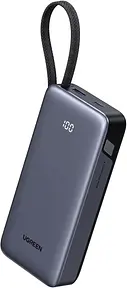
UGREEN Nexode Power Bank 20000mAh 45W mit integriertem USB-C Kabel
View at Amazon (as of Aug 11)Affiliate link. Buying through it earns us a commission; the price stays the same for you.
The bar it is being measured against
Anyone using the phrase blackout preparedness seriously is talking about a different order of magnitude. tink.de names 1,000 watt-hours as the minimum entry point for one person or a small flat, 1,000 to 2,000 watt-hours for couples and small families, more above that. It is an editorial recommendation rather than a lab study, though it comes from a retailer who knows the category.
What 1,000 watt-hours buys in practice, the ADAC spells out: around 66 smartphone charges, or roughly 20 hours of a 50 W cool box, though the real runtime depends heavily on the cooler type.
And even EcoFlow, a manufacturer that makes money selling power banks, recommends at least 30,000 mAh for genuine independence during an outage. A company with every incentive to talk up the small option declines to do so.
What the power bank is genuinely good for in a blackout
Here is the honest part, because the answer is not a flat no.
For a phone, a charged 20,000 mAh unit during an outage is exactly right. A smartphone battery sits at roughly 15 watt-hours, so a unit like that holds somewhere around four charges (our own arithmetic, using the ADAC assumption and the Warentest measurements). Four charges means a reachable phone, a working torch, readable news, a functioning emergency alert app. For an outage lasting a few hours, that is most of what you need.
What it will not do: fridge, heating pump, kettle, coffee machine. Nothing on mains voltage, simply because an ordinary power bank has no socket.
The second point is more mundane and gets missed constantly anyway. An empty power bank in a drawer is not preparedness, it is a paperweight. If you only own one, a top-up every few months belongs to the plan.
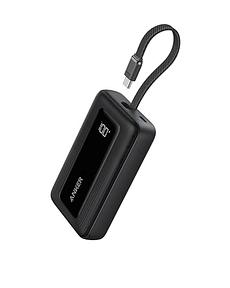
Affiliate link. Buying through it earns us a commission; the price stays the same for you.
What actually closes the gap
Between roughly 70 watt-hours and 1,000 watt-hours sits a full order of magnitude. Closing it means a power station, meaning a unit with a real mains output. Which capacity makes sense for which household is worked through in power station for a blackout at home.
The entry point: around 300 watt-hours
Roughly four times a large power bank, plus a proper socket. Laptop, lamps, router and modem all run off it. Past about 100 W of continuous draw it gets tight, which the Euronics test shows on a 270 Wh unit: television and laptop yes, kettle and hair dryer no.
ALLPOWERS R600 Tragbare Powerstation, 299Wh LiFePO4 Batterie Solargenerator
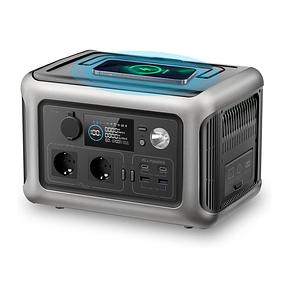
ALLPOWERS R600 Tragbare Powerstation, 299Wh LiFePO4 Batterie Solargenerator
View at AmazonAffiliate link. Buying through it earns us a commission; the price stays the same for you.
Household grade: 1,000 watt-hours and up
Only in this class do you reach the entry figure tink.de names for serious preparedness. It is a different price league than a power bank, and that belongs in the honest answer too.
Anker SOLIX C1000 Gen 2 Tragbare Powerstation, 1024Wh LiFePO4, 2000W Solargenerator
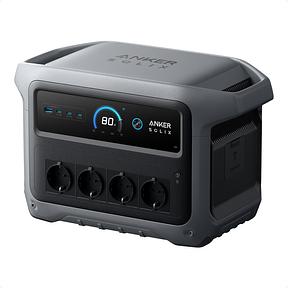
Anker SOLIX C1000 Gen 2 Tragbare Powerstation, 1024Wh LiFePO4, 2000W Solargenerator
View at Amazon (as of Aug 27)Affiliate link. Buying through it earns us a commission; the price stays the same for you.
Where that leaves things
The 55% who keep a power bank ready for a blackout are not bad news. It is just different news than it sounds like. What is sitting in that drawer keeps a phone alive for days and a router alive for an evening. It does not keep a household running.
If that is all you wanted, fine. Charging it regularly is the only maintenance it needs.
And if you genuinely mean the multi-day scenario, the useful move is to think in watt-hours instead of mAh and start at the sizing calculation rather than at a product.
All products from this post
The ones we named above are marked; the rest are alternatives in the same category.
Affiliate notice: As an Amazon Associate, we earn from qualifying purchases. Product prices and availability are subject to change.
Frequently Asked Questions
Is a power bank enough for a power outage?
For a phone, a torch and a small radio, yes, and during a short outage that is the part that matters. For a household, no. A 20,000 mAh power bank delivers 58.3 to 69.9 usable watt-hours per Stiftung Warentest, while tink.de puts serious blackout preparedness at 1,000 watt-hours or more. An ordinary power bank also has no mains output at all.
How many watt-hours are in a 20,000 mAh power bank?
Around 74 watt-hours nominal at 3.7 V cell voltage. Usable output stays at 58.3 to 69.9 watt-hours per Stiftung Warentest, because energy is lost converting up to 5 V. Calculating with the 5 V at the USB port is the most common mistake and throws the result off by roughly a third.
What should you do in a blackout if a power bank is all you have?
The biggest gain comes from putting the phone into low power mode and reserving the bank for the phone rather than a laptop or a speaker. Around four phone charges is realistic that way. A light source that does not depend on the phone, plus a battery radio, sensibly belong alongside it.
How much capacity does a multi-day blackout need?
tink.de names at least 1,000 watt-hours for one person or a small flat, and 1,000 to 2,000 watt-hours for couples and small families. The ADAC quantifies what 1,000 watt-hours delivers: roughly 66 smartphone charges, or about 20 hours of a 50 W cool box. That is power station territory, not power bank territory.
How often should an emergency power bank be recharged?
Every few months, since lithium cells slowly self-discharge. An empty power bank in a cupboard is no help when it counts. A fixed date helps, the clock change in spring and autumn being an easy one to remember.