Power Bank or Power Station for a Cooler Box: What Capacity Actually Keeps Things Cold?
 12 min read
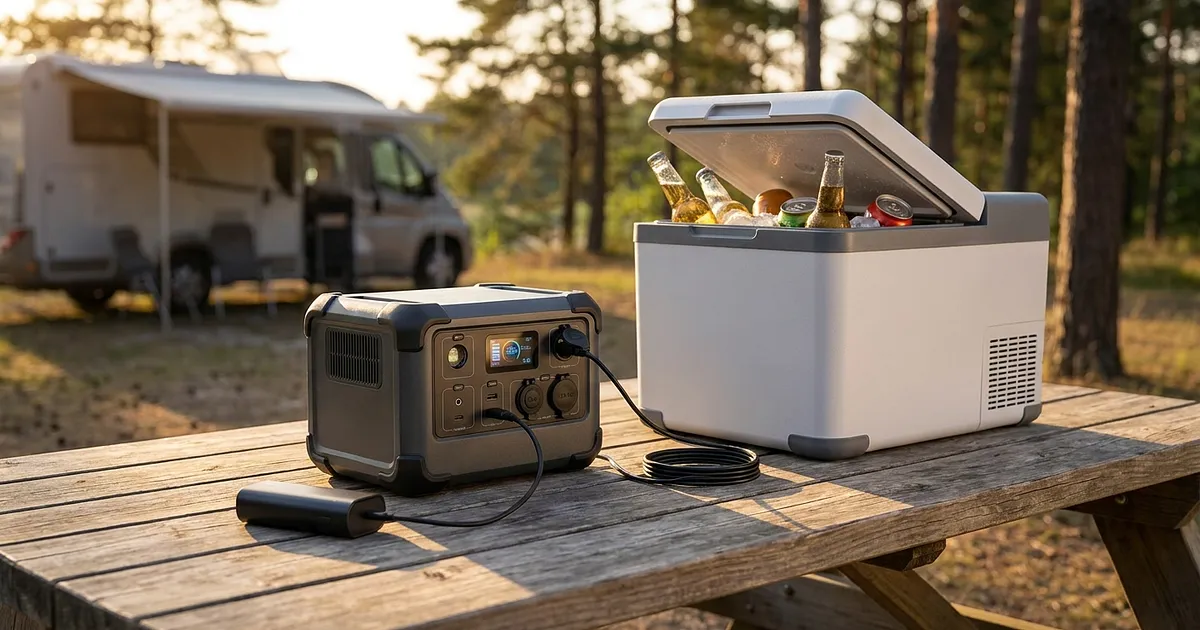
This looks like a choice between two product categories. It is really an arithmetic problem with two unknowns. The first is how much your cooler box actually draws, and two boxes that look nearly identical from the outside can differ by a factor of four. The second is how many watt-hours your power source really holds.
Neither number tends to be printed where you would look for it. The cooler box advertises its volume, the power bank advertises milliamp-hours, and neither answers the question of whether the drinks will still be cold in the morning. Convert both to the same unit and the answer gets blunt very quickly.
Cooling technology first, power source second
The order matters, because the cooling technology sets the consumption and the consumption sets the capacity you need. Buy the power station first and the cooler box second, and you will almost always buy too small.
A thermoelectric box, often called a Peltier box, has no moving parts. It pushes heat outward through a semiconductor element, and that element draws current for as long as it is asked to cool. Most models do not throttle back; they simply run. They also only achieve a fixed difference from ambient temperature rather than a fixed interior temperature.
A compressor box works like a refrigerator. The compressor starts, pulls the interior down to the set temperature, and switches off. After that it only cycles back on periodically. That cycling is the whole trick: the peak wattage tells you almost nothing, and the hourly average tells you everything.
What compressor and Peltier boxes really draw
The cleanest comparison the datasheets allow is two boxes from the same manufacturer at practically the same size.
| Specification | Dometic CFX3 35 (compressor) | Dometic TropiCool TCX 35 (Peltier) |
|---|---|---|
| Volume | 36 litres | 33 litres |
| Draw on 12V | 0.98Ah/h average, i.e. 11.8W | 3.8A continuous, i.e. 45.6W |
| Rated input power on AC | 50W | 64W |
| Calculated per 24 hours | about 282Wh | about 1,094Wh |
| Energy efficiency class | not stated on the datasheet | E (Regulation (EU) 2019/2016) |
| Weight | 16.9kg | 10.5kg |
Both figures come from the manufacturer datasheets, retrieved on 07.08.2026: Dometic CFX3 35 and Dometic TropiCool TCX 35. The wattage figures are current multiplied by voltage; the 24-hour figures are extrapolated from the average.
The important part of the compressor number is the condition Dometic attaches to it: 32°C ambient, 4°C interior. That is a hot summer day, not a comfortable 20°C lab bench. In cooler surroundings the draw falls; parked in direct sun it climbs.
The Peltier box carries no such condition, because there is nothing to cycle. 3.8A is 3.8A whether it is 18°C or 34°C outside. What changes is the interior temperature it manages to reach, and it changes in the wrong direction.
What that means for runtime
Here is where it gets concrete. The arithmetic is simple: usable watt-hours divided by average power draw gives you hours.
| Power source | Capacity | Compressor box at 11.8W | Peltier box at 45.6W |
|---|---|---|---|
| Large USB-C power bank | about 86Wh | about 7 hours | about 1.9 hours |
| Small power station | 256Wh | about 21.7 hours | about 5.6 hours |
| Mid-size power station | 512Wh | about 43.5 hours | about 11.2 hours |
| Large power station | 1,024Wh | about 87 hours | about 22.5 hours |
Those are calculated ceilings, not measurements. Take something off the top of each: every conversion costs energy, and running the box through a 230V inverter rather than the 12V socket costs more than running it directly. Dometic rates the same Peltier box at 45.6W on 12V but 64W on AC. That is the same cooling effect for noticeably more power.
The lesson in one sentence: a Peltier box on a power station is an expensive way to flatten a battery. For anything beyond a car journey the compressor pays for itself, no matter how cheap the thermoelectric box was on offer.
Why the power bank often will not start it at all
The runtime table hides a problem that many people discover on the campsite: electrically, a power bank often does not fit a cooler box in the first place.
Cooler boxes want 12V DC through a car socket, or 230V from a wall outlet. A power bank puts out USB-C with Power Delivery. That is a different voltage on a different connector, and the box has no way to negotiate for it.
Then there is the capacity ceiling. Power banks are built to be carried onto aircraft, so in practice the form factor stops at 100Wh. A large model such as the Anker Prime Powerbank 24.000 mAh, 140 W, Display, rated 24,000mAh with 140W output, sits just under it. Anker does not publish a watt-hour figure for this model; calculated at the 3.6V nominal voltage typical of lithium-ion cells, it comes to roughly 86Wh. Our guide to power banks in carry-on baggage covers where that limit comes from.
Output wattage does not rescue the situation either. Since Power Delivery revision 3.1 the USB standard allows up to 240W, implemented as 48V at 5A, as the USB Implementers Forum announced in May 2021. That is plenty of watts for a laptop. But watts are not the cooler box's problem; watt-hours and the right connector are.
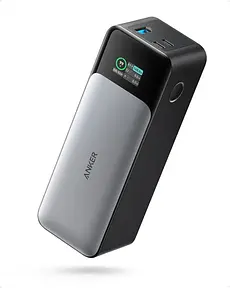
Anker Prime Powerbank 24.000 mAh, 140 W, Display
View at Amazon (as of Aug 10)Affiliate link. Buying through it earns us a commission; the price stays the same for you.
The adapter that turns USB-C into 12V
Cables do exist that present a 12V car socket on a USB-C output, such as the USB-C auf Kfz-Buchse Adapterkabel 15V 3A 45W, which rates its output at 15V, 3A and 45W. In principle that lets you run a small compressor box off a power bank.
Two honest caveats. First, the continuous rating of such an adapter comfortably covers the box's average draw, but a compressor's inrush at startup sits well above its average, and whether a given adapter tolerates that is not stated on any of the datasheets. Second, the adapter does nothing about the 86Wh. It converts a connector problem into a capacity problem, and only solves the first one.
For a day trip with a pre-chilled box, that is enough. For a night, it is not.
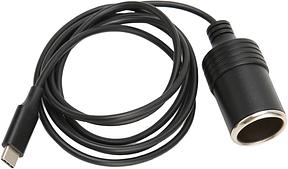
USB-C auf Kfz-Buchse Adapterkabel 15V 3A 45W
View at AmazonAffiliate link. Buying through it earns us a commission; the price stays the same for you.
Which power station for which duration
From here it is only about watt-hours. The rule of thumb: take your box's daily consumption from the table above and plan at least a third on top, because heat, frequent opening and the initial pull-down all push in the same direction.
One night out: 256 watt-hours
For an overnight stay with a small to mid-sized compressor box, the 256Wh class is the right size. The EcoFlow RIVER 2 Powerstation 256Wh delivers 256Wh from LiFePO4 cells with up to 600W output, so it has headroom for inrush current and a 12V output that skips the inverter detour entirely.
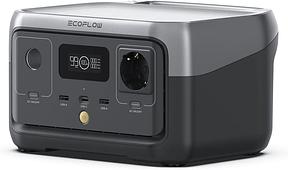
EcoFlow RIVER 2 Powerstation 256Wh
View at AmazonAffiliate link. Buying through it earns us a commission; the price stays the same for you.
The alternative with 300W continuous
Same capacity class, different priorities: the Jackery Explorer 240 v2 Powerstation 256Wh also offers 256Wh of LiFePO4 capacity, delivering 300W through the AC socket and 100W over USB-C. If you want to charge a laptop and camera alongside the cooler box, this suits that better.
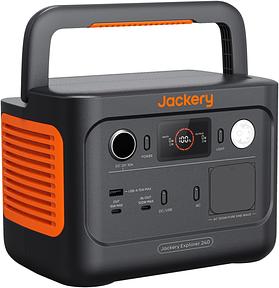
Jackery Explorer 240 v2 Powerstation 256Wh
View at AmazonAffiliate link. Buying through it earns us a commission; the price stays the same for you.
A long weekend: 512 watt-hours
For two to three days without recharging, 512Wh becomes the sensible floor. The EcoFlow RIVER 2 Max Powerstation 512Wh doubles its smaller sibling to 512Wh and raises output to 1,000W. On paper that is a good 43 hours of compressor running, so with reserve, a realistic two days.
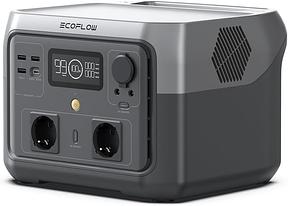
EcoFlow RIVER 2 Max Powerstation 512Wh
View at AmazonAffiliate link. Buying through it earns us a commission; the price stays the same for you.
Several days or bigger loads: 1,024 watt-hours
If you are staying off-grid longer, or running a genuine 230V appliance alongside the cooler, you end up at a kilowatt-hour. The EcoFlow Delta 3 Plus Powerstation, 1024 Wh offers 1,024Wh and 1,800W continuous. This class makes most sense paired with a solar panel, because the box's daily consumption can then be partly replaced during the day. We ran the numbers on how storage pays back in our piece on balcony solar with a battery.
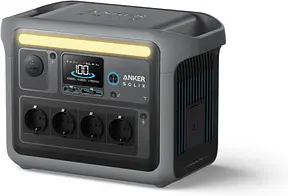
Not available in your region — closest match
Anker SOLIX C1000 Powerstation, LiFePO4, 1800 W
View at Amazon (as of Aug 11)Affiliate link. Buying through it earns us a commission; the price stays the same for you.
The cooler box itself: what matters
The power source is only half the decision. On the box, technology aside, volume is what counts, because every extra litre is more surface area for heat to come through.
Small and frugal: 10 litres
The smallest form factor that still brings real compressor cooling. The EUHOMY Kompressor-Kühlbox 10 Liter cools from -20°C to 20°C according to the manufacturer and runs on 12V, 24V and 230V. At this size, running from a power bank with an adapter becomes realistic at all, and on 256Wh it lasts well over a day.
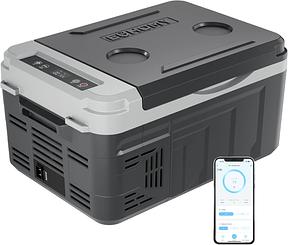
EUHOMY Kompressor-Kühlbox 10 Liter
View at AmazonAffiliate link. Buying through it earns us a commission; the price stays the same for you.
The compromise: 22 litres
Enough room for two people's food over a weekend without the box taking half the car. The BougeRV CRX3 Kompressor-Kühlbox 22 Liter cools to -20°C and runs on 12V and 230V. Its consumption is naturally higher than the 10-litre model's, but it remains well matched to a 512Wh station.
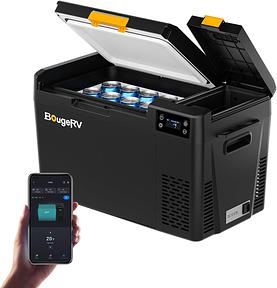
BougeRV CRX3 Kompressor-Kühlbox 22 Liter
View at AmazonAffiliate link. Buying through it earns us a commission; the price stays the same for you.
Family format: 46 litres
At this size the power station becomes the limiting factor. The KLAMER Kompressor-Kühlbox 46 Liter offers two separately adjustable compartments and cools to 45°C below ambient according to the manufacturer. Running that volume for several days means starting at 1,024Wh or planning to recharge from the vehicle.
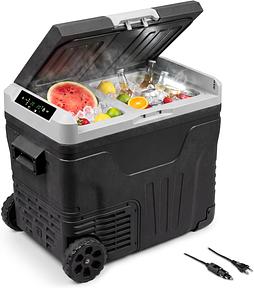
KLAMER Kompressor-Kühlbox 46 Liter
View at AmazonAffiliate link. Buying through it earns us a commission; the price stays the same for you.
What actually drives consumption up
Four things cost more than most people expect, and all four are within your control.
Ambient temperature. Dometic's figure holds at 32°C. Inside a closed car in direct sun it gets considerably hotter, and the compressor cycles proportionally longer. A shaded spot is the cheapest capacity upgrade available.
The initial pull-down. A box filled with warm contents runs continuously at first rather than cycling. Pre-chilling at home on mains power and loading already-cold goods saves the most expensive part of the daily budget.
The set temperature. Every degree lower costs continuously. Drinks and most foods are fine at 4°C to 7°C; freezer operation at -18°C is an entirely different consumption case.
The route through the inverter. If the power station has a 12V output and the box has a 12V cable, take that path. Dometic's datasheet puts the detour through 230V at 64W instead of 45.6W on their Peltier box.
How to run the numbers for your own setup
Three steps, no measuring equipment required.
- Find the box's draw in watts. The datasheet gives either an average in Ah/h or a rated current in amps. Multiply by 12 for watts. If it only gives a rated current and the box is a Peltier model, that figure is also its continuous consumption.
- Scale to 24 hours. Watts times 24 gives watt-hours per day. For a compressor box use only the average, never the startup figure.
- Add reserve. A third on top covers heat, opening and conversion losses. The result is the minimum capacity your power station should have.
If you want to run this calculation for a single appliance rather than a cooler box, the general version lives in our guide to sizing a power station.
As of 07.08.2026. All consumption and output figures are taken from the linked manufacturer datasheets, retrieved on 07.08.2026. Runtimes are calculated from those figures, not measured. Product prices and ratings change; the retailer's page is authoritative.
All products from this post
The ones we named above are marked; the rest are alternatives in the same category.
Not available in your region — closest match
Anker SOLIX C1000 Powerstation, LiFePO4, 1800 W
View at Amazon (as of Aug 11)
Affiliate notice: As an Amazon Associate, we earn from qualifying purchases. Product prices and availability are subject to change.
Frequently Asked Questions
Can I run a cooler box from an ordinary power bank?
Technically yes, practically only within limits. The box needs 12V at a car socket, the power bank outputs USB-C, and an adapter cable belongs in between. Capacity matters more: power banks stop at roughly 100Wh because of their form factor. A compressor box averaging 11.8W runs about seven hours on that; a thermoelectric box at 45.6W runs under two. Fine for a day trip, not for a night.
How many watt-hours do I need for one night?
For a small to mid-sized compressor cooler, 256Wh is a solid baseline. At an average draw of 11.8W that calculates to roughly 21 hours. With reserve for heat, frequent opening and conversion losses, one night stays comfortably covered. The same capacity on a thermoelectric box only lasts a good five hours.
Why does a Peltier box use so much more than a compressor?
Because it never switches off. A compressor cools down and then pauses, so its average sits far below its connected load. A Peltier element draws current the whole time it is asked to cool. Across the two Dometic models compared here that is 11.8W average against 45.6W continuous, at almost identical volume.
Is 12V or 230V better on a power station?
12V, if both devices support it. Going through the inverter costs additional energy. For the Dometic TropiCool TCX 35 the datasheet lists 3.8A at 12V, which is 45.6W, against 64W rated input on 230V. If your power station has a 12V output and the box has a matching cable, that is the more efficient connection.
How much does outside temperature affect consumption?
Considerably on a compressor box and not at all on a Peltier box, but in different ways. Dometic states its consumption figure explicitly for 32°C ambient and 4°C interior. When it gets warmer the compressor cycles longer and the average rises. The Peltier box keeps drawing the same current but simply no longer reaches as low an interior temperature.
Is a solar panel worth adding to the power station?
Once you want to stay off-grid longer than two days, yes. A compressor box uses roughly 282Wh per day, and that order of magnitude is realistically replaceable with a portable panel on a sunny day. For shorter trips, a sufficiently large power station is the simpler and cheaper route.
What about the compressor's startup current?
It sits well above the average for a brief moment, which is why a power station's output rating matters and not just its capacity. Stations rated 300W or more continuous are untroubled by it. The tighter case is slim USB-C adapter cables on power banks, whose datasheets usually say nothing about startup behaviour.