
From a Battery Fire to a Rule: How One 2025 Incident Changed Power Bank Regulations on Aircraft
 14 min read
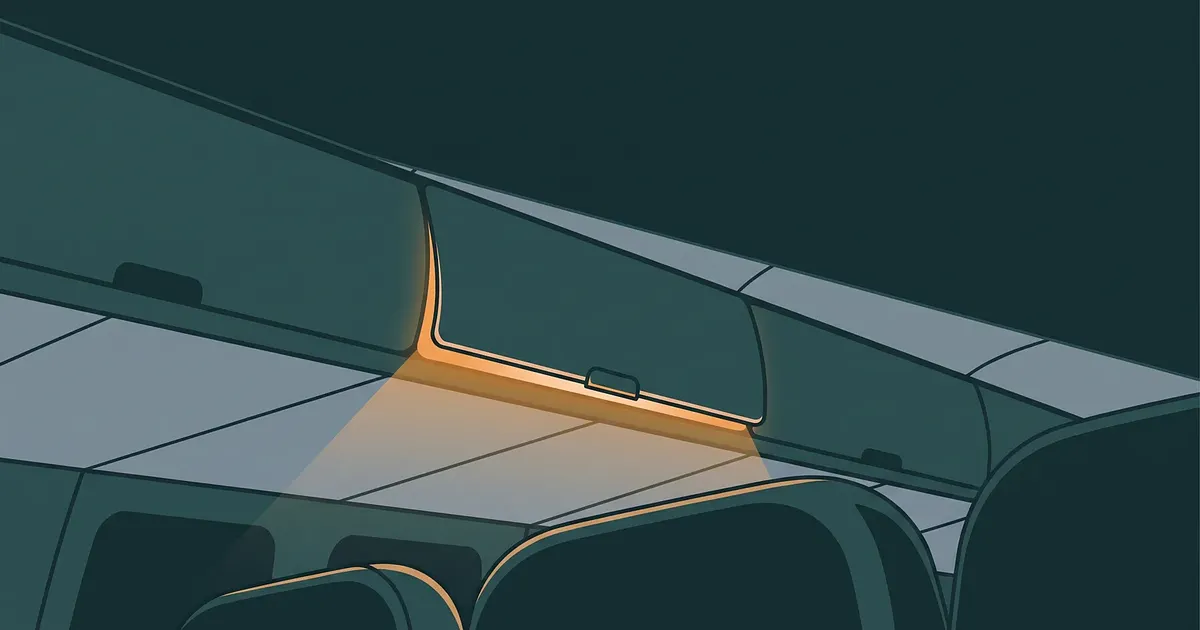
Fourteen months separate a burning overhead bin in South Korea from the sentence "no more than two power banks may be carried per person" in an ICAO document. In between, a national aviation ministry, Europe's EASA, America's FAA, China's CAAC and a series of airlines each reacted in turn, with their own rules and their own deadlines. Anyone standing at a gate today wondering why exactly two power banks are allowed, and why they may not go in the bin above the seat, will not find the answer in the rule itself. It is in the chain.
This article reconstructs that chain. It names a source for every incident and every date, and where sources contradict each other it says so. That happens twice below, and both times at a point that English-language coverage tends to smooth over.
What this article is not: a summary of current rules. What applies since 27 March 2026 is set out in The New Power Bank Rules Since 27 March 2026, and the airline table with the watt-hour calculator is in Power Banks in Carry-On. This one is about the why.
22:14 at Gimhae International Airport
Air Busan flight BX391 was due to fly from Busan to Hong Kong on the evening of 28 January 2025. The Airbus A321-231, registration HL7763, was at the gate with the door closed and boarding complete. According to the preliminary report by South Korea's investigation authority ARAIB, released on 4 March 2025 and summarised by the Aviation Herald, the cockpit received a fire warning at 22:14, evacuation was ordered at 22:15 and emergency services arrived at 22:17. Fire suppression ran from 22:20 until 23:31.
The fire had started in a rear overhead cabin area and spread quickly, eventually breaking through the crown of the aircraft. Everyone on board left via the emergency slides. The aircraft was a total loss.
Two numbers from this accident circulate in more than one version, and that matters because both get quoted as evidence. The Aviation Herald reports 177 occupants (170 passengers, 6 crew, 1 maintenance engineer) and 27 injuries, 3 of them serious. The English-language Wikipedia account of the accident reports 176 occupants and 7 minor injuries. What is not in dispute: nobody died, and every occupant was evacuated. Passing on either injury figure without its source means passing on a number you have not checked.
Who attributed the fire to what, and who did not
This is the first contradiction most accounts skip. The preliminary ARAIB report of 4 March 2025 does not determine a cause; it establishes where and when the fire occurred.
The attribution to a power bank came from elsewhere. South Korea's National Forensic Service said, as reported by AJU Press on 14 March 2025, that the fire was likely triggered by a short circuit inside a power bank; scorch marks on battery debris at the point where the fire was first detected pointed to a breakdown of the insulation inside the cell. Why the insulation failed, investigators could not say at that stage.
"Likely" is the word that disappears from the story afterwards. The rules that followed were justified with a cause that had not been conclusively established when the first of them took effect. That does not make the rules wrong. It does describe how fast this moved.
What happens inside a lithium cell when it goes
The technical term is thermal runaway. The FAA defines it in Safety Alert for Operators SAFO 25002, dated 25 August 2025, as "self-sustaining uncontrolled increases in pressure and temperature". Self-sustaining is the load-bearing word: past a certain point the reaction no longer needs an external heat source.
One consequence of that is decisive in a cabin, and it is stated in the same document. Halon extinguishers, the standard equipment on board, can briefly suppress open flames, "however they do not halt the thermal runaway process". What stops it is cooling: "The primary response involves using large amounts of water to cool the battery and suppress flames." The cell has to be cooled until every cell block has discharged its energy.
A battery fire on board is therefore not a fire you put out and then it is over. It is a process the crew has to cool down with water over a period of time. And that leads directly to the FAA's second sentence, the one that explains the overhead bin rule: batteries stowed in overhead bins or in carry-on baggage "may be obscured, difficult to access, or not readily monitored by passengers or crewmembers", so detection and firefighting may be delayed.
A fire in a seat pocket is seen in seconds. A fire behind a closed latch above people's heads is not.
The chain: from one overhead bin to a global rule
| Date | Who | What |
|---|---|---|
| 28.01.2025 | Air Busan BX391, Gimhae | overhead bin fire on the ground, A321 destroyed, all occupants evacuated |
| 13.02.2025 | South Korea, MOLIT ministry | announces ban: no power banks or e-cigarettes in overhead bins |
| 01.03.2025 | South Korea | rule in force; no charging from seat USB ports, maximum 5 power banks per person in carry-on |
| 04.03.2025 | ARAIB | preliminary report, no determination of the fire's cause |
| 14.03.2025 | National Forensic Service | short circuit in a power bank named as the probable cause |
| 20.03.2025 | Hong Kong Airlines HX115 | bin fire in flight Hangzhou–Hong Kong, diverted to Fuzhou, no injuries |
| 28.05.2025 | EASA | Safety Information Bulletin 2025-03, explicitly recommendations, not a ban |
| 28.06.2025 | China, CAAC | power banks without a valid CCC marking banned on domestic flights |
| 25.08.2025 | USA, FAA | SAFO 25002 to airlines: review firefighting and passenger messaging |
| 01.10.2025 | Emirates | 1 power bank under 100 Wh only, no use and no charging on board |
| 18.10.2025 | Air China CA139 | bin fire in flight Hangzhou–Seoul, diverted to Shanghai, no injuries |
| 15.01.2026 | Lufthansa Group | use and charging banned across all group airlines, maximum 2, not in bins |
| 27.03.2026 | ICAO | addendum to the Technical Instructions applicable worldwide |
The three cabin fires in that table are documented, and all three began in an overhead bin. On HX115 of 20 March 2025 the South China Morning Post reported an Airbus A320 with 160 passengers and 8 crew flying Hangzhou to Hong Kong, a fire in an overhead compartment, a diversion to Fuzhou, and a suspected overheated portable charging device. On Air China CA139 of 18 October 2025 the same paper reported an emergency landing in Shanghai after a lithium battery fire in an overhead bin roughly 40 minutes into the flight; the crew extinguished it with onboard equipment and nobody was hurt.
For the intermediate steps: South Korea's announcement of 13 February 2025 and the rule from 1 March 2025, including the seat-USB charging ban and the five-unit carry-on limit, are set out in the accident account. EASA published Safety Information Bulletin 2025-03 on 28 May 2025, containing the line "Power banks should not be used to charge PEDs during the flight" and noting that passengers now typically bring four to five battery-powered items on board. CAAC justified its 28 June 2025 ban in its English-language notice of 9 July 2025 by citing an increase in fire and smoke events during 2025 and recalls by several manufacturers. Emirates published its rule effective 1 October 2025 in its own media centre.
The Lufthansa Group published its rule effective 15 January 2026 in its own notice. The notable thing about that date is the ordering: the group acted ten weeks before ICAO, not after it.
One word that was not chosen by accident
The ICAO addendum to Doc 9284 has been applicable since 27 March 2026. The wording of the power bank passage is reproduced as Appendix C of IATA's Guidance to Operators dated 31 March 2026. Power banks
"must be carried as carry-on baggage",
"must not be recharged while onboard the aircraft",
"should not be used to recharge a portable electronic device while onboard the aircraft",
"no more than two power banks may be carried per person",
"must be individually protected so as to prevent short circuits when not in use".
Two lines, two different levels of obligation. Recharging the power bank itself is a must not, a mandatory prohibition. Charging your phone from the power bank is a should not, a recommendation. IATA lists the change as three items in its own summary: power banks are separated from spare batteries, a limit of two applies, and recharging the power bank in flight is prohibited. A ban on using it is not among them.
That many travellers nonetheless experience a full usage ban is not down to ICAO but to airlines that go further. The gap between the global rule and a carrier's house rule is broken down in The New Power Bank Rules Since 27 March 2026.
Why every clause has an incident behind it
Read as a list, the rule looks arbitrary. Read alongside the FAA's reasoning and the three fires, every line has a purpose.
| Clause | The failure it answers |
|---|---|
| carry-on only, never checked baggage | nobody is in the hold to notice a runaway or cool it |
| not in the overhead bin (airline rules, not ICAO) | all three documented fires started there; the FAA calls bins "obscured, difficult to access, or not readily monitored" |
| the power bank may not be recharged on board | mandatory since 27 March 2026, without ICAO or IATA naming a single cause for it |
| a maximum of two per person | caps the stored energy per seat regardless of each unit's capacity |
| each power bank individually protected against short circuit | the short circuit is precisely what forensics in Busan named as the probable cause |
The last line is the most revealing. The duty to tape terminals or put each power bank in its own pouch is not a 2026 invention; it was already in the Technical Instructions. What is new is how seriously it is taken.
What ICAO does not say
ICAO's announcement of 27 March 2026 names no single incident as the trigger. It justifies the change in general terms, citing growing expertise around the risks posed by passengers' lithium batteries. IATA, in its own document, names not a fire but the shape of the market as the concern: low barriers to manufacturing and a general lack of confidence in regulatory oversight of non-conforming manufacturers. It singles out wireless power banks as an emerging problem.
So the direct line from Busan to the global rule is drawn by others. The German motoring association ADAC wrote on 14 July 2026 that a fire on board an Air Busan A321 was the reason many airlines introduced stricter rules in early 2026. That is an attribution by a serious source, not a statement by ICAO. The distinction is small and still worth keeping: Air Busan moved the airlines, and the airlines and national authorities set the direction ICAO followed fourteen months later.
On how often this happens: the FAA maintains a continuously updated register of lithium battery incidents on aircraft, last updated 16 July 2026. ADAC, in its 14 July 2026 piece, puts the order of magnitude at one to two battery fires per week at cruising altitude. Annual totals for 2025 circulate in the press in several mutually inconsistent versions; they are not repeated here, because the underlying FAA analysis is published only as an interactive chart and was not retrievable as a checkable table.
What it means for your carry-on
The practical upshot is short: two power banks at most, carry-on only, within reach rather than above your head, each one individually protected against short circuit, and recharging the power bank itself is prohibited on board. Up to 100 Wh this applies without asking; between 100 Wh and 160 Wh you need the airline's approval. That exemption is going away, and the reason is in Power Bank 160 Wh.
None of it applies to a defective or swollen unit, which does not belong on an aircraft at all but back at the retailer. Whether your model is affected by a recall is covered in Power bank recall 2026.
In short
The 2026 power bank rules were not written at a desk. They are the sum of a destroyed aircraft in Busan, two more overhead bin fires in the same year, four authorities reacting independently of each other, and a handful of airlines that moved faster than the global body. The rule reads as arbitrary because it was tidied up afterwards. Every line in it has a backstory.
And one qualification worth carrying with it: the cause of the Busan fire was described by forensic investigators as probable, not proven. A cascade of rules built on a probable cause is normal in aviation, because nobody there waits for a second proof. It should simply not be told as something else.
All figures and sources as of 07.08.2026. Every rule reflects the state of the linked publication and may be tightened further by individual airlines.
Frequently Asked Questions
Which incident triggered the new power bank rules?
The fire on board Air Busan flight BX391 on 28 January 2025 is regarded as the trigger. An Airbus A321 burned out at the gate, every occupant was evacuated and the aircraft was a total loss. South Korea's National Forensic Service named a short circuit inside a power bank as the probable cause in March 2025. ICAO itself names no single incident in its 27 March 2026 announcement; that connection is drawn by airlines and media, such as ADAC on 14 July 2026.
Was anyone killed in the Busan fire?
No. Every occupant left the aircraft via the emergency slides and there were no fatalities. Injury figures differ by source: the Aviation Herald reports 27 injuries, 3 of them serious, among 177 occupants, while other accounts report 7 minor injuries among 176 occupants.
Why do many airlines forbid power banks in the overhead bin?
Because a battery fire there is noticed too late. The FAA states in SAFO 25002 of 25 August 2025 that batteries in overhead bins are obscured, difficult to access and not readily monitored, so detection and firefighting are delayed. On top of that, Halon extinguishers do not halt thermal runaway; what is needed is cooling with large amounts of water over time. All three documented cabin fires of 2025 started in an overhead bin.
Is using a power bank on board banned worldwide?
Not by ICAO. Its addendum draws an explicit distinction: recharging the power bank on board is a mandatory prohibition, while charging a device from the power bank is only a recommendation against. A full usage ban comes from individual airlines' house rules, such as the Lufthansa Group since 15 January 2026 and Emirates since 1 October 2025.
Which countries were stricter than ICAO first?
South Korea was first: rules from 1 March 2025, announced on 13 February 2025, banning storage in overhead bins and charging from seat USB ports. China followed on 28 June 2025 by banning power banks without a valid CCC marking on domestic flights. EASA published recommendations rather than prohibitions on 28 May 2025, and the FAA addressed airlines rather than passengers on 25 August 2025.
Sources
- Aviation Herald avherald.com
- Wikipedia account of the accident en.wikipedia.org
- AJU Press on 14 March 2025 ajupress.com
- Safety Alert for Operators SAFO 25002, dated 25 August 2025 faa.gov
- South China Morning Post scmp.com
- emergency landing in Shanghai scmp.com
- Safety Information Bulletin 2025-03 on 28 May 2025 easa.europa.eu
- English-language notice of 9 July 2025 caac.gov.cn
- own media centre emirates.com
- own notice business.lufthansagroup.com
- IATA's Guidance to Operators dated 31 March 2026 iata.org
- ADAC wrote on 14 July 2026 adac.de
- register of lithium battery incidents on aircraft faa.gov