Solid State Powerbank and Graphene Power Banks in 2026: Marketing Label or Real Technology?
 14 min read
Last checked: 27 Aug 2026
Since spring, the phrase solid state powerbank has been showing up on product pages more and more often. It sounds like the battery technology carmakers have been promising for their next vehicle generation. It is almost never the same thing. And the gap between the two decides whether you're buying a new cell design or a sticker.
That's the whole article in four sentences. The rest explains where the terms come from, why the pattern is repeating right now, and which three numbers deserve your attention instead.
Solid state, semi-solid-state, lithium-ion: what the terms actually mean
Every lithium cell needs an electrolyte to move ions between anode and cathode. In a classic Li-ion or LiPo cell that electrolyte is liquid and flammable, and the entire safety discussion hangs off exactly that.
The three terms differ on that one point only. Wikipedia sums the distinction up cleanly: a semi-solid-state cell keeps a small liquid fraction, a true solid-state cell has none at all.
| Cell type | Electrolyte | Availability in power banks (as of 27 Aug 2026) |
|---|---|---|
| Classic Li-ion / LiPo | fully liquid | the standard, effectively every retail model |
| Semi-solid-state | gel or slurry, residual liquid present | a handful of models, usually marketed as "solid state" |
| All-solid-state (ASSB) | fully solid | no consumer product found on sale |
The third row is the point. A manufacturer printing "solid state" on the box while meaning semi-solid-state underneath isn't lying, but it isn't the same claim either. Compare that product to an EV battery announced for 2028 and the comparison falls apart. That fine print is what turns every solid state powerbank on the shelf into a bit of a lottery ticket: the name promises more than the cell chemistry actually delivers.
Why the semi variant is still interesting: less liquid means less flammable material in the cell, and more energy per kilogram. Industry figures for semi-solid-state cells put that at 260 to 400 Wh/kg, roughly 40 to 80 percent above classic lithium polymer. That's a manufacturer and industry number, not an independent lab measurement, and no such measurement for these cells is public anywhere I could find.
In practice the claim means this: a 20,000 mAh power bank might eventually fit inside the shell of today's 10,000 mAh unit. Not more capacity. The same capacity, thinner. Convenience, not a leap.
Why real solid-state cells aren't in your power bank yet
The best gauge of how mature a battery technology is isn't consumer electronics. It's the car industry, because billions in factory investment ride on it and the timelines get published.
Toyota and QuantumScape are targeting true all-solid-state cells for production vehicles from 2027 to 2028 at the earliest, according to industry reporting, and only in the premium segment at first. Mass-market vehicles running them are treated as a post-2030 topic.
Battery timelines slip, historically and often. Treat that as a target window, not a date.
Even so, one conclusion holds up. If a carmaker with its own cell production doesn't have a finished all-solid-state cell in series manufacturing in 2026, it isn't sitting inside a €40 power bank either. When you see a solid state powerbank and read "solid state battery" on the label, you're almost certainly reading semi-solid-state underneath.
Graphene power banks: what became of the 2019 hype
We've had this story before. It just used a different word.
From 2019 onwards, a wave of graphene power banks rolled through crowdfunding platforms and tech blogs. ElecJet advertised its Apollo series with a full charge in 19 minutes thanks to graphene technology, as Notebookcheck reported on 27 Oct 2019. Technically, graphene was used as a layer on the positive electrode. An additive inside a conventional cell, in other words, not a new class of battery.
That's the point the industry analysis from Xnergy puts most plainly: graphene is an enhancement layered onto existing chemistries, not a new chemistry that stores energy by itself. Xnergy is an energy storage company rather than a neutral research body, so read it as an industry view. It does match what actually went into the products.
The sobering up didn't start in marketing either. Back in 2015, Jari Kinaret, director of the EU's Graphene Flagship initiative, told IEEE Spectrum that graphene had probably already passed the peak of inflated expectations. That was eleven years before this article, and a mass-market pure graphene battery still doesn't exist.
How fragile some of those promises were is on record in a long thread on the EEVblog forum. Electronics hobbyists took a graphene power bank campaign apart piece by piece: suspiciously thin wiring in the demo videos, a quiet switch of cell format from 18650 to 21700 with no technical explanation, and advertising built around a cell designation the named supplier didn't actually list. Backers later reported units that simply died.
One data point is deliberately missing here. It would be nice to back the fading interest with a hard search-trend figure, say the peak year for "graphene battery" queries. There's no solid primary source for that, and nothing gets estimated on this site.
What can be said instead: coverage of graphene power banks today is mostly from 2020 to 2023. After that the topic went quiet, without a single product delivering on the promises.
The pattern worth recognising
Fairness matters here. Semi-solid-state isn't the graphene wave repeated. There are real products from established brands in normal retail, not crowdfunding vapourware. Still, the warning signs from back then have aged well.
A material name gets used as if it were a product category, when it only describes an ingredient
Charging times and capacities get advertised as percentage jumps with no measurement method named
A well-known supplier is mentioned, never with a cell designation you could look up
And the classic: the term is printed large on the box, the cell chemistry appears nowhere
That fourth line applies to a lot of "solid state" listings in 2026. It doesn't make them bad. It makes them hard to verify.
What's genuinely on sale in 2026
Two product families keep turning up in this year's coverage, and both reward a close reading of the wording.
Zens sells Qi2 2.2 compatible MagSafe power banks at 5,000 mAh in an 8 mm body and 10,000 mAh at 14 mm, built on a hybrid semi-solid-state cell. Ben Lovejoy assessed the unit for 9to5Mac on 8 May 2026 and called the progress "modest but worthwhile". Noticeably thinner and lighter at comparable capacity, no jump in capacity or charging time. The prices quoted there are US dollar prices (59.99 and 79.99 US dollars, as of 8 May 2026), and no European list price is given.
BMX showed its SolidSafe line at CES 2026, spanning 5,000 mAh at 6.8 mm up to 25,000 mAh with 140 W output. Android Authority covered it on 5 June 2026: according to the manufacturer, the cells contain only around 2.5 percent liquid electrolyte.
That 2.5 percent is a manufacturer figure. None of the available sources cites an independent lab test confirming the number or the fire safety conclusion drawn from it. That's not an accusation aimed at BMX. It's a description of the evidence available.
What stands out in both cases: the real benefit is described as a form factor, not as performance. Thinner, lighter, safer. Nowhere does it say "double the capacity" or "half the charging time". Honestly, that's a good sign for how seriously to take the announcements, and a bad one for anyone who was waiting for the big jump.
Safety, thermal runaway and the ICAO rules since 27 March 2026
Why the topic is so loud right now has less to do with chemistry than with aviation.
In a thermal runaway, a lithium cell heats itself uncontrollably and can drag neighbouring cells with it. The reaction releases its own oxygen, which is why smothering it barely works. That risk is what sits behind the new rules.
Since 27 March 2026, new provisions apply according to the International Civil Aviation Organization (ICAO): a maximum of two lithium power banks per passenger in cabin baggage, and no charging of a power bank during the flight. What the ICAO actually mandates, and what individual airlines demand on top of it, is broken down in our piece on the ICAO power bank rules from 27 March 2026 and in the airline table with per-carrier check dates.
A second regulatory driver comes out of China. A safety standard designated GB38031-2025, effective from June 2026, requires cells to survive a nail penetration test without fire or explosion. That's a secondary account from trade coverage; the original standard document wasn't available for this article.
And now the part product pages tend to skip. Less liquid electrolyte does mean less flammable material in the cell, which is physically plausible. An independent test measuring a semi-solid-state power bank against a classic one under identical conditions is not publicly findable.
For flying it changes nothing anyway. The ICAO rules key off watt-hours and unit count, not electrolyte. A semi-solid-state power bank at 74 Wh gets treated at the gate exactly like a classic one at 74 Wh.
What to check instead
Three figures decide how a power bank behaves day to day, and none of them lives in a buzzword.
Watt-hours first. The number on the casing is the only one that counts for air travel, and nearly every unit prints it. If it's missing, Wh = (V × mAh) ÷ 1000, using 3.7 V as the cell voltage and not the 5 V measured at the USB port. Most calculations online get this wrong, and it throws the result off by roughly a third. The full derivation is in our explainer on converting mAh to Wh.
Charging power in watts second, in both directions. A 45 W output decides whether a laptop charges or just drains more slowly. The input rating decides how long the power bank itself is tied to a wall socket.
Cycle life third. This one is unsatisfying: the widely quoted 300 to 500 charge cycles come almost entirely from manufacturer and retailer blogs, with no standard named and no definition of what "end of life" is supposed to mean. Nothing solid exists there, so no number appears here. Look at the warranty period instead. That one is at least enforceable.
What's missing from that list is missing on purpose. Cell chemistry doesn't belong on it until an independent test shows a difference you'd notice. The same three numbers matter for a solid state powerbank exactly as much as for a classic lithium-ion model.
Four 20,000 mAh models that print the Wh figure on the listing
What follows isn't an argument against semi-solid-state. It's the control group: four common models with no chemistry buzzword attached, where the specs can be checked. All four state 20,000 mAh nominal capacity and 74 Wh as the energy figure, in each case a manufacturer figure on the product page. Prices, ratings and review counts are Amazon.de values as of 27 Aug 2026 and move daily.
| Model | Nominal capacity | Energy | Output | Air travel verdict |
|---|---|---|---|---|
| Anker Zolo | 20,000 mAh | 74 Wh (manufacturer figure) | 45 W | under 100 Wh, allowed without approval |
| UGREEN Nexode | 20,000 mAh | 74 Wh (manufacturer figure) | 45 W | under 100 Wh, allowed without approval |
| Baseus QPow3 | 20,000 mAh | 74 Wh (manufacturer figure) | 45 W | under 100 Wh, allowed without approval |
| INIU | 20,000 mAh | 74 Wh (manufacturer figure) | 45 W | under 100 Wh, allowed without approval |
Anker Zolo, 20,000 mAh with two built-in USB-C cables
Two fixed cables rather than one, which covers the usual travel case: phone and headphones at once, without a pouch full of cables. On Amazon.de it sits at €29.99 with 4.7 out of 5 stars from 1,750 ratings, as of 27 Aug 2026.
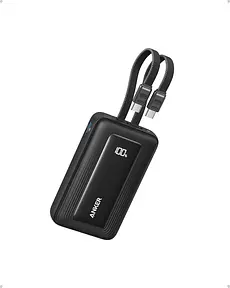
Anker Zolo Powerbank 20.000 mAh, 45 W Max
View at Amazon (as of Aug 11)Affiliate link. Buying through it earns us a commission; the price stays the same for you.
UGREEN Nexode, 20,000 mAh, the price argument
The cheapest of the four and the one with the broadest ratings base: €25.98, 4.6 out of 5 stars from 4,064 ratings on Amazon.de, as of 27 Aug 2026. One built-in USB-C cable, the same 45 W, the same 74 Wh.
Set those numbers next to a 5,000 mAh semi-solid-state power bank at around 60 US dollars and you get the real argument against the new technology. Per watt-hour, it currently costs several times as much.
UGREEN Nexode Power Bank 20000mAh 45W mit integriertem USB-C Kabel
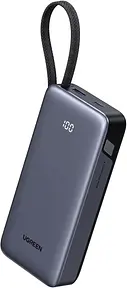
UGREEN Nexode Power Bank 20000mAh 45W mit integriertem USB-C Kabel
View at Amazon (as of Aug 11)Affiliate link. Buying through it earns us a commission; the price stays the same for you.
Baseus QPow3, 20,000 mAh, two cables and a display
At €35.99 the most expensive of the four, rated 4.6 out of 5 stars from 1,173 ratings on Amazon.de, as of 27 Aug 2026. Two built-in USB-C cables again, and 45 W. Baseus is interesting here for another reason too: the brand published its own blog post about graphene power banks in March 2026, and still advertises this model plainly on cables, watts and capacity.
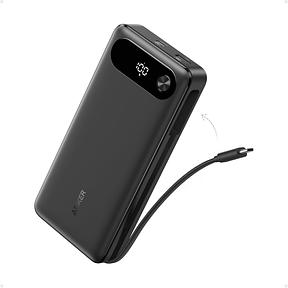
Not available in your region — closest match
View at Amazon (as of Aug 15)Affiliate link. Buying through it earns us a commission; the price stays the same for you.
INIU, 20,000 mAh, the compact one
€27.20, 4.6 out of 5 stars from 5,164 ratings on Amazon.de, as of 27 Aug 2026, one built-in USB-C cable and 45 W. The most reviews of the four, which says nothing about quality on its own and quite a lot about how widely it sold.
Not available in your region — closest match
View at Amazon (as of Aug 15)Affiliate link. Buying through it earns us a commission; the price stays the same for you.
The verdict: buy it for the form factor, not for the label
A solid state powerbank in 2026 is almost always a semi-solid-state powerbank: real, just a great deal smaller than the name suggests, and noticeably pricier per watt-hour. If 8 mm of thickness genuinely matters to you, say because the unit is meant to hang magnetically off a phone, that premium makes sense. If you need capacity for a trip, it doesn't.
The graphene question has a shorter answer in 2026. If a product advertises graphene and names no verifiable cell designation, you're buying a word.
What you can check is watt-hours, watts and the warranty. What's inside the cell, nobody will confirm independently for you right now.
All products from this post
The ones we named above are marked; the rest are alternatives in the same category.
Not available in your region — closest match
Anker Powerbank, 20.000mAh tragbares Ladegerät mit integriertem USB-C-Kabel, 87W Max Schnellladung, kompatibel mit MacBook, iPhone, Samsung und mehr
View at Amazon (as of Aug 15)
Not available in your region — closest match
Anker Powerbank, 20.000mAh tragbares Ladegerät mit integriertem USB-C-Kabel, 87W Max Schnellladung, kompatibel mit MacBook, iPhone, Samsung und mehr
View at Amazon (as of Aug 15)Affiliate notice: As an Amazon Associate, we earn from qualifying purchases. Product prices and availability are subject to change.
Frequently Asked Questions
What is a solid state powerbank?
A power bank whose cell uses a solid electrolyte instead of a liquid one. In practice, though, the term is used in 2026 for semi-solid-state cells, where the liquid fraction is only heavily reduced. The difference isn't cosmetic: a true all-solid-state cell contains no liquid at all.
Can you actually buy a true solid state power bank in 2026?
Not one that can be verified. No maker has a power bank with a genuine all-solid-state cell on shelves today. Even the car industry, sitting on billions in factory investment and the clearest published timeline, points to 2027 or 2028 at the earliest (Toyota, QuantumScape), premium segment only. Consumer electronics comes after that.
Is there really graphene in a graphene power bank?
Usually yes, but not as the storage medium. Graphene goes in as a conductive additive inside a conventional lithium cell, where it can improve internal resistance and heat dissipation. A standalone graphene battery still isn't a mass-market product. Buy a "graphene power bank" and you're technically getting an ordinary lithium cell with an additive at the electrode, not a new battery type.
Is a semi-solid-state power bank safer on a plane?
Not proven, only plausible. Less liquid electrolyte should mean less flammable material, but nobody has independently measured that against a classic cell yet. It makes no difference at security either way: ICAO rules count watt-hours and units, never cell chemistry.
Is solid state or graphene worth paying extra for?
Only if you need the form factor. The demonstrable advantage of current semi-solid-state models is thinner and lighter at the same capacity, not more capacity or faster charging. Per watt-hour you pay considerably more than for a classic 20,000 mAh unit rated at 74 Wh.
Sources
- Wikipedia sums the distinction up cleanly en.wikipedia.org
- according to industry reporting eepower.com
- a full charge in 19 minutes thanks to graphene technology notebookcheck.net
- Xnergy xnergy.us
- IEEE Spectrum spectrum.ieee.org
- a long thread on the EEVblog forum eevblog.com
- assessed the unit for 9to5Mac on 8 May 2026 9to5mac.com
- Android Authority covered it on 5 June 2026 androidauthority.com
- International Civil Aviation Organization (ICAO) icao.int