Power Station Motorhome: What Capacity, Which Ports?
 15 min read
As of: 27.08.2026
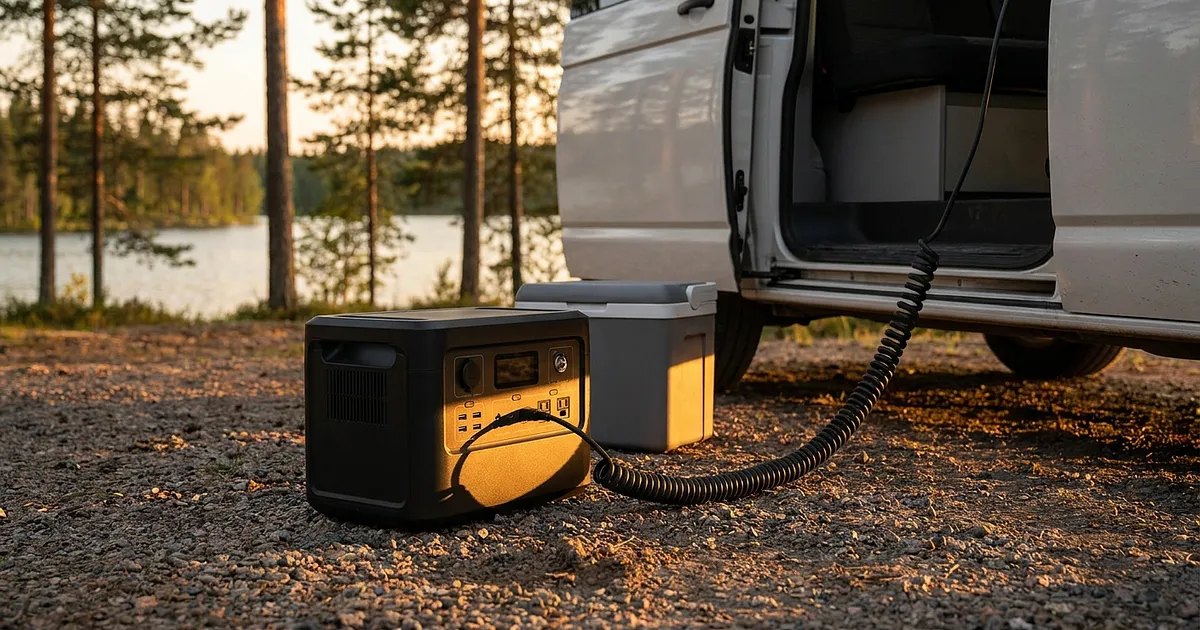
Two numbers decide which power station belongs in your motorhome. One of them is printed on the box in large type: the watt-hours. The other one sits at the bottom of the spec sheet and is called the port list, and in practice it's the one that decides whether the unit actually fits your vehicle.
Search for "power station motorhome" or "power station camping" and you'll land on a ranked list with no arithmetic behind it. Those lists read fast. They just don't answer the question you actually came with: is this enough for two nights by a lake, or for a week with no hookup post in sight?
How much power station capacity does your motorhome actually need?
The general arithmetic from watt-hours to real runtime lives in our sizing guide, "Sizing a power station: from watt-hours to real runtime". This piece only covers the camping half of it: the loads that genuinely stack up in a motorhome, and how many days they have to run.
One anchor first. The ADAC, Germany's largest motoring association, states that a 1,000 Wh power station runs a cool box for roughly 20 hours or charges a smartphone about 66 times. Keep that order of magnitude in mind before you add anything up. It heads off the two most common bad purchases, in both directions.
The cool box is almost always the biggest single item. And it isn't a fixed number.
A 48-hour comparison by planmycamper.de at 30 °C ambient (updated 12.07.2026) measured a spread from 214.5 Wh for the most frugal box in the field, the Maentum IceCube X50, up to 465.6 Wh for the thirstiest, the Mobicool FR40. The Engel MR040F sat at 254.1 Wh and the Truma Cooler C43 at 273.9 Wh. That's more than a factor of two between best and worst under identical conditions. The same source gives a rule of thumb of 15 to 45 Wh per hour.
Which means your cool box helps decide which power station you have to buy. Not your travel style. That single number is what ends up deciding which power station for your motorhome actually makes sense.
The Wh budget for a weekend and for a week
| Load | Assumption | Weekend (2 days) | Week (7 days) | Where the number comes from |
|---|---|---|---|---|
| Compressor cool box | frugal model, 30 °C | 215 Wh | 750 Wh | planmycamper.de, 48h measurement, 12.07.2026 |
| Compressor cool box | thirsty model, 30 °C | 466 Wh | 1,630 Wh | planmycamper.de, 48h measurement, 12.07.2026 |
| Smartphone, 2 people | 4 charges total | approx. 60 Wh | approx. 210 Wh | derived from 1,000 Wh / 66 charges (ADAC, 11.06.2025) |
| Laptop | 60 W charger, 2 h/day | approx. 120 Wh | approx. 420 Wh | our own arithmetic, nameplate wattage |
| LED lantern | 3 W, 4 h/day | approx. 24 Wh | approx. 84 Wh | our own arithmetic, nameplate wattage |
| Total, frugal box | approx. 420 Wh | approx. 1,460 Wh | ||
| Total, thirsty box | approx. 670 Wh | approx. 2,290 Wh |
Two caveats before you reuse that table anywhere.
First, there's no independent camping-context measurement for laptops and camping lanterns that we could cite. So those rows are pure nameplate arithmetic, wattage times hours, flagged as derived. A 60 W charger rarely pulls a continuous 60 W in real use. Treat the figure as a ceiling, not a measurement.
Second, conversion losses aren't in there. What leaves the cell and what arrives at the socket are not the same number. Add headroom, or read the derivation in the sizing guide.
Weekend trips with very little tech
Drop the cool box and the whole calculation changes. Phones, one lantern, maybe a camera battery: that's roughly 100 Wh across two nights, and at that point a 1,000 Wh unit is dead weight in the rear locker.
If you're settling on this class: the Anker SOLIX C300X brings 288 Wh LiFePO4 and 300 W continuous output (manufacturer figures), currently €242.08 on Amazon.de (as of 27.08.2026). For phones, a laptop, lights and camera batteries over a weekend, that's enough.
What it isn't enough for: a compressor cool box across two days. Even the most frugal box in the measurement above, at 215 Wh, would only just make it and would be flat by Sunday morning. The thirsty one, at 466 Wh, blows past the capacity on day one. If the box comes along, this class is the wrong purchase.
Anker SOLIX C300X Tragbare Powerstation, 288Wh LiFePO4 Akku, 300W, Camping
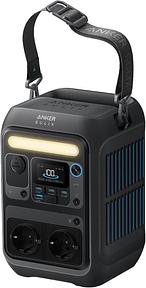
Anker SOLIX C300X Tragbare Powerstation, 288Wh LiFePO4 Akku, 300W, Camping
View at AmazonAffiliate link. Buying through it earns us a commission; the price stays the same for you.
A week off-grid: the 1,000 Wh class
Once the cool box runs continuously and there's no hookup post nearby, you're in the class the ADAC tested in 2025: eight units between 768 and 1,440 Wh, up to 17 kg, up to 2,200 W continuous output, priced at roughly €700 to €1,500 RRP at the time.
Right in the middle of that class: the BLUETTI Elite 100 V2, 1,024 Wh LFP, two AC outputs rated 1,800 W together (manufacturer figures), at €699.00 on Amazon.de (as of 27.08.2026). Against the budget in the table above it falls just short of a full week with a frugal box. With a solar panel on the roof it doesn't, which is exactly why the solar input further down isn't a side note.
And 17 kg is not a detail, by the way. In a motorhome every kilo counts against your permitted gross weight, permanently.
BLUETTI Elite 100 V2 (2025) Tragbare Power Station, 1024Wh LFP, 1800W AC
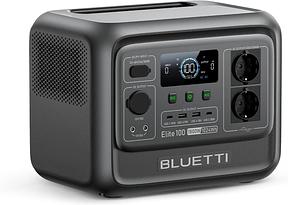
BLUETTI Elite 100 V2 (2025) Tragbare Power Station, 1024Wh LFP, 1800W AC
View at Amazon (as of Aug 27)Affiliate link. Buying through it earns us a commission; the price stays the same for you.
Which ports does your motorhome's power station actually need?
Four ports turn any power station into one that actually works in a motorhome, and each has one clear reason to be there. The order below is by how often you'll use them, not by importance.
230 V: the socket on the unit itself
This is the port for anything you'd plug into a wall at home. Laptop charger, camera charger, at a push the coffee machine.
Two numbers count: continuous output in watts, and surge. A 2,000 W kettle won't start on a unit rated 300 W continuous, no matter how many watt-hours are inside. Capacity and power output are different things, and ranked lists mix them up constantly.
This socket on the housing has nothing to do with feeding the vehicle's wiring, more on that below. That's the part most people get wrong.
USB-C with Power Delivery
Phones, tablets, modern laptops. Anything with a USB-C cable should go straight into the power station instead of detouring through a 230 V charger. Every conversion step costs energy, and across a week it adds up.
Look at the wattage per port rather than the number of ports. A laptop that charges over USB-C generally wants Power Delivery at 65 W minimum, realistically 100 W. Why the 100 W mark keeps coming up with laptops is covered in our piece on power banks for laptops.
The 12 V output
The least glamorous of the four, and the one you'll use most in a motorhome. Compressor cool boxes run on 12 V. So do fans, water pumps and most camping lamps.
Running a 12 V cool box off the 230 V socket through its own mains adapter means converting twice: cell to 230 V, then back down to 12 V. Use the 12 V output and one of those steps disappears, and over a week of continuous running that stops being a rounding error.
Whether your unit is allowed to carry the box's current continuously on that output is a manual question. Not every car socket is rated for sustained load.
Solar input, plus a warning from the ADAC
If a week off-grid is the goal, there's no way around the solar input. With no way to top up, any power station is just a tank of fixed size.
The EF ECOFLOW DELTA 3 Classic at 1,024 Wh (manufacturer figure) costs €549.00 on Amazon.de (as of 27.08.2026), roughly €150 below the Bluetti unit in the same capacity class. How much panel wattage makes sense comes down to your roof area rather than to the unit.
Now the warning that barely appears in any buying guide. In the 2025 ADAC test, two of eight models failed on safety grounds, partly because their two DC inputs were not isolated from one another. The ADAC spells out the risk: charging from a solar panel and from the vehicle's 12 V socket at the same time risks overvoltage that can damage the vehicle's electrical system. In a motorhome that combination is the normal case, not the exception.
Check the manual for whether your unit explicitly permits simultaneous charging on both DC inputs. If it says nothing, charge them one at a time.
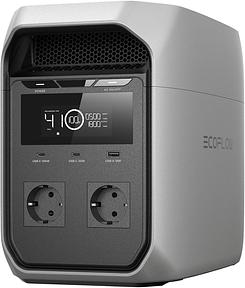
EF ECOFLOW DELTA 3 Classic Tragbare Powerstation 1024 Wh
View at AmazonAffiliate link. Buying through it earns us a commission; the price stays the same for you.
Connecting a power station to a motorhome: CEE, RCD and the floating output
This is the part worth slowing down for.
Standing a power station next to the bed and plugging in a laptop is trivial. Feeding its energy into the motorhome's fixed 230 V ring so the built-in sockets come alive is something else entirely. And the obvious solution is the wrong one.
What the CEE standard requires
The blue CEE plug you know from every campsite is standardised Europe-wide under IEC 60309, according to Reisemobil International. It's rated 16 A at 230 V, so up to 3,680 W with the cable reel fully unwound. The spec also calls for IP44 as a minimum, a conductor cross-section of at least 2.5 mm² in H07RN-F rubber cable, and a maximum length of 25 m. In Germany, campsite electrical installations fall under DIN VDE 0100-708.
The figure that tends to get lost: leave the reel wound and the permissible continuous load drops to roughly 1,000 W. That isn't a suggestion. It's a fire risk.
And you're not allowed to use a Schuko adapter for feeding the vehicle itself, per PiNCAMP by ADAC (31.05.2026). For a single appliance off a cable reel, Schuko is fine. For the vehicle feed, it isn't.
Why a standard RCD adapter isn't enough
This is where most guides stop, and it's the most important paragraph here.
As solarkontor.de explains (29.08.2025), a simple residual current device of the kind built into many manufacturers' standard cables often doesn't work reliably in this scenario. The reason sits at the power station's output: it's a floating output, with no fixed earth reference. A normal RCD is built to detect fault currents against a fixed earth reference, and a power station's inverter doesn't provide one the way shore power does.
What a feed-in cable needs, per the same source: an RCD specifically designed for floating sources, with protective earth (PE) and neutral (N) kept separate.
"My power station has a socket and I own an RCD adapter, so I'm covered" is probably the most dangerous assumption in this whole topic. It looks right. It feels right. It isn't.
If you only ever run appliances directly off the power station, none of this applies to you. If you want to feed the vehicle's wiring, the cable is a safety component with its own specification rather than an extension lead, and when in doubt it belongs to somebody who knows vehicle electrics.
Power station, shore power or leisure battery?
Honestly? If you only ever stay on serviced pitches, you probably don't need one.
Shore power is unlimited, adds no weight, and delivers the 3,680 W that no portable unit in this size class sustains. The leisure battery covers the rest while you're driving and the alternator tops it up.
An extra power station gets interesting in four situations:
You regularly stay off-grid for more than one night.
Your leisure battery is an older lead-acid unit, where you can realistically draw only about half the rated capacity.
You want power away from the vehicle too, on the beach, at the grill, in the awning.
You want 230 V without having an inverter permanently installed, which means a workshop bill and a change to the vehicle's wiring.
If none of that describes you, keep the money. That recommendation is here because it isn't anywhere else.
The four units in this piece, side by side
Before you pick from the table below, it's worth reading how these units actually perform against each other in independent testing rather than on spec sheets alone: our comparison of Jackery, EcoFlow, Bluetti and Anker covers all of that in full. This table only shows which of these four suits which motorhome trip.
| Model | Capacity (manufacturer) | AC continuous | Price (Amazon.de, 27.08.2026) | Suits |
|---|---|---|---|---|
| Anker SOLIX C300X | 288 Wh LiFePO4 | 300 W | €242.08 | weekend without a cool box |
| EcoFlow Delta 3 Classic | 1,024 Wh | not stated | €549.00 | a week with solar top-up |
| BLUETTI Elite 100 V2 | 1,024 Wh LFP | 2 × 1,800 W | €699.00 | a week off-grid, heavier loads |
| Jackery E1000 v2 | 1,070 Wh | 1,500 W | €349.00 | see the note below |
All four carry the four ports from the section above according to their manufacturers: 230 V socket, USB-C with Power Delivery, 12 V output and solar input. Prices are from Amazon.de, they move constantly, and they're valid for 27.08.2026.
The cheapest route into the 1,000 Wh class, with one caveat
Roughly €350 cheaper than the Bluetti unit, at practically the same capacity: the Jackery E1000 v2 comes in at 1,070 Wh and a 1,500 W AC output (manufacturer figures), €349.00 on Amazon.de (as of 27.08.2026), by a wide margin the cheapest 1,000 Wh-class unit in this group.
There's a finding attached to it that we're not leaving out. Under the name Jackery Explorer 1000 v2 this model carries a grade of 5.0 from the ADAC test of 11.06.2025, one of two units that failed in that field. The stated reason is the DC inputs not being isolated from one another, which is precisely the scenario from the solar section above. Why we lean on the ADAC here rather than Stiftung Warentest is covered in our look at where Warentest's power-station testing actually stands: the page carries a recent revision date, but the last real measurement dates back to 2023. We have no manufacturer statement and no information about a changed revision. The moment one exists, it goes here.
That's a finding about this unit from this one test, not a verdict on the brand. What you do with it is your call, and you should make that call with the information rather than without it.
Jackery E1000 v2 Tragbare Powerstation, 1070Wh, 1500W AC-Ausgang, LiFePO4
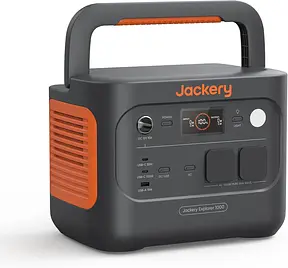
Jackery E1000 v2 Tragbare Powerstation, 1070Wh, 1500W AC-Ausgang, LiFePO4
View at Amazon (as of Aug 11)Affiliate link. Buying through it earns us a commission; the price stays the same for you.
Final thought
Don't buy the largest power station for your motorhome that your budget allows. Buy the one whose watt-hours match your Wh budget and whose back panel carries all four ports.
And if you genuinely intend to feed the vehicle's wiring: the price gap between any old RCD adapter cable and one built for a floating output is the cheapest part of this entire project.
If converting between mAh and Wh trips you up, the formula and its most common error are in our piece on converting mAh to Wh.
All products from this post
The ones we named above are marked; the rest are alternatives in the same category.
Affiliate notice: As an Amazon Associate, we earn from qualifying purchases. Product prices and availability are subject to change.
Frequently Asked Questions
Which power station suits a motorhome?
Honestly, it comes down to two things: your Wh demand per day, and whether you stay off-grid. Without a cool box, under 300 Wh often covers a weekend. Run a compressor cool box continuously for a week with no hookup and you're in the 1,000 Wh class the ADAC tested in 2025. Having all four ports matters more than the badge on the front, that's the real checklist.
How many watt-hours do I need for camping?
Simplest way: add up your loads individually and multiply by travel days. The biggest item is almost always the compressor cool box: a 48-hour comparison of five models at 30 °C measured between 214.5 and 465.6 Wh over two days. For a weekend with a box, phones, a laptop and lights, you'll land roughly between 400 and 700 Wh, rarely more.
Can I connect a power station directly to my motorhome?
Depends what you mean. Plugging appliances into the power station's own socket is straightforward. Feeding the fixed 230 V wiring is a different story: a CEE cable is required, a Schuko adapter for the vehicle feed is not permitted, and an off-the-shelf RCD adapter often fails to protect a floating power station output reliably. That cable is a safety component, not an afterthought.
Which ports should a camping power station have?
Four. A 230 V socket for anything with a mains plug, USB-C with Power Delivery for phone and laptop, a 12 V output for the cool box and water pump, and a solar input for topping up on the move. Without the 12 V output you convert twice for the cool box, and across a week that costs more energy than you'd think.
Is a power station worth it alongside shore power and a leisure battery?
Honestly? If you're always on a serviced pitch, probably not. Shore power delivers up to 3,680 W and never runs out. It gets worthwhile if you regularly stay off-grid, your leisure battery is old, you want power away from the vehicle, or you want 230 V without having an inverter installed.