The New Power Bank Rules Since 27 March 2026: What ICAO Actually Requires
 16 min read
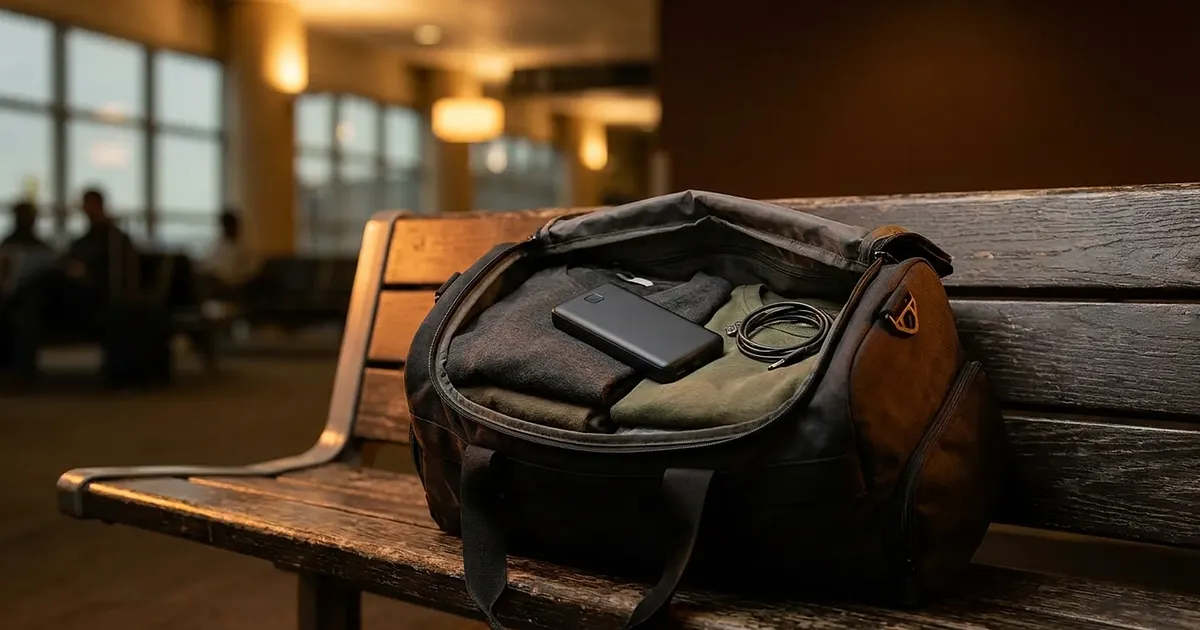
New worldwide rules for power banks on aircraft took effect on 27 March 2026, published by the International Civil Aviation Organization as an addendum to its Technical Instructions. Most of the coverage that followed carries the same mistake: it turns a recommendation into a ban.
The difference hangs on one word. ICAO writes "must not" in one line and "should not" two lines later. One binds you, the other does not. Report both as prohibitions and you are telling people something about their flight that the rulebook does not say.
As of 30.03.2026. Everything below comes from the ICAO addendum itself, the German Federal Aviation Office's published translation of the same table, and IATA's operator guidance of 31/03/2026. One date here is already scheduled to change things again: 1 January 2027.
What applies since 27 March 2026
The governing document is Doc 9284-AN/905, Technical Instructions, 2025–2026 Edition, Addendum No. 1, dated 27/3/26. Its cover page states plainly: "is applicable from 27 March 2026."
The addendum gives power banks their own entry in Table 8-1; until then they rode along under "spare batteries". Five provisions sit in it, and they do not carry equal weight:
| Provision | Wording in the original | Force |
|---|---|---|
| Carriage in the cabin | "must be carried as carry-on baggage" | mandatory |
| Recharging the power bank on board | "must not be recharged while on board the aircraft" | mandatory — prohibited |
| Charging your phone from it | "should not be used to recharge a portable electronic device while on board the aircraft" | recommendation only |
| Maximum per person | "no more than two power banks may be carried per person" | mandatory |
| Short-circuit protection | "must be individually protected so as to prevent short circuits when not in use" | mandatory |
Power banks remain banned from checked baggage — not new in 2026, that was already in the table.
A compact unit like the INIU Ultra Mini Powerbank 10.000 mAh, 45 W sits at roughly 36 Wh, well clear of any approval question — though its small capacity changes nothing about the two-unit cap or the carry-on-only rule.
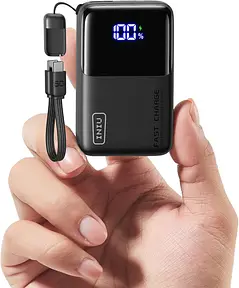
INIU Ultra Mini Powerbank 10.000 mAh, 45 W
View at Amazon (as of Aug 11)Affiliate link. Buying through it earns us a commission; the price stays the same for you.
One word separates a ban from a recommendation
Germany's Luftfahrt-Bundesamt publishes the German text of the same table, explicitly marked as Ausgabe 2025-2026 ADDENDUM NO. 1. The two decisive lines sit directly beneath one another:
— dürfen an Bord des Flugzeugs nicht aufgeladen werden;
— sollten an Bord des Flugzeugs nicht zum Aufladen eines tragbaren elektronischen Geräts verwendet werden;
"Must not" and "should not" are not a stylistic variation in dangerous goods law. In ICAO's Technical Instructions must marks a requirement and should a recommendation, and the German translation reproduces that split exactly.
In practice: recharging the power bank from an aircraft socket is globally prohibited since 27 March 2026. Charging your phone from it is not — unless your airline wrote stricter rules of its own. Several have.
IATA's own guidance for operators dated 31/03/2026 lists only three changes: "separate out power banks from spare batteries", "limit passengers (and crew) to two power banks for personal use" and "prohibit passengers recharging the power bank in flight". A ban on use does not appear in that list.
Charge your phone from something like the Anker Zolo Powerbank 20.000 mAh, 45 W Max and, under ICAO's own wording, you are breaking a recommendation, not a rule — your airline is free to make it a rule anyway.
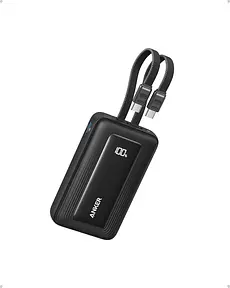
Anker Zolo Powerbank 20.000 mAh, 45 W Max
View at Amazon (as of Aug 11)Affiliate link. Buying through it earns us a commission; the price stays the same for you.
How it got here
Europe's regulator moved earlier and went further. EASA's Safety Information Bulletin 2025-03, issued 27 May 2025, recommended operators impose a "prohibition of use power banks to charge electronic devices during the flight" — on a document whose every page reads "This is information only. Recommendations are not mandatory."
So EASA recommended a use ban in May 2025 that ICAO, ten months later, adopted only as a recommendation. The same bulletin still classed power banks with spare batteries: "Power banks are not PEDs - they are spare batteries." That classification is precisely what the March 2026 addendum undid.
The 100-to-160 Wh contradiction nobody writes down
Here it gets messy, and the mess sits inside one document. Three sources describing the same addendum say three different things about power banks between 100 Wh and 160 Wh:
| Source | What it says | Dated |
|---|---|---|
| ICAO Addendum No. 1, Table 8-1 item c) | "each battery may exceed 100 Wh but not exceed 160 Wh Watt-hour rating for lithium ion with the approval of the operator" — and the closing note applies items b) to e) explicitly to power banks | 27.03.2026 |
| IATA guidance, Appendix B, row "Power bank" in the >100 to ≤160 Wh band | Forbidden — while "Spare battery(ies)" in the same band stays permitted with operator approval, up to two | 31.03.2026 |
| Luftfahrt-Bundesamt, passenger page | "mit Genehmigung des Betreibers jede Batterie 100 Wh übersteigen, jedoch höchstens 160 Wh haben", plus a maximum of two spare batteries per person | no date shown on the page |
IATA explains the contradiction in its own body text, and it is the most important sentence in the document: "The addendum provides for passengers to carry power banks of 100-160 Wh with the approval of the operator; however, given the concerns with regulatory oversight of power bank manufacturers and the limitation to 100Wh of power banks for crew in the performance of their operational duties, this provision will not be carried into the 68th edition of the DGRs."
Put plainly: ICAO permits it, IATA thinks that is wrong and is deleting it from the next edition of its own rulebook. The same page records that the guidance "will not be effective beyond 31 December 2026" and that the 68th edition of the Dangerous Goods Regulations enters into force on 1 January 2027.
What to take from that: a power bank above 100 Wh is a negotiation, not an entitlement. The legal instrument allows it with airline consent; the table ground staff work from lists it as forbidden. Buy in that band today and you buy a device that loses its basis in the IATA rules on 1 January 2027 — see our piece on the 160 Wh exception disappearing.
Above 160 Wh there is no ambiguity. IATA's table states such batteries must be "prepared and transported as cargo in accordance with the IATA Dangerous Goods Regulations". They are not permissible as passenger baggage in any form.
Crew face a tighter limit
The addendum's new paragraph 2.2.2 requires that power banks an airline brings on board for its crew "not exceed a Watt-hour rating of 100 Wh". There is no 160 Wh option for crew equipment at all, and IATA cites exactly that mismatch as one of its reasons for scrapping the passenger allowance.
ICAO's announcement of 27 March 2026 confirms crew may continue to carry and use power banks in line with the aircraft's operational requirements. So if you see someone using one in flight, that is not the rule being broken.
A unit like the Anker Laptop Powerbank 25.000 mAh, 165 W, which the manufacturer itself rates at 90 Wh, is unaffected by that crew ceiling: as passenger baggage it sits comfortably inside the 100 Wh line.
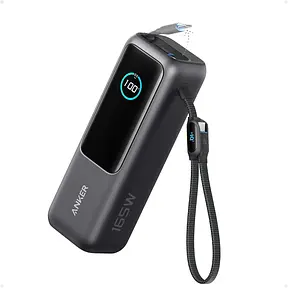
Anker Laptop Powerbank 25.000 mAh, 165 W
View at Amazon (as of Aug 11)Affiliate link. Buying through it earns us a commission; the price stays the same for you.
What individual airlines do with it
The ICAO text is a floor, not a finished answer. Airlines may be stricter, and several already were before 27 March 2026 — this rule travelled upward from national regulators and carriers, not down from ICAO. An addendum is also not yet national law: IATA notes enforceability depends on each state, "for some States, it is immediate; some require a short administrative period, and some will require public notification and legislative amendment." In practice, your airline's rule is the one enforced at the gate.
| Operator | Rule | Effective | Evidence |
|---|---|---|---|
| South Korea (MOLIT) — incl. Korean Air, Asiana | Power bank kept on the person, not in overhead bins; no charging in flight | 01.03.2025 | Ministry of Land, Infrastructure and Transport, reported by aerotime and korea.net |
| EASA (recommendation, not binding) | Recommended the use ban that ICAO later adopted only as should | 27.05.2025 | SIB 2025-03, above |
| China (CAAC) | Power banks without CCC marking, with unclear marking, or from recalled batches are barred on domestic flights | 28.06.2025 | CAAC notice |
| Emirates | One power bank under 100 Wh; no use on board; no charging from aircraft power; stowed in the seat pocket or under the seat, not in overhead bins | 01.10.2025 | Emirates media centre |
| Lufthansa Group (Lufthansa, SWISS, Austrian, Eurowings, Discover, Brussels, Edelweiss, Air Dolomiti) | Use and charging on board prohibited; maximum two; not in overhead bins | 15.01.2026 — ten weeks before ICAO | see the note below |
| ICAO (global floor) | Recharging prohibited, use only "should not", maximum two | 27.03.2026 | Addendum No. 1 |
⚠️ About the Lufthansa row, stated openly: the airline's own pages at
business.lufthansagroup.comandeurowings.comblock automated retrieval and returned HTTP 403 on every attempt. We have not read those pages ourselves. The entries above rest on trade press and consumer organisations that report the 15 January 2026 date consistently — among them infranken.de and the ADAC. The Lufthansa Group's own notice is published under the title "Powerbanks an Bord: aktualisierte Regelungen ab dem 15. Januar 2026" at business.lufthansagroup.com. Open it in a browser and check it before you fly.
A use ban at Condor circulates widely but could not be substantiated; only carriage limits are confirmed there. No reliable primary source could be reached for Singapore Airlines, Ryanair or easyJet, so they are absent. A figure we could not verify is one we would rather not print.
The two-unit cap counts each device on its own — two of the Anker Powerbank, 20.000mAh tragbares Ladegerät mit integriertem USB-C-Kabel, 87W Max Schnellladung, kompatibel mit MacBook, iPhone, Samsung und mehr, each around 72 Wh by our calculation, is already the maximum the Lufthansa Group or Emirates will let through.
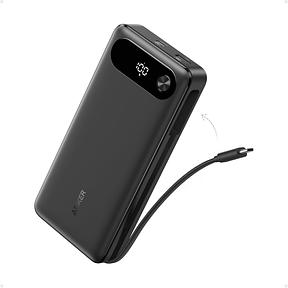
Affiliate link. Buying through it earns us a commission; the price stays the same for you.
The China trap applies to one leg, not the whole trip
The CAAC rule is the only one here that depends on a property of the device rather than on your behaviour. It requires Chinese CCC certification, a printed conformity mark that a power bank bought in Europe usually does not carry.
The scope is what matters: CAAC applies it to domestic flights. A Frankfurt–Shanghai sector is unaffected; the onward Shanghai–Xi'an sector is not. Check only the rules of the airline you leave Europe with, and you miss precisely the leg where the device gets confiscated.
What this is not: the 30 % charge rule is about cargo
A claim has circulated since early 2026 that lithium batteries may only travel charged to 30 %. That requirement sits in the 67th edition of the IATA Dangerous Goods Regulations and binds air cargo shippers. It does not apply to your hand luggage.
State of charge does appear on the passenger side, but far more weakly: IATA records that an airline may, as a safety measure, require multiple spare batteries to be separated or carried at a low state of charge — "(<25% indicated charge when inserted into the device)". That is an operator option in approval cases, not a general obligation, and not a 30 % limit.
Cargo and passenger rules live in separate parts of the same rulebook, and mixing them is the most common error in this subject.
Six listings, six times the wrong unit
The rule is written in watt-hours. Retail sells in milliamp-hours. That gap between regulation and purchase only surfaces at the gate.
We went through the Amazon.de listings for six common power banks to see whether they state capacity in watt-hours — the unit Table 8-1 is written in. Exactly one of six does. The Wh columns below are therefore not seller figures but our own conversion from the mAh number in the listing title.
The formula appears in none of the listings: Wh = mAh × cell voltage ÷ 1000. Cell voltage is the catch. Both 3.6 V and 3.7 V are common, and no listing title says which applies.
| Model | mAh per listing title | Wh stated by seller | Wh calculated (3.6 V) | Wh calculated (3.7 V) | Under 100 Wh? |
|---|---|---|---|---|---|
| INIU Ultra Mini, 45 W | 10,000 mAh | not stated | 36.0 Wh | 37.0 Wh | yes, comfortably |
| Anker Zolo, 45 W Max | 20,000 mAh | not stated | 72.0 Wh | 74.0 Wh | yes |
| Anker, 87 W Max | 20,000 mAh | not stated | 72.0 Wh | 74.0 Wh | yes |
| INIU Laptop, 100 W | 25,000 mAh | not stated | 90.0 Wh | 92.5 Wh | yes |
| Anker Laptop, 165 W | 25,000 mAh | 90 Wh | 90.0 Wh | 92.5 Wh | yes |
| INIU Laptop, 140 W | 27,000 mAh | not stated | 97.2 Wh | 99.9 Wh | yes, by 0.1 Wh |
Every mAh value is a seller figure from the listing title, not a measured value. One ASIN can carry several variants — check the product page before buying. Prices move daily and sit on the product cards, not in this table.
Anker calculates at 3.6 V. The one seller publishing its own Wh figure gives exactly 90 Wh for 25,000 mAh, which is 25,000 × 3.6 ÷ 1000. At 3.7 V the same cell reads 92.5 Wh — one device, two numbers.
At 27,000 mAh the convention decides. 97.2 Wh or 99.9 Wh depending on the voltage assumed, so the margin shrinks from 2.8 Wh to 0.1 Wh. That is why the figure printed on the casing governs, not your arithmetic on a listing title.
All six stay under 100 Wh either way and need no airline approval — given the 100-to-160 Wh contradiction, the quieter option.
The tightest margin in our table belongs to the INIU Laptop Power Bank 27.000 mAh, 140 W: depending on which cell voltage you assume, it clears the 100 Wh line by as little as 0.1 Wh.
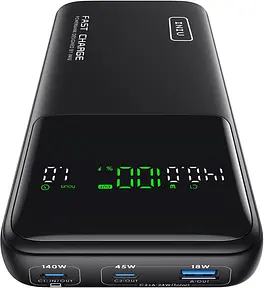
INIU Laptop Power Bank 27.000 mAh, 140 W
View at Amazon (as of Aug 11)Affiliate link. Buying through it earns us a commission; the price stays the same for you.
What to do before you fly
Read the watt-hours off the casing, don't derive them from a listing title. The rulebook works exclusively in Wh. How to convert safely is in our guide to converting mAh to Wh.
Two devices, no more. The two-unit limit is mandatory, not advisory, and counts per person.
Cabin bag, within reach. Lufthansa Group and Emirates additionally require the device stays out of the overhead bin.
Tape the terminals, or keep the retail packaging. Short-circuit protection is mandatory and does get checked at the gate.
Above 100 Wh, ask in writing beforehand. A verbal yes at the check-in desk will not help you much at the gate.
Check connecting flights separately. Domestic sectors in China and South Korea carry their own rules that your first operating carrier does not answer for.
Which limits apply at which airline is set out in our overview of power banks in hand luggage.
If you'd rather not think about it, something like the INIU Laptop Power Bank 25.000 mAh, 100 W stays comfortably under the limit at roughly 90 Wh calculated and needs no airline approval at all.
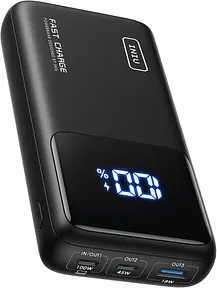
INIU Laptop Power Bank 25.000 mAh, 100 W
View at Amazon (as of Aug 10)Affiliate link. Buying through it earns us a commission; the price stays the same for you.
In short
Since 27 March 2026: two power banks at most, cabin baggage only, protected against short circuits, and no recharging on board. Using one to charge your phone is a recommendation globally — though the Lufthansa Group and Emirates prohibit it anyway, being stricter than the floor.
The point that has barely reached the coverage is the 100-to-160 Wh contradiction: permitted in ICAO's text, "Forbidden" in IATA's table, and deleted on 1 January 2027 regardless. Buying that size today means buying an expiring entitlement.
All products from this post
The ones we named above are marked; the rest are alternatives in the same category.
Affiliate notice: As an Amazon Associate, we earn from qualifying purchases. Product prices and availability are subject to change.
Frequently Asked Questions
Can I still use my power bank on a plane?
Under the ICAO addendum of 27 March 2026 the wording is that you "should not" use it to charge a device on board. That is a recommendation, not a worldwide ban. Individual airlines go further: the Lufthansa Group has prohibited use since 15 January 2026 and Emirates since 1 October 2025. Your airline's rule is what governs, not the global floor.
Can I recharge the power bank from an aircraft socket?
No. This is the point where ICAO writes "must not", making it a genuine requirement rather than advice. Recharging a power bank from aircraft power is prohibited on all flights regardless of airline. Only the use of a power bank to charge other devices is phrased as a recommendation.
How many power banks may I take?
Two per person at most, and that limit is binding. They must travel in carry-on baggage; checked baggage remains prohibited. Emirates allows only a single power bank under 100 Wh, in force since 1 October 2025. Check your airline's rule before packing two.
Are power banks between 100 and 160 Wh allowed?
That is the contradiction in this ruleset. ICAO's text permits them with operator approval, while the operational table in IATA's guidance of 31/03/2026 marks power banks in this band as "Forbidden". IATA states itself that the exception will not carry into the 68th edition of its rules, which takes effect on 1 January 2027.
What changes on 1 January 2027?
The 68th edition of the IATA Dangerous Goods Regulations enters into force. According to IATA, the allowance for power banks between 100 and 160 Wh will not be included in it. The current guidance document explicitly does not apply beyond 31 December 2026. Anyone buying a power bank in that size should factor this in.
Does the 30 % charge limit apply to my hand luggage?
No. The requirement to transport lithium batteries charged to no more than 30 % sits in the 67th edition of the IATA Dangerous Goods Regulations and is addressed to air cargo shippers. It does not apply to passengers. An airline may require a low state of charge for spare batteries that need approval, but that is a case-by-case measure.
Do I need a special power bank for China?
On Chinese domestic flights, yes. The aviation regulator CAAC has barred power banks without a CCC mark, with an unclear mark, or from recalled batches since 28 June 2025. Devices bought in Europe usually do not carry that mark. Your international inbound flight is unaffected; the domestic connecting sector is not.
Sources
- Doc 9284-AN/905, Technical Instructions, 2025–2026 Edition, Addendum No. 1 icao.int
- Ausgabe 2025-2026 ADDENDUM NO. 1 lba.de
- guidance for operators dated 31/03/2026 iata.org
- Safety Information Bulletin 2025-03 ad.easa.europa.eu
- passenger page lba.de
- announcement of 27 March 2026 icao.int
- CAAC notice caac.gov.cn
- Emirates media centre emirates.com
- infranken.de infranken.de
- business.lufthansagroup.com business.lufthansagroup.com