Power Banks in Carry-On: Airline Rules, Watt-Hour Limits and the Capacity Calculator
 18 min read
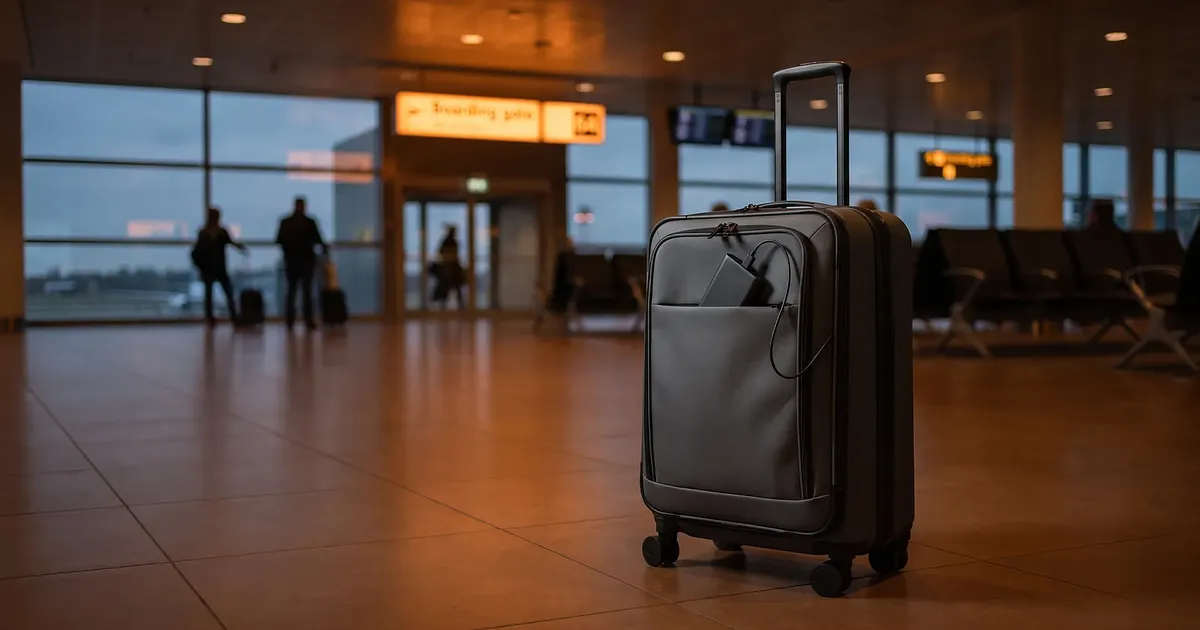
Nobody stands at the gate with a calculator. Yet one piece of arithmetic decides whether your power bank flies: aviation does not care about milliamp-hours, it cares about watt-hours. The packaging almost always prints the first number and almost never the second.
There is a second problem, and it is new since the start of 2026. Two layers of rules now exist side by side: a worldwide minimum, and the stricter house rules that individual airlines have adopted on top of it. Read only one of the two and you either pack far more cautiously than you need to, or you travel with a device your airline no longer accepts. That is also why two perfectly reliable German sources can read like a contradiction to anyone who is not a dangerous-goods officer.
This article separates the two layers, runs the limits against actual products, and states for every airline when the entry was last checked. All figures as of 8 April 2026.
What has applied worldwide since 27 March 2026
The International Civil Aviation Organization published an addendum to its dangerous-goods instructions on 27 March 2026, and it took effect the same day. The text is Addendum No. 1 to Doc 9284-AN/905, reproduced in full as Appendix C of IATA's guidance document for operators dated 31 March 2026.
IATA summarises the addendum in three bullets, verbatim: it will "separate out power banks from spare batteries", "limit passengers (and crew) to two power banks for personal use", and "prohibit passengers recharging the power bank in flight".
One word in that text carries an unusual amount of weight, and it is routinely flattened in consumer coverage. The amended Table 8-1 distinguishes must not from should not:
| Action | ICAO wording (Addendum 1, 27 March 2026) | Status |
|---|---|---|
| Recharging the power bank on board | "must not be recharged while onboard the aircraft" | binding prohibition |
| Charging your phone from it | "should not be used to recharge a portable electronic device while onboard the aircraft" | recommendation only |
| Carrying more than two | "no more than two power banks may be carried per person" | binding |
| Carriage in checked baggage | "must be carried as carry-on baggage" | binding |
| Short-circuit protection | "must be individually protected so as to prevent short circuits when not in use" | binding |
So the only binding restriction on use is that you may not top the power bank itself up. Charging your phone from it is, at the global level, advice — and that is exactly the gap the stricter airline policies moved into.
The addendum also names a figure that matters to frequent flyers: power banks an airline supplies to its own crew for operational duties must not exceed 100 Wh, with no upward exception at all.
A model like the INIU Powerbank 10000mAh 22.5W Kompakt shows how small that can be in practice: at roughly 36 to 37 Wh it sits far below every limit named here, and it is easy enough to protect individually the way the rule requires.
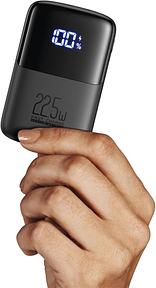
INIU Powerbank 10000mAh 22.5W Kompakt
View at Amazon (as of Aug 10)Affiliate link. Buying through it earns us a commission; the price stays the same for you.
The timeline: who tightened what, and when
The important point first: the worldwide rule arrived after the airline rules, not before. Knowing the order explains why older articles and current airline pages disagree.
| Date | Who | What changed | Binds whom |
|---|---|---|---|
| until 14 Jan 2026 | IATA baseline | Power banks counted as spare batteries; up to 20 spare batteries per person, each up to 100 Wh | all airlines |
| 15 Jan 2026 | Lufthansa Group | Use and charging on board banned; max 2 power banks; not in the overhead bin | group airlines only |
| 27 Mar 2026 | ICAO / IATA | Power banks separated from spare batteries; max 2; recharging on board prohibited | all airlines worldwide |
| 1 Jan 2027 | IATA DGR, 68th edition | Current guidance "will not be effective beyond 31 December 2026"; the 68th edition takes over | all airlines worldwide |
The number 20 is not invented. IATA's passenger table of 31 March 2026 still carries footnote 2: "Each person is limited to a maximum of 20 spare batteries of any type" — for spare batteries. Footnote 3 immediately below reads "Limited to a maximum of 2 power banks". That split is the new part. Before it, power banks fell under the first footnote, which is why Stiftung Warentest was right to report on 22 January 2026 that Lufthansa's two-unit rule went beyond the industry baseline of the time. Since late March 2026 the two-unit rule is the worldwide standard, which is why Germany's ADAC states it on 14 July 2026 without any such distinction: "Maximal sind zwei Powerbanks im Handgepäck erlaubt." Both statements are correct; they describe different moments.
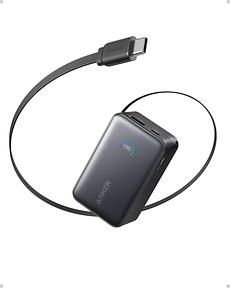
A unit like the Anker Nano Powerbank, 10.000mAh Externer Akku mit 70cm Anker InstaCord Einzugskabel, 45W Max Kompakter Akku, Smart-Display stayed unproblematic through all three tightenings: at roughly 36 to 37 Wh it sat far below every limit in force, whether the rule of the day allowed 20 spare batteries or only two power banks.
Affiliate link. Buying through it earns us a commission; the price stays the same for you.
The 100–160 Wh contradiction
Between 100 Wh and 160 Wh things get awkward — inside a single document. IATA's 31 March 2026 guidance carries two statements that do not agree:
| Source | Power bank above 100 Wh up to 160 Wh |
|---|---|
| ICAO addendum, Table 8-1 item c) (Appendix C of that same PDF) | "may exceed 100 Wh but not exceed 160 Wh … with the approval of the operator" — permitted with approval |
| IATA passenger table (Appendix B of that same PDF) | Row "Power bank", carry-on column: "Forbidden" |
| Germany's Luftfahrt-Bundesamt (passenger page, no date stamp) | "jede Batterie 100 Wh übersteigen, jedoch höchstens 160 Wh haben", plus "maximal zwei Ersatzbatterien pro Person" |
The Luftfahrt-Bundesamt sides with the legal text, while stating on the same page that "Lose Lithiumersatzbatterien (power banks) sind im aufgegebenen Gepäck verboten" — loose spare lithium batteries and power banks are forbidden in checked baggage. That page carries no last-updated date, which for a regulator's page on this topic is a real gap.
What to do with that in practice: if your power bank is above 100 Wh, the answer is not "it's fine with approval". The answer is that the airline decides, the operational industry table says forbidden, and you want that approval in writing before you leave for the airport. For almost everyone the simpler route is to stay below 100 Wh – with a compact model like the Anker MagGo Powerbank 10.000 mAh Qi2 15 W mit Halterung, for instance.
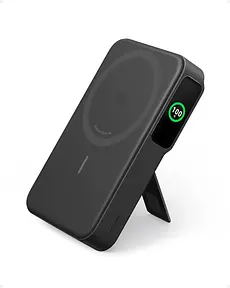
Anker MagGo Powerbank 10.000 mAh Qi2 15 W mit Halterung
View at Amazon (as of Aug 11)Affiliate link. Buying through it earns us a commission; the price stays the same for you.
Converting mAh to Wh — and the trap in it
The formula is trivial:
Wh = (V × mAh) ÷ 1000
At the usual nominal lithium-ion cell voltage of 3.7 V, the 100 Wh ceiling works out at roughly 27,027 mAh. That is the number in nearly every guide, and as a rule of thumb it is fine.
The trap: plenty of cells are rated 3.6 V, not 3.7 V. That moves the ceiling to roughly 27,778 mAh. A 27,650 mAh device therefore sits either under or over the line depending on its cell chemistry — and such a device is genuinely on sale (see the table below).
Hence the rule that matters: the Wh figure printed on the casing beats any arithmetic you do yourself. The manufacturer knows its cell voltage; you do not. The conversion is for sizing up a purchase, not for arguing at the gate. For a fuller treatment of the various numbers printed on a power bank, see converting mAh to Wh.
| Rated capacity | Wh at 3.6 V | Wh at 3.7 V | Verdict |
|---|---|---|---|
| 5,000 mAh | 18.0 Wh | 18.5 Wh | free to carry |
| 10,000 mAh | 36.0 Wh | 37.0 Wh | free to carry |
| 20,000 mAh | 72.0 Wh | 74.0 Wh | free to carry |
| 25,000 mAh | 90.0 Wh | 92.5 Wh | free to carry |
| 27,000 mAh | 97.2 Wh | 99.9 Wh | free to carry, but tight |
| 30,000 mAh | 108.0 Wh | 111.0 Wh | needs approval, and forbidden per IATA's table |
| 45,000 mAh | 162.0 Wh | 166.5 Wh | forbidden |
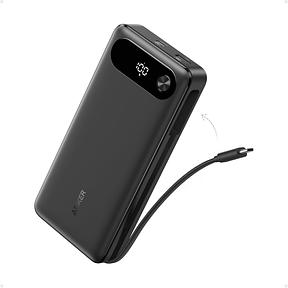
A real-world example of the 20,000 mAh row is the Anker Powerbank, 20.000mAh tragbares Ladegerät mit integriertem USB-C-Kabel, 87W Max Schnellladung, kompatibel mit MacBook, iPhone, Samsung und mehr: it works out to roughly 72 to 74 Wh, comfortably inside the free-to-carry range.
Affiliate link. Buying through it earns us a commission; the price stays the same for you.
Six power banks, run through the numbers
All figures taken from the retail listings on amazon.de, retrieved on 3 August 2026. Prices move; the watt-hour figure is what matters here.
| Model | Capacity | Wh stated in listing | Price (3 Aug 2026) | Verdict |
|---|---|---|---|---|
| Anker Prime 27,650 mAh (250 W) | 27,650 mAh | 99.54 Wh | €149.99 | free to carry — just under 100 Wh |
| Anker laptop power bank 165 W | 25,000 mAh | 90 Wh | €84.99 | free to carry |
| Anker power bank 87 W | 20,000 mAh | not stated | €44.99 | free to carry (roughly 72–74 Wh by calculation) |
| Anker MagGo Qi2 15 W with stand | 10,000 mAh | not stated | €56.99 | free to carry (roughly 36–37 Wh by calculation) |
| Anker Nano 45 W with built-in cable | 10,000 mAh | not stated | €37.97 | free to carry (roughly 36–37 Wh by calculation) |
| INIU Mini 22.5 W | 10,000 mAh | not stated | €18.29 | free to carry (roughly 36–37 Wh by calculation) |
Two things stand out.
First, the Anker Prime Powerbank 27.650 mAh (250 W) — the Anker Prime. At 27,650 mAh it sits above the 27,027 mAh rule of thumb — yet the product page explicitly states "99,54Wh" and advertises it as the maximum capacity still permitted on an aircraft, under 100 Wh. That is the 3.6 V effect from the section above. Anyone calculating at 3.7 V alone will wrongly write off a perfectly legal device.
Second, the blanks. Of these six listings, only two state a watt-hour figure at all as of 3 August 2026. On the other four, the one number aviation actually cares about appears nowhere in the offer — at best it is on the casing, which you get to read after buying. Below 20,000 mAh this hardly matters, because the margin to the limit is enormous. From 25,000 mAh upwards it is the point at which you should ask before you pay.
For the separate question of 100 W USB-C laptop charging and how close to the 100 Wh line it is sensible to go, there is a dedicated article: power banks for laptops.
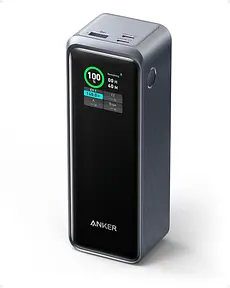
Anker Prime Powerbank 27.650 mAh (250 W)
View at Amazon (as of Aug 10)Affiliate link. Buying through it earns us a commission; the price stays the same for you.
The airline table
Here is the real obstacle with this topic: most airlines put their dangerous-goods pages behind bot protection that blocks automated retrieval. All 13 pages below were requested on 3 August 2026; ten of them answered with HTTP 403 or 404. Rather than filling the gaps with someone else's summary, they are recorded as what they are — with the link you can check yourself.
| Airline | Max number | Wh limit | Use on board | Recharging the power bank | Source / checked |
|---|---|---|---|---|---|
| Worldwide minimum (ICAO) | 2 units | 100 Wh; 100–160 Wh only with approval | should not — recommendation | prohibited (must not) | ICAO Addendum 1, 27 Mar 2026 · checked 3 Aug 2026 |
| Lufthansa | 2 units | 100 Wh; 100–160 Wh only with approval | prohibited | prohibited | Lufthansa Group, from 15 Jan 2026; page unreachable on 3 Aug 2026, figures per fvw 14 Jan 2026, Stiftung Warentest 22 Jan 2026 and ADAC 14 Jul 2026 |
| SWISS | 2 units | as Lufthansa Group | prohibited | prohibited | swiss.com · page unreachable 3 Aug 2026; group rule per ADAC 14 Jul 2026 |
| Austrian Airlines | 2 units | as Lufthansa Group | prohibited | prohibited | austrian.com · page unreachable 3 Aug 2026; group rule per ADAC 14 Jul 2026 |
| Eurowings | 2 units | as Lufthansa Group | prohibited | prohibited | eurowings.com · page unreachable 3 Aug 2026; group rule per ADAC 14 Jul 2026 |
| Discover Airlines | 2 units | as Lufthansa Group | prohibited | prohibited | discover-airlines.com · page unreachable 3 Aug 2026; group rule per ADAC 14 Jul 2026 |
| Brussels Airlines | 2 units | as Lufthansa Group | prohibited | prohibited | brusselsairlines.com · page unreachable 3 Aug 2026; group rule per ADAC 14 Jul 2026 |
| ITA Airways | not stated | not stated | listed by ADAC among the stricter carriers | not stated | ita-airways.com · page unreachable 3 Aug 2026; listing per ADAC 14 Jul 2026 |
| Emirates | 1 unit | under 100 Wh (about 27,000 mAh) | prohibited | prohibited | Emirates Media Centre, from 1 Oct 2025 · page unreachable 3 Aug 2026, figures per The National and aerotime, both 1 Oct 2025 |
| Condor | not stated | not stated | not stated | not stated | condor.com · checked 3 Aug 2026: Condor places power banks in hand luggage, no use ban stated on the page |
| Ryanair | not stated | not stated | not stated | not stated | ryanair.com · page not readable 3 Aug 2026 |
| easyJet | not stated | not stated | not stated | not stated | easyjet.com · page not readable 3 Aug 2026 |
| TUI fly | not stated | not stated | not stated | not stated | tuifly.com · page not readable 3 Aug 2026 |
| Turkish Airlines | not stated | not stated | not stated | not stated | turkishairlines.com · page not readable 3 Aug 2026 |
For every row marked "not stated", the worldwide minimum in the first row applies: any airline may be stricter, none may be more permissive. If you are flying one of the lower carriers with more than one power bank, or with a device close to 100 Wh, a short enquiry before departure is the only answer you can rely on. That is exactly what ADAC recommends on 14 July 2026.
Anyone limited to a single unit, as with Emirates, is well served by a higher-capacity model like the Anker Laptop Powerbank 25.000 mAh, 165 W, rated at roughly 90 Wh – plenty of reserve without touching the 100 Wh line.
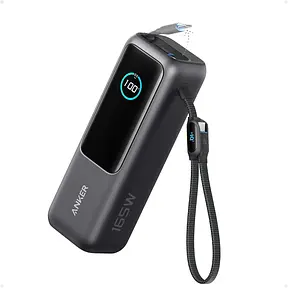
Anker Laptop Powerbank 25.000 mAh, 165 W
View at Amazon (as of Aug 11)Affiliate link. Buying through it earns us a commission; the price stays the same for you.
On board: using it, charging it, stowing it
Three things changed in January 2026 that you notice at your seat.
Recharging the power bank from aircraft power is prohibited everywhere. This is the one binding change ICAO made, and it covers the USB sockets in the seat as well as any AC outlet.
Charging your phone from the power bank depends on the airline. Globally it is a recommendation to refrain. In the Lufthansa Group it has been forbidden since 15 January 2026 — German trade title fvw reported on 14 January 2026 that power banks "dürfen während des Flugs generell nicht mehr genutzt und auch nicht geladen werden". ADAC puts it plainly on 14 July 2026: "Die Nutzung der Akkus während eines Fluges ist komplett verboten."
Not in the overhead bin. ADAC states: "Sie müssen in Reichweite aufbewahrt werden und dürfen nicht ins Gepäckfach." The reason is not bureaucratic. A fire in the seat pocket or in the bag under the seat in front is reachable by crew in seconds; a fire in a closed bin above your head is not. Emirates has required the same since 1 October 2025.
There is also the short-circuit rule, which predates all of this and which the new ICAO text repeats explicitly: every power bank must be individually protected — original packaging, taped-over terminals, or a separate pouch each. Two power banks rattling loose in the same camera-bag pocket do not meet that.
Checked baggage: never
There is no gradation here and no exception. ICAO's text for power banks is "must be carried as carry-on baggage". Germany's Luftfahrt-Bundesamt states that loose spare lithium batteries and power banks are forbidden in checked baggage. ADAC writes: "Im aufgegebenen Gepäck bleiben die Powerbanks weiterhin generell verboten." Three sources, one answer.
The practical case that catches people is the cabin bag surrendered at the gate because the overhead bins are full: the power bank has to come out first. That is the single most common route by which a power bank ends up in the hold.
At the gate: what actually gets challenged
Security screening mainly checks that the power bank is in your carry-on — the scanner shows that. Watt-hours usually only come up when a device is conspicuously large or an officer picks it up. This is precisely why a printed Wh figure is so valuable: it ends the conversation without anyone having to calculate.
What draws attention: devices well above 20,000 mAh, devices with no legible marking at all, and more than two power banks per person. Emirates has explicitly required since 1 October 2025 that the capacity rating be clearly visible on the device — a worn or covered label is a foreseeable problem there.
In short
Two units, under 100 Wh, carry-on only, not in the overhead bin, never recharged from aircraft power. Follow that and you are fine with any airline in the world, because an airline may be stricter than the worldwide minimum but none is stricter than "two units under 100 Wh, don't use them". A device with a printed watt-hour figure below 100 Wh is the cheapest insurance against any discussion there is.
One date is worth noting: 1 January 2027. The 68th edition of the IATA Dangerous Goods Regulations takes effect, and the current guidance expressly applies "not beyond 31 December 2026". If you own a power bank in the 100–160 Wh band, keep that date in view.
All products from this post
The ones we named above are marked; the rest are alternatives in the same category.
Affiliate notice: As an Amazon Associate, we earn from qualifying purchases. Product prices and availability are subject to change.
Frequently Asked Questions
How many power banks can I take on a plane?
Two. Since the ICAO addendum of 27 March 2026 the worldwide rule is "no more than two power banks may be carried per person". Before that, power banks counted as spare batteries, of which up to 20 were allowed. Individual airlines go further: Emirates has allowed only one power bank per passenger since 1 October 2025. Figures per ICAO Addendum No. 1 and the Emirates notice of 1 October 2025.
How many mAh is a power bank allowed to have on a plane?
Aviation counts watt-hours, not milliamp-hours. The limit is 100 Wh, which is roughly 27,027 mAh at 3.7 V cell voltage and roughly 27,778 mAh at 3.6 V. What binds is always the Wh figure printed on the casing, not your own conversion. A 20,000 mAh unit sits at about 72 to 74 Wh, comfortably below the line.
Can I use my power bank during the flight?
That depends on the airline. Since 27 March 2026 ICAO recommends against using one to charge another device — the wording is "should not", so it is not an obligation. The Lufthansa Group has banned both use and charging outright since 15 January 2026, as has Emirates since 1 October 2025. The only worldwide binding prohibition is on recharging the power bank itself on board.
Can a power bank go in checked baggage?
No, under no circumstances. The ICAO provision reads "must be carried as carry-on baggage". Germany's Luftfahrt-Bundesamt states that loose spare lithium batteries and power banks are forbidden in checked baggage. This also matters for a cabin bag surrendered at the gate: take the power bank out before you hand it over.
What about power banks between 100 and 160 Wh?
Two statements in the same IATA document of 31 March 2026 disagree. The reproduced ICAO text permits 100 to 160 Wh with airline approval, while IATA's own operational passenger table marks power banks in that band as "Forbidden". The Luftfahrt-Bundesamt also cites the 160 Wh exception. In practice: do not travel with one without written approval from the airline.
Where must the power bank be kept during the flight?
Within reach, and not in the overhead bin. ADAC writes on 14 July 2026: "Sie müssen in Reichweite aufbewahrt werden und dürfen nicht ins Gepäckfach." The usual places are the seat pocket, your clothing, or the bag under the seat in front. Each power bank must also be individually protected against short circuits, for example in its original packaging or a separate pouch.
Is anything else changing in 2027?
Yes. IATA's guidance of 31 March 2026 states it is not effective beyond 31 December 2026, and the 68th edition of the IATA Dangerous Goods Regulations takes force on 1 January 2027, carrying the addendum's changes. If you use a large power bank in the 100 to 160 Wh band, keep that date in view.
Sources
- took effect the same day icao.int
- Addendum No. 1 to Doc 9284-AN/905 icao.int
- IATA's guidance document for operators dated 31 March 2026 iata.org
- beyond the industry baseline of the time test.de
- without any such distinction adac.de
- Luftfahrt-Bundesamt lba.de
- Lufthansa Group business.lufthansagroup.com
- swiss.com swiss.com
- austrian.com austrian.com
- eurowings.com eurowings.com
- discover-airlines.com discover-airlines.com
- brusselsairlines.com brusselsairlines.com
- ita-airways.com ita-airways.com
- Emirates Media Centre emirates.com
- condor.com condor.com
- ryanair.com ryanair.com
- easyjet.com easyjet.com
- tuifly.com tuifly.com
- turkishairlines.com turkishairlines.com