
Power Bank With an Outlet (230 V): When the AC Port Pays Off
 12 min read
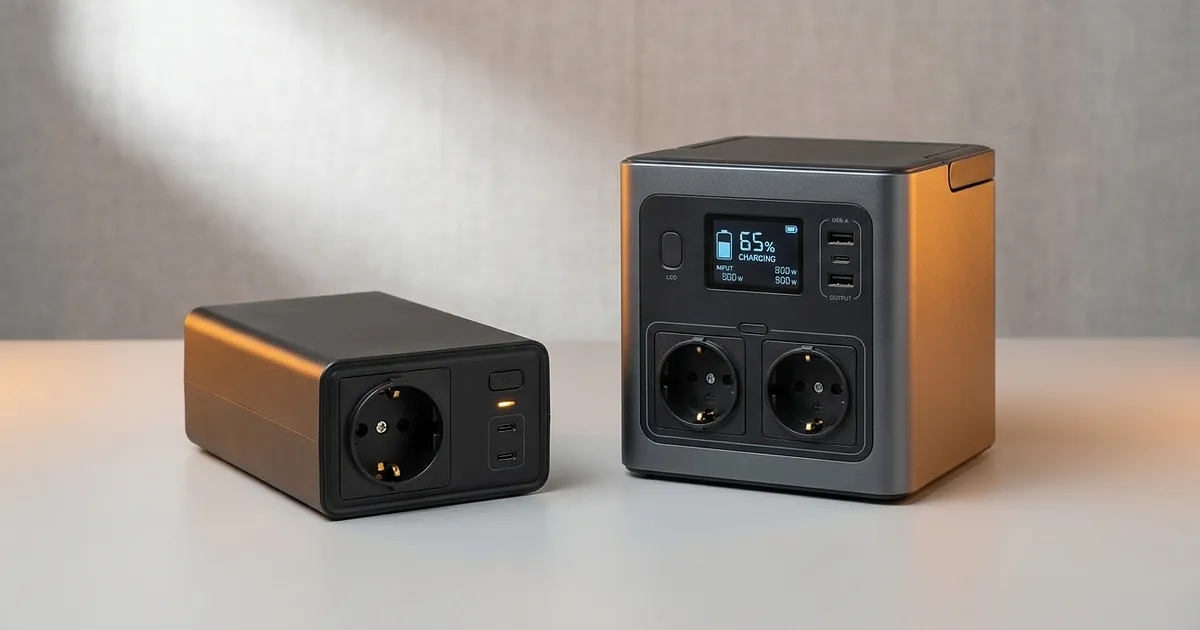
A power bank with an outlet sounds like the one device that does everything: a battery for your bag that still feeds a real 230-volt plug. Sometimes that is exactly right. Often, though, you pay for an inverter you do not need, when a cable and a decent USB-C port would have done the same job.
The gap between "worth it" and "wasted money" comes down to one question. Does the thing you want to charge even have a mains plug that nothing else can serve? If yes, the AC port can be worth its weight. If no, you are buying dead weight.
As of 20.08.2026. Every watt-hour, efficiency, and price figure below is attributed to a source with its date.
What is a power bank with an outlet, exactly?
A normal power bank puts out power over USB only. A power bank with an outlet has an inverter built in as well. It converts the stored direct current from the battery cells into 230-volt alternating current, the kind that comes out of your wall socket. Without that component there is no AC port, no matter how big the battery is.
This is where the confusion starts. That inverter is really a part from the power-station world. It has just been squeezed into a smaller case. A power bank with a 230 V port sits at the bottom of the power-station family, not the top of the power-bank family. That is not word-splitting. It decides what the thing can actually do later on.
A second point almost nobody reads up on: not every inverter delivers clean mains quality. According to heise online, cheaper models differ from higher-quality ones by producing a modified rather than a pure sine wave. For a laptop charger that does not matter. A motor, a sensitive charger, or an older power supply can run into trouble with a modified sine wave.
When does the AC port actually pay off?
Short version: a power bank with an AC outlet pays off whenever your device has a mains plug and there is no sensible USB-C route.
That sounds obvious, but it is the whole trick. Plenty of devices that used to need a wall socket now run on USB-C Power Delivery. And the strongest power banks on the market bet on exactly that, not on an outlet.
In a test by ComputerBase (14.08.2025, Frank Hüber), four flagship power banks from Anker, EcoFlow, Ugreen, and Baseus delivered between 81.8 and 88.5 percent of their rated capacity under a steady load. All four are rated 165 to 300 watts. And not one has a 230 V port. So if you charge a modern laptop over USB-C, you do not need the outlet at all. More on that in our laptop power bank guide.
When do you still need it? In cases like these:
A laptop power supply with a round barrel connector and no USB-C alternative. Older business notebooks, plenty of gaming laptops.
Small mains devices while travelling: a CPAP machine, a camera charger with a fixed mains plug, a small pump.
Tools or hobby gear with low draw, far from the nearest socket.
The common thread: low continuous draw, a real mains plug, no USB route. For that niche a power bank with an outlet is exactly right, and a full power station would just be needless weight.
A few devices in this class stay just under the important 100 watt-hour mark:
The MARBERO Powerbank mit Steckdose 99 Wh / 27.000 mAh, 230 V / 150 W has 99 Wh, a 230 V port rated at 150 watts, and sells for about €127 (as of 08/2026, per Amazon.de). At 4.1 stars from more than 7,000 ratings, it is the best-selling model in the class.
A little cheaper, but far less reviewed, is the SBAOH Powerbank mit Steckdose 99 Wh, 150 W Solargenerator mit AC/Kfz-Anschluss. Also 99 Wh and 150 watts, about €100 (as of 08/2026, per Amazon.de).
If you also want a small solar panel, you get one with the Powkey Powerstation mit Steckdose 97,68 Wh + 40 W Solarpanel, 230 V AC. 97.68 Wh, a 230 V port, about €165 (as of 08/2026, per Amazon.de). This is the exact device class heise online tested in 2024 under the Powkey name, more on that in a moment.
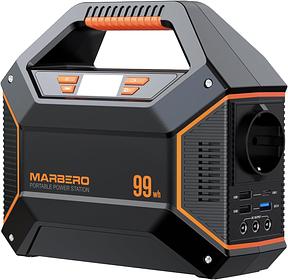
MARBERO Powerbank mit Steckdose 99 Wh / 27.000 mAh, 230 V / 150 W
View at AmazonAffiliate link. Buying through it earns us a commission; the price stays the same for you.
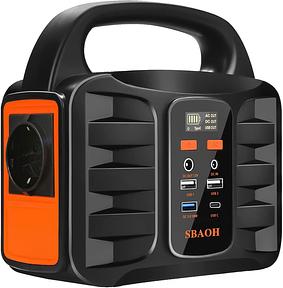
SBAOH Powerbank mit Steckdose 99 Wh, 150 W Solargenerator mit AC/Kfz-Anschluss
View at AmazonAffiliate link. Buying through it earns us a commission; the price stays the same for you.
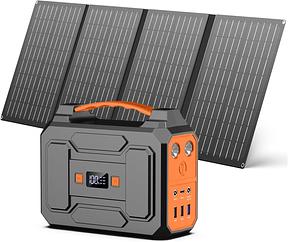
Powkey Powerstation mit Steckdose 97,68 Wh + 40 W Solarpanel, 230 V AC
View at AmazonAffiliate link. Buying through it earns us a commission; the price stays the same for you.
Watch the wattage claims: the 3000-watt trap
Now for the part nobody runs the numbers on. Search for "power bank 230v 3000w" or "power bank 230v 5000w". Those searches genuinely exist, hundreds a month. And there are listings that advertise exactly those figures.
The problem: no pocket-sized power bank delivers 3000 or 5000 watts continuously. Those numbers, where they rest on anything real at all, are peak values for a fraction of a second.
The distinction is continuous power versus peak power. According to Jackery Germany, continuous power describes what an inverter can supply indefinitely, while peak power is only meant for brief start-up currents, such as a motor spinning up. (That is a manufacturer statement, not an independent measurement, but the definition holds.) A "3000 W" marketing figure on a small power bank almost always means the second kind.
How tight that line is in practice shows in heise online's test of the Powkey mini power station (05.04.2024, Philipp Sussmann). The 98 Wh unit was rated at "100 watts continuous" and delivered 78 to 85 Wh usable. With devices drawing 90 to 100 watts at high inrush current, the protection circuit tripped, and above 130 to 140 watts the 230 V port shut off entirely.
Then there is the quiet loss almost no one factors in. The ADAC test of eight mobile power stations (11.06.2025) found usable capacity running on average 10 to 15 percent lower than the manufacturers stated. And the inverter alone draws roughly 30 watts just switched on, before you plug anything in.
Run the numbers yourself. A 99 Wh power bank, minus 10 to 15 percent conversion loss, minus the inverter's idle draw, gets you maybe 45 minutes at a 100-watt load. That is enough for one laptop charge cycle. It is nowhere near enough for a kettle.
Remember: on a power bank with an outlet, the only wattage that counts is the continuous rating. If it is missing and all you see is a big round peak number, that is a warning sign.
When is a power station the better choice?
The moment your math goes past the 100-to-150-watt line, or you need mains power for longer than a good hour, the power bank with an outlet is the wrong tool. Then you want a real power station.
The jump is bigger than the photos suggest. The eight units in the ADAC test ran between 768 and 1,440 Wh and delivered 1,000 watts and up of continuous power. That is the class where a camping cooler, a kettle, small tools, and a few hours of backup power actually work. A 99 Wh power bank plays in a different league, two orders of magnitude below.
Two devices that mark the entry to this class:
The Jackery Explorer 240 Powerstation 240 Wh / 200 W has 240 Wh, 200 watts continuous, and costs about €152 (as of 08/2026, per Amazon.de). Small, light, good for a weekend and a camera kit. Still not a kitchen appliance, but three times the energy of a 99 Wh power bank.
If you want serious continuous power, you land on the BLUETTI Elite 30 V2 Powerstation 288 Wh, 600 W (Peak 1500 W), 6x AC-Ausgang. 288 Wh, 600 watts continuous, up to 1500 watts briefly, six AC ports, about €279 (as of 08/2026, per Amazon.de). This runs devices that every power bank with an outlet would shut down on instantly. The comparison by capacity class across the big brands is worth a look of its own.
A word on safety, because "more ports" does not automatically mean "better built". In that same ADAC test, two of the eight units, including the Jackery Explorer 1000 v2, failed with a grade of 5.0. The reason was not a wattage problem but that their DC charging inputs were not isolated from one another (ADAC, 11.06.2025). Jackery responded to the test and announced improvements. The lesson for you: build quality matters as much as the outlet itself.
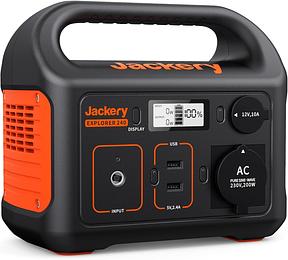
Jackery Explorer 240 Powerstation 240 Wh / 200 W
View at AmazonAffiliate link. Buying through it earns us a commission; the price stays the same for you.
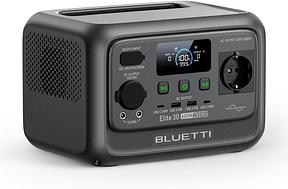
BLUETTI Elite 30 V2 Powerstation 288 Wh, 600 W (Peak 1500 W), 6x AC-Ausgang
View at Amazon (as of Aug 21)Affiliate link. Buying through it earns us a commission; the price stays the same for you.
Decision table: power bank with an outlet or a power station?
The one table this article really exists for. All figures are device-class guide values, not individual tests.
| Criterion | Power bank with outlet | Power station |
|---|---|---|
| Rated capacity | approx. 90 to 100 Wh | approx. 240 to 1,440 Wh |
| Continuous power (AC) | approx. 100 to 150 W | approx. 200 to 2,200 W |
| Weight | approx. 1 to 1.5 kg | approx. 3 to 15 kg |
| Price range | approx. €100 to €170 | approx. €150 to €1,500 |
| Carry-on friendly | usually yes (under 100 Wh) | usually no (over 100 Wh) |
| Good for | laptop, small mains devices, travel | camping, kitchen, tools, backup |
| Wrong for | kettle, cooler, high continuous load | slipping into a jacket pocket |
Rule of thumb: anything you can handle under 100 watt-hours and under 150 watts continuous, the small outlet power bank does lighter and cheaper. Everything above that is power-station territory, and trying to force it with a power bank ends at the protection circuit.
What to look for when buying
A few things that tend to get lost on the product page when buying a power bank with an outlet:
Continuous power, not peak power. If all you see is a big round number, ask whether that is a one-second value. Usually it is.
Watt-hours, not milliamp-hours. A "27,000 mAh" spec tells you nothing about energy without the voltage. The honest figure is Wh. We cover the conversion step by step elsewhere; the formula is Wh = (volts × mAh) / 1000, using 3.7 V as the typical cell value, not the 5 V at the USB port. 27,000 mAh times 3.7 V comes to about 99 Wh, and that is also the figure that decides whether it can fly.
On a device with an inverter and 230 volts inside the case, the certification mark matters more than on almost any other electronics purchase. GS and TÜV marks serve as a guide. "Very high charge capacities at low prices should be treated with caution," warns Dr. Hermann Dinkler of the TÜV-Verband (06.07.2023).
Planning to run sensitive electronics, a motor, or an older power supply? Then look for "pure sine wave". For a plain laptop charger it does not matter.
And if you want to take the device on a plane: most of the power banks here sit at around 99 Wh, just under the 100 Wh limit airlines apply to carry-on. Power stations at 240 Wh and up are over that line and usually cannot come aboard. The exact airline rules are their own topic, which we are not opening here.
Conclusion
The honest answer to "power bank with an outlet, yes or no" is a question back at you: what exactly do you want to charge, and does it have a USB-C port? If the device needs a real mains plug, is small, and is meant to travel with you, the 99 Wh outlet power bank is the light, affordable, flight-friendly answer. As soon as a kettle, a cooler, or several hours of mains power come into it, stop forcing it with a power bank and take a power station.
Manufacturers will not solve the wattage problem for you. So do the continuous-power math, ignore the big round peak numbers, and you buy exactly the device your actual use case calls for.
All products from this post
The ones we named above are marked; the rest are alternatives in the same category.
Affiliate notice: As an Amazon Associate, we earn from qualifying purchases. Product prices and availability are subject to change.
Frequently Asked Questions
What is the difference between a power bank and a power station?
A classic power bank puts out power over USB only. A power station with an outlet has an inverter and at least one 230 V port. A power bank with an outlet is the smallest form of that power-station world: around 100 Wh, roughly 100 to 150 watts continuous, near pocket size. A real power station starts at about 240 Wh and delivers far more watts.
How many watts should a power bank with an outlet have?
What matters is the continuous rating, not a big peak number. For a laptop and small mains devices, 100 to 150 watts is enough. Figures like 3000 or 5000 watts on a small power bank are peak values for fractions of a second, not real continuous power. If no continuous rating is stated, treat that as a warning sign.
Power bank for a laptop: do you need the AC outlet?
Yes, a power bank for a laptop is the most common sensible use of the outlet. A laptop power supply usually draws 45 to 90 watts, which a 99 Wh power bank handles for about one charge cycle. If your laptop has a USB-C port, you often do not need the outlet at all and can charge directly over USB-C, which is lighter and more efficient.
How long does a power bank with a 230 V port last?
After 10 to 15 percent conversion loss and the inverter's idle draw (per ADAC, 11.06.2025, roughly 30 watts), about 78 to 85 Wh remain usable out of 99 Wh. At a 100-watt load that is roughly 45 minutes, at 20 watts correspondingly longer. Actual runtime always depends on real draw.
Can I take a power bank with an outlet in my carry-on?
Models at around 99 Wh sit just under the 100 Wh limit and are allowed in carry-on with most airlines, and lithium batteries do not belong in the hold anyway. Power stations at 240 Wh and up are over the limit and usually cannot come along. Always check your specific airline's rules before flying, because the details differ.