Power Bank Test Winners 2026: What Stiftung Warentest, heise and the ADAC Actually Measured
 14 min read
As of: 2026-02-04
Three German institutions come up whenever somebody searches for a power bank test winner: Stiftung Warentest, heise online and the ADAC. They did not measure the same thing. They did not even measure the same class of device. And one of them never tested a power bank at all.
That's why the search results look like they contradict each other. They don't. Three separate measurements of partly unrelated products, blended by comparison sites into a ranking nobody ever published.
Nothing here is our own measurement or ranking. This is attribution work: who measured what, when, in which unit, and how much you can read for free.
What each body actually measured
| Institution | What was tested | Device class | Date | Free or paid | What was actually measured |
|---|---|---|---|---|---|
| Stiftung Warentest | 24 power banks from 18 brands | 10,000 mAh and 20,000 mAh | issue 2/2026, published 2026-01-07 | teaser free, full test including the winner's name for €4.90 | usable energy in Wh, output in W, prices (survey via Geizhals.de, December 2025) |
| heise online, list 1 | top 10, no capacity limit | mostly 10,000 to 12,000 mAh | as of 2026-01-16 | free | usable capacity via a FNIRSI FNB58 load simulator, efficiency in % from that |
| heise online, list 2 | top 10 from 20,000 mAh up | 20,000 mAh and larger | published 2026-02-01 | free | same FNB58 method, different device class, different winner |
| ADAC | portable power stations, no power banks | 768 to 1440 Wh | published 2025-06-11 | free | usable versus rated capacity, safety inspection of DC inputs |
| Öko-Test | 11 power banks | 5,000 to 10,400 mAh | issue 12/2017 | free | not stated for any newer test |
Stiftung Warentest tested 24 power banks from 18 brands in issue 2/2026 (2026-01-07). The winner's name sits behind the €4.90 unlock.
heise online measures in the open with a FNIRSI FNB58 load simulator and runs two best-of lists. Almost every comparison site drops this: heise has two winners, depending which list you land on.
And the ADAC gets its own section further down: no power bank, ever.
A methodological comparison across the three isn't available. Who measured better isn't a question anyone can answer, since they didn't measure the same thing.
74 Wh rated, 66.32 Wh delivered: the free measurement table
This is the table that doesn't exist anywhere else. Rated capacity, measured usable energy, efficiency. Every cell carries its unit; where a figure isn't published, the cell says not stated. Nothing here is converted or estimated.
| Device | Source and date | Class | Rated | Measured usable | Efficiency | Output | Weight | Price per the test |
|---|---|---|---|---|---|---|---|---|
| Anker Zolo Power Bank 20k (A1689) | heise, list 1, as of 2026-01-16 | 20,000 mAh | 74 Wh | 66.32 Wh | 89 % | 30 W out / 20 W in | 353 g | €24 |
| Selore & S-Global 30W | heise, list 1, as of 2026-01-16 | 10,000 mAh | not stated | not stated | not stated | 30 W | not stated | €11 |
| Ugreen Nexode 12,000 mAh | heise, list 1, as of 2026-01-16 | 12,000 mAh | 44 Wh | approx. 30 Wh | not stated | 100 W | 309 g | approx. €35 to €40 |
| Anker 737 (PowerCore 24K) | heise, list 2, 2026-02-01 | 24,000 mAh | 88.56 Wh | 14,000 to 15,000 mAh (mAh, not Wh) | not stated | 140 W | 630 g | €80 |
| Ecoflow Rapid Pro 27K | heise, list 2, 2026-02-01 | 27,000 mAh | 99.54 Wh | not stated | 83 % | 140 W (300 W total) | 699.4 g | €165 |
| Cuktech 15 SE | heise, list 2, 2026-02-01 | 20,000 mAh | not stated | not stated | above 92 % | 65 W | not stated | €32 |
| Warentest, 10,000 mAh class (range) | test.de, 2026-01-07 | 10,000 mAh | not stated | 28.5 to 35.8 Wh | not stated | 18 to 200 W (all 24 units) | not stated | €30 to €100 (tested range) |
| Warentest, 20,000 mAh class (range) | test.de, 2026-01-07 | 20,000 mAh | not stated | 58.3 to 69.9 Wh | not stated | 18 to 200 W (all 24 units) | not stated | €30 to €100 (tested range) |
The prices in that last column come from the test articles themselves. They are not retailer prices and they are not today's prices. heise quotes them as of its own test date; Warentest states it surveyed its range via Geizhals.de in December 2025.
The most useful figure in the table sits in row one. Of 74 Wh rated, heise recorded 66.32 Wh under load, an efficiency of 89 percent. The roughly 8 Wh that vanish are conversion loss, not a fault. Why that happens, and how you get from mAh to watt-hours, is covered in the conversion, step by step.
heise's standalone review of the Anker Zolo 20k, first published 2025-01-22 and updated 2026-01-16, adds dimensions of 119.9 × 73.4 × 31.4 mm, a weight of 353 g, at 30 W output.
The row where most comparisons quietly go wrong
Look closely at the Anker 737 line. heise gives that device's usable capacity in mAh, 14,000 to 15,000 mAh, and not in watt-hours. For the Zolo 20k it gives Wh plus a percentage.
That mAh figure can't honestly convert to watt-hours. Doing that needs the real voltage curve under load, which nobody published. heise states no Wh efficiency here. So neither do we.
This is exactly where comparison sites invent a percentage. It appears in no source.
What's behind the €4.90 paywall, and what's publicly knowable
Worth separating. Behind the test.de paywall sits what most people search for: the winner's name, plus per-device grades for all 24 units.
Plenty is readable for free, and it's more than nothing:
usable energy in the 10,000 mAh class, which Stiftung Warentest puts at 28.5 to 35.8 watt-hours (2026-01-07)
the same figure for the 20,000 mAh class, 58.3 to 69.9 watt-hours
the output span across all 24 devices, 18 to 200 W
the tested price band, €30 to €100
the cohort size, 24 devices from 18 brands
What's deliberately missing here is the name. As of 2026-02-04, no free source with an appropriate date names the Warentest winner from 2/2026. One vetted aggregator serves two mutually contradictory names on the same domain, and its article page carries an update date later than this post. Sources like that don't get cited here.
If you need the name, €4.90 at test.de is the answer. The figures above are free; the winner isn't. More on that test sits in our write-up of the Warentest result.
The test winner that got recalled
Now for the part that test-winner lists rarely carry.
The device heise puts at the top of its general list, the Anker Zolo Power Bank 20k with model number A1689, is part of a worldwide voluntary recall Anker started in June 2025.
Anker frames it this way on its recall page: "While the likelihood of malfunction is considered minimal, out of an abundance of caution", it offers a replacement, voucher or refund.
According to produktwarnung.eu (2025-06-30), the recall covers models A1257, A1647, A1652, A1681 and A1689, with overheating traced to cells from a single supplier. heise notes the unit was unavailable June to August 2025 and has been back on sale since.
Is that a reason not to buy it? Not automatically. It's a reason to check the model and serial number before buying, especially second-hand. Affected models and how to check them live in the recall register.
Recalls here aren't a one-off either. IKEA recalled its VARMFRONT power bank series in the 10,400 mAh and 5,200 mAh variants, covering production weeks 2313, 2316, 2318, 2319 and 2322, over an increased fire risk caused by a manufacturing defect. Notebookcheck reported that in July 2024, a secondary source, not an IKEA primary document.
What the ADAC tested, and what it didn't
The ADAC surfaces constantly in power bank searches. It has published no power bank test.
Its relevant work (2025-06-11) covers portable power stations of 768 to 1440 watt-hours, examined at the ADAC Technik Zentrum in Landsberg am Lech, a class roughly ten to twenty times larger than anything in hand luggage. The top grade went to the Bluetti AC180P at 2.0, per the ADAC. Two of the eight units failed, the Ective BlackBox 10 and the Jackery Explorer 1000 v2, both at 5.0, because their DC inputs aren't decoupled from one another.
As of 2026-02-04 no public statement from Jackery or Ective on that finding was findable. That doesn't mean none exists. It means we didn't find one, and that belongs in the text rather than in a footnote. The brand comparison on the same cohort sits in our power station brand comparison.
One number from that test keeps migrating into power bank articles. The ADAC found real usable capacity averaging "a good 10 to 15 percent" below the manufacturer's rating. How wide that gap runs on a power station, and how to calculate it, is covered in from rated watt-hours to real runtime. That's a finding about power stations, not power banks. For power banks, heise measured 89 percent on the Zolo 20k and above 92 percent on the Cuktech 15 SE, numbers from an entirely different measurement series on a different product class.
The only ADAC test where the word power bank appears at all is a jump-starter comparison from 2016-01-19 with a single device labelled that way. Ten years old, third device class, worth nothing for a 2026 question.
That leaves Öko-Test as Germany's fourth address. Its most recent findable power bank test is issue 12/2017, 11 devices between 5,000 and 10,400 mAh, purchased in August 2017. Which is why it isn't in the main comparison.
Which power bank for which job
No winner, no crown. Four classes, each one naming whoever did the measuring.
10,000 mAh, when weight is the constraint
Warentest tested this class and publishes a usable energy range of 28.5 to 35.8 Wh for free. Per-device grades are paywalled.
INIU is among the 18 brands in that cohort. The INIU Powerbank 10000mAh 22.5W Kompakt is a current 10,000 mAh model from that manufacturer. Whether this exact unit was in the Warentest cohort isn't documented, so no Warentest grade is attached to it here.
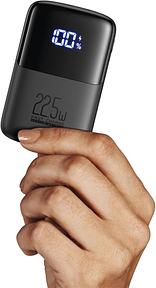
INIU Powerbank 10000mAh 22.5W Kompakt
View at Amazon (as of Aug 10)Affiliate link. Buying through it earns us a commission; the price stays the same for you.
12,000 mAh at 100 W: heise's technology pick
heise lists the Ugreen Nexode Powerbank 12.000 mAh, 100 W (PB724) as the technology winner of list 1 (as of 2026-01-16). Measured: roughly 30 Wh usable of 44 Wh rated, 100 W output, 309 g, around €35 to €40 per that test. heise states no percentage efficiency for this one.
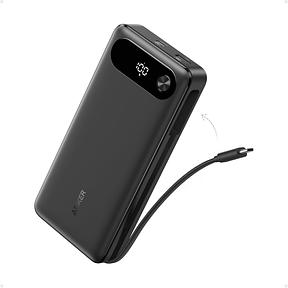
Not available in your region — closest match
View at Amazon (as of Aug 15)Affiliate link. Buying through it earns us a commission; the price stays the same for you.
20,000 mAh, the class with the most published measurements
Two devices with figures on the record:
The Anker Zolo Powerbank (2025 Upgrade), 20000mAh, 30W High-Speed-Ladegerät mit integriertem USB-C Kabel, Akku-Pack für iPhone 17/16/15-Serie, Galaxy und mehr is the winner of heise's list 1 (as of 2026-01-16) at 66.32 Wh of 74 Wh and 89 percent, €24 per that test. It is also model A1689 from the Anker recall covered above.
The Cuktech 15 SE Powerbank 20.000 mAh, 65 W (PB200), sold on Amazon as CUKTECH 65W Power Bank with 20000mAh, is the value pick of heise's list 2 (2026-02-01) at above 92 percent efficiency and 65 W output, €32 per that test.
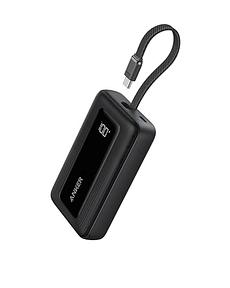
Affiliate link. Buying through it earns us a commission; the price stays the same for you.
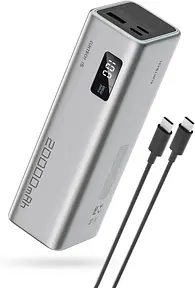
Cuktech 15 SE Powerbank 20.000 mAh, 65 W (PB200)
View at Amazon (as of Aug 11)Affiliate link. Buying through it earns us a commission; the price stays the same for you.
24,000 mAh at 140 W, for laptops
The Anker Prime Powerbank 24.000 mAh, 140 W, Display is the Anker 737, also sold as the PowerCore 24K and listed on Amazon as Anker Prime 24000mAh 140W. heise names it the winner of its separate list for 20,000 mAh and up (2026-02-01): 88.56 Wh rated, of which 14,000 to 15,000 mAh usable, 140 W, 630 g, €80 per that test.
Whether 140 W is enough for your machine, and what the wattage means in practice, is worked through in our laptop power bank guide.
On air travel, Stiftung Warentest states spare lithium batteries may only be carried in hand luggage, never in checked baggage. Batteries up to 100 watt-hours need no separate airline permission, above that they do, and each passenger may carry at most two spare batteries. Three devices above carry a rated Wh figure: 44 Wh, 74 Wh and 88.56 Wh, all under 100 Wh. The Cuktech 15 SE and the INIU model have none published. What individual carriers demand on top of that is tabulated in the airline table with check dates.
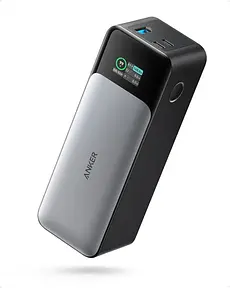
Anker Prime Powerbank 24.000 mAh, 140 W, Display
View at Amazon (as of Aug 10)Affiliate link. Buying through it earns us a commission; the price stays the same for you.
What changes in August 2026
Reading those tables, you probably noticed how inconsistent the labelling is. Sometimes mAh, sometimes Wh, sometimes rated, sometimes measured usable energy. Even the testing bodies use different units for the same quantity.
There's a regulatory reason. An EU-wide labelling duty for capacity does not exist on 2026-02-04.
It is coming. Under Annex VI Part A of EU Battery Regulation (EU) 2023/1542, capacity must be labelled from 18 August 2026. That reading comes from the summary published by the law firm Goertz, so treat it as a secondary source. That duty covers portable battery categories generally; the source names no power-bank-specific rule.
Until then, the number on the box is whatever the manufacturer thought useful. And the only number that tells you what actually comes out is a measured one.
The short version
Take one thing away: in 2026 the question of who won has four answers, not one. heise measures in the open and has two winners across two lists. Warentest has the bigger cohort and sells the name for €4.90. The ADAC tested a different product category. Öko-Test has been dormant since 2017.
The only complete, freely readable measurement of the whole season is 66.32 Wh out of 74 Wh on the Anker Zolo 20k. That same device sits on a recall list published by its own manufacturer.
It isn't a tidy market. But it's the one that exists, and with a date next to every figure you can work with it.
All products from this post
The ones we named above are marked; the rest are alternatives in the same category.
Not available in your region — closest match
Anker Powerbank, 20.000mAh tragbares Ladegerät mit integriertem USB-C-Kabel, 87W Max Schnellladung, kompatibel mit MacBook, iPhone, Samsung und mehr
View at Amazon (as of Aug 15)
Affiliate notice: As an Amazon Associate, we earn from qualifying purchases. Product prices and availability are subject to change.
Frequently Asked Questions
Who is the power bank test winner for 2026?
Depends who you ask. heise names the Anker Zolo Power Bank 20k in its general list (2026-01-16) and the Anker 737 in its 20,000 mAh list (2026-02-01). Stiftung Warentest's winner, issue 2/2026 (2026-01-07), needs a €4.90 unlock. No single winner exists across all tests.
What does the Stiftung Warentest power bank test cost?
The full test, winner's name and per-device grades included, costs €4.90 on test.de. Free headline figures: 24 power banks from 18 brands, usable energy 28.5 to 35.8 Wh (10,000 mAh class) and 58.3 to 69.9 Wh (20,000 mAh class), output 18 to 200 W, price band €30 to €100. As of 2026-01-07.
Did the ADAC test power banks?
No. On 2025-06-11 the ADAC tested portable power stations of 768 to 1440 watt-hours at its Technik Zentrum in Landsberg am Lech, a much larger class than a hand-luggage power bank. Its finding, usable capacity about 10 to 15 percent below the manufacturer rating, applies to power stations, not power banks.
How many watt-hours does a 20,000 mAh power bank hold?
For the Anker Zolo 20k, heise states 74 Wh rated, 66.32 Wh proven usable under load, measured with a FNIRSI FNB58 (2026-01-16). Stiftung Warentest found usable energy of 58.3 to 69.9 Wh across the 20,000 mAh class (2026-01-07). The mAh number alone isn't an energy figure.
Is heise's test winner affected by the Anker recall?
Yes. The Anker Zolo Power Bank 20k, model number A1689, appears per produktwarnung.eu (2025-06-30) on the worldwide voluntary recall Anker started June 2025, alongside A1257, A1647, A1652 and A1681. Anker cites cells from a single supplier and offers a replacement, voucher or refund.
Why do power banks show mAh instead of watt-hours?
Because on 2026-02-04 there's still no EU-wide labelling duty for capacity. Under Annex VI Part A of EU Battery Regulation (EU) 2023/1542, that duty starts 18 August 2026, per the law firm Goertz's summary. Until then the manufacturer picks the unit on the box.
Sources
- Stiftung Warentest test.de
- heise online heise.de
- standalone review of the Anker Zolo 20k heise.de
- its recall page anker.com
- produktwarnung.eu produktwarnung.eu
- Notebookcheck notebookcheck.com
- ADAC adac.de
- issue 12/2017 oekotest.de
- its separate list for 20,000 mAh and up heise.de
- Stiftung Warentest test.de
- Goertz goertz-legal.de