How Long Does a Power Bank Really Last? Charge Cycles, Aging and When Replacing Pays Off
 13 min read
A power bank rarely dies on a particular day. It gets quietly weaker over months, and at some point it no longer carries your phone through to the evening — without a single warning light having come on beforehand. That is exactly why the lifespan question is so unsatisfying to answer: there is no moment at which the device is broken, only a curve that points downwards.
As of: 7 August 2026
1. A charge cycle is not "one trip to the socket"
The most common mistake sits in the unit itself. A charge cycle is not a plug-in session but a cumulative quantity: it is complete once the full capacity has passed through the cells in total — however many partial charges that took.
In its guide Was ist ein Ladezyklus? dated 17 July 2026, Anker works this through with three examples: using 50% twice equals one charge cycle, using 25% four times equals one, using 20% five times equals one.
That changes the order of magnitude considerably. Someone who uses a 20,000 mAh power bank to top a phone up twice a week may be drawing perhaps a quarter of its capacity each time, depending on the phone's battery — roughly half a cycle per week. Over a year that adds up to a number well below the count of trips to the socket. A manufacturer's cycle rating therefore never describes a period of time, and any conversion into years is an assumption about your own usage, not a manufacturer's claim.
2. What the manufacturers state — and why the numbers diverge
Two figures from the same product category, both from the manufacturers themselves:
| Manufacturer | Rating | Residual capacity stated? | Source, date |
|---|---|---|---|
| Anker | "bis zu 300-500 Ladezyklen" (up to 300–500 cycles) | no | Anker blog, 11 Aug 2024 |
| UGREEN (Nexode 20000mAh 130W) | "1000 Zyklen bei 80 % Kapazität" plus a 200-day aging test | yes: 80% | UGREEN product page, retrieved 7 Aug 2026 |
The factor of three between the two is largely not a quality difference but a definitional one. In its battery lifespan tips of 11 Aug 2024, Anker writes that its power banks "halten bis zu 300-500 Ladezyklen". What is not stated is the residual capacity that "last" refers to. For the Nexode Power Bank 20000mAh 130W, UGREEN states both: 1,000 cycles and the 80% capacity threshold it was measured against, using automotive-grade 21700 cells (retrieved 7 Aug 2026).
A cycle count without a residual-capacity threshold is about as informative as a range figure without a speed. If you are comparing two power banks and only one of the two ratings names a threshold, you are not comparing durability — you are comparing two different measurement rules.
3. Depth of discharge moves the cycle count by a factor of six
Cycle life is not a material constant. It depends on how deeply the cell is discharged on each cycle. Battery University (BU-808, retrieved 7 Aug 2026) lists the following figures for lithium-ion cells, measured down to the point at which 70% of the original capacity remains:
| Depth of discharge per cycle | Cycles to 70% capacity (NMC) | Cycles to 70% capacity (LiFePO4) |
|---|---|---|
| 100% | about 300 | about 600 |
| 80% | about 400 | about 900 |
| 60% | about 600 | about 1,500 |
| 40% | about 1,000 | about 3,000 |
| 20% | about 2,000 | about 9,000 |
For NMC cells there is more than a factor of three between the top row and the second-to-last, and more than a factor of six between 100% and 20% depth of discharge. These numbers come from cell testing and do not describe any particular power bank — the cell chemistry of a specific unit is rarely printed on the spec sheet. The direction is unambiguous nonetheless, and it is usable in practice: topping the power bank up once it is half empty, rather than routinely running it down to shutdown, moves you a row further down that table.
Anker recommends a charge limit for the same reason: an "80 percent charge limit" reduces "the time the battery spends at a fully high charge" (Anker, 17 July 2026). Germany's Federal Environment Agency puts it more bluntly in its guide Sicherer Umgang mit Lithium-Batterien und Akkus (as of 16 July 2026): do not charge batteries fully empty or fully full, and ideally charge only to 90 percent.
4. Calendar aging: the power bank ages in the drawer too
The second aging mechanism has nothing to do with use at all. A lithium-ion cell loses capacity through time alone — and the faster the warmer it sits and the fuller it is while sitting. Battery University quantifies the effect after one year of storage as follows (BU-808, retrieved 7 Aug 2026):
| Storage temperature | at 40% charge | at 100% charge |
|---|---|---|
| 0 °C | 98% | 94% |
| 25 °C | 96% | 80% |
| 40 °C | 85% | 65% |
The interesting column is the right-hand one. A fully charged cell at 25 °C — ordinary room temperature — loses about a fifth of its capacity in a year without ever having been used. At 40 °C, easily reached in a parked car in summer or on a sunny windowsill, it is about a third.
From this follows the rule for the power bank you keep "for emergencies": do not put it away fully charged, and do not store it warm. Anker names an optimised operating temperature of "0℃ bis 25℃" and recommends recharging the lithium battery "mindestens einmal alle 3 Monate" — at least once every three months (11 Aug 2024). The Federal Environment Agency names 10 to 25 degrees as a good range for rechargeable batteries generally (16 July 2026). The two lower bounds disagree because they describe different things — operation in one case, storage in the other. The shared conclusion is the upper bound: above 25 °C it gets expensive.
5. What actually shortens the lifespan
From the two mechanisms above — cycle aging and calendar aging — four behaviours follow that measurably cost capacity. All four are documented; none is a rule of thumb pulled from the air:
Heat. By far the biggest lever. Going from 25 °C to 40 °C drops the recoverable capacity after one year at full charge from 80% to 65% (Battery University, BU-808).
Sitting permanently full. Battery University notes that high temperature and dwelling at a full state of charge for an extended time can be more stressful than cycling itself. The power bank permanently attached to a charger is not aging less — it is aging differently.
Always running it down to shutdown. See the table in section 3: 100% depth of discharge costs roughly two thirds of the cycles compared with 40%.
Leaving it empty for months. Hence Anker's three-month recommendation. A deeply discharged cell that sits at low voltage for a long time is the one case in which a power bank genuinely fails to wake up from one day to the next.
What you will deliberately not find here is a figure for "a power bank lasts this many years". None of the manufacturers quoted above states one, and it could only be constructed from assumptions about your usage. If you read one somewhere, check which cycle count and which cycles-per-week are buried inside it.
6. Five signs a replacement is due
1. The casing bulges, or a seam starts to open. This is not wear, it is a stop criterion. The Federal Environment Agency is unambiguous here: do not use swollen or deformed rechargeable batteries (as of 16 July 2026). A unit in that state does not belong in household waste — how to dispose of it correctly is covered in our piece on disposing of a power bank.
2. It no longer charges the target device even once. This is the most honest everyday criterion, because it measures capacity against the actual job rather than against a percentage. The arithmetic runs through watt-hours — the mAh-to-Wh conversion and the losses involved are in our mAh to Wh explainer.
3. It gets noticeably warm with nothing plugged in. A power bank generating heat with no device attached is turning energy into something that is not charging.
4. It is nearly empty after a few weeks in a drawer. Elevated self-discharge is a classic aging symptom. It shows up precisely when you need the device — reaching into the drawer before a trip.
5. The charge indicator jumps, or the unit cuts out under load. If the display drops from four bars to one as soon as a load is applied, the internal resistance of the cells has risen. That is not a display fault; it is internal resistance becoming visible.
7. When a replacement pays off — and when it does not
Swapping "because a year has passed" does not pay. Swapping because the power bank no longer does its job almost always does — prices in this class sit below what many people pay for the feeling of not being stranded without a phone.
Three units that suit different replacement profiles, with the values amazon.de showed on 7 August 2026:
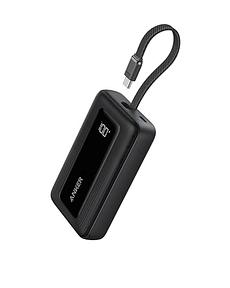
For the everyday case — phone, earbuds, the occasional tablet — a 20,000 mAh unit with 45 W is enough. The UGREEN Nexode Power Bank 20000mAh 45W mit integriertem USB-C Kabel comes from the one manufacturer above that publishes a cycle count with a residual-capacity threshold; that is no proof of this particular model's durability, but it does indicate a manufacturer willing to state such figures at all.
If you mainly want a dependable second source for a phone and can do without charging speed, the Anker Zolo Powerbank (2025 Upgrade), 20000mAh, 30W High-Speed-Ladegerät mit integriertem USB-C Kabel, Akku-Pack für iPhone 17/16/15-Serie, Galaxy und mehr is the cheaper route — 30 W is plenty for any handset, and the built-in cable removes the accessory that always goes missing first.
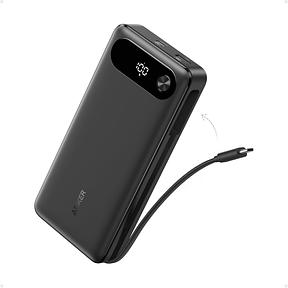
If the replacement also has to feed a laptop, there is no way around higher output. The Anker Powerbank, 20.000mAh tragbares Ladegerät mit integriertem USB-C-Kabel, 87W Max Schnellladung, kompatibel mit MacBook, iPhone, Samsung und mehr delivers up to 87 W and stays at 20,000 mAh, below the point where carry-on rules get complicated — the watt-hour arithmetic for that is in section 6.

UGREEN Nexode Power Bank 20000mAh 45W mit integriertem USB-C Kabel
View at Amazon (as of Aug 11)Affiliate link. Buying through it earns us a commission; the price stays the same for you.
Affiliate link. Buying through it earns us a commission; the price stays the same for you.
Affiliate link. Buying through it earns us a commission; the price stays the same for you.
8. What the big tests say about this: nothing
It is striking how little solid data exists on this exact question. On 7 January 2026 Germany's Stiftung Warentest tested 24 power banks and weighted the verdict as follows: function 60%, handling 25%, robustness 15%, plus safety checks for short circuit and overcharging. Lifespan, cycle count and capacity loss over time do not appear in that test at all. What the test did measure, and how the 24 units fared, we broke down in our piece on the 2026 Warentest safety test.
That is not a criticism of the method — a 500-cycle endurance run takes months and fits badly into a test schedule for a product whose model generation turns over within a year. But it does mean the only durability figures available come from the manufacturers themselves. And those, as section 2 shows, are not even comparable with each other.
In practice that leaves one reliable strategy: do not buy on a cycle rating, avoid the four behaviours from section 5, and know the five signs from section 6. Both cost nothing and work with any cell chemistry.
All products from this post
The ones we named above are marked; the rest are alternatives in the same category.
Affiliate notice: As an Amazon Associate, we earn from qualifying purchases. Product prices and availability are subject to change.
Frequently Asked Questions
How many charge cycles does a power bank last?
Anker states "up to 300-500 charge cycles" for its own power banks (as of 11 Aug 2024) but names no residual capacity. UGREEN states 1,000 cycles at 80% capacity for the Nexode 20000mAh 130W (retrieved 7 Aug 2026). The figures are not comparable: only the second says how much capacity is left at the end. Battery University lists roughly 300 cycles at full discharge and roughly 1,000 at 40% depth of discharge for NMC cells in BU-808.
Does every recharge count as one charge cycle?
No. A charge cycle counts cumulatively. Anker's worked examples: using 50% twice equals one cycle, using 25% four times equals one, using 20% five times equals one (as of 17 July 2026). Discharging the power bank only partially therefore uses less than a full cycle per trip to the socket — and is gentler on it as well, because a lower depth of discharge markedly raises the achievable cycle count.
Does a power bank age even if I do not use it?
Yes. Battery University puts the capacity still recoverable after one year of storage at 25 °C at 96% for a cell held at 40% charge, and at 80% for a fully charged one. At 40 °C the figures are 85% and 65% respectively (BU-808, retrieved 7 Aug 2026). Fully charged and stored warm is the worst case. Anker recommends topping the power bank up at least once every three months.
At what charge level should I store a power bank?
Neither full nor empty. Germany's Federal Environment Agency advises not charging rechargeable batteries fully empty or fully full, and ideally only to 90 percent (as of 16 July 2026). For longer storage, Battery University's numbers argue for a much lower level: a cell held at 40% charge retains 96% of its capacity after a year at 25 °C, a full one only 80%. The agency names 10 to 25 degrees as the storage temperature range.
How do I know a power bank needs replacing?
Five signs: a bulging casing or an opening seam, failing to charge the target device even once, noticeable warmth with nothing plugged in, markedly elevated self-discharge after a few weeks in a drawer, and a jumping charge indicator or cutting out under load. The first is a stop criterion: Germany's Federal Environment Agency advises against using swollen or deformed rechargeable batteries (as of 16 July 2026).
Do consumer test labs measure power bank lifespan?
Not in the current test. On 7 January 2026 Stiftung Warentest examined 24 power banks, weighting function at 60%, handling at 25% and robustness at 15%, plus safety checks for short circuit and overcharging. Lifespan, cycle count and capacity loss over time were not part of it. The durability figures that are available therefore come exclusively from the manufacturers themselves.