
Power Bank for Laptop: 100 Watt USB-C and the 100 Wh Limit
 18 min read
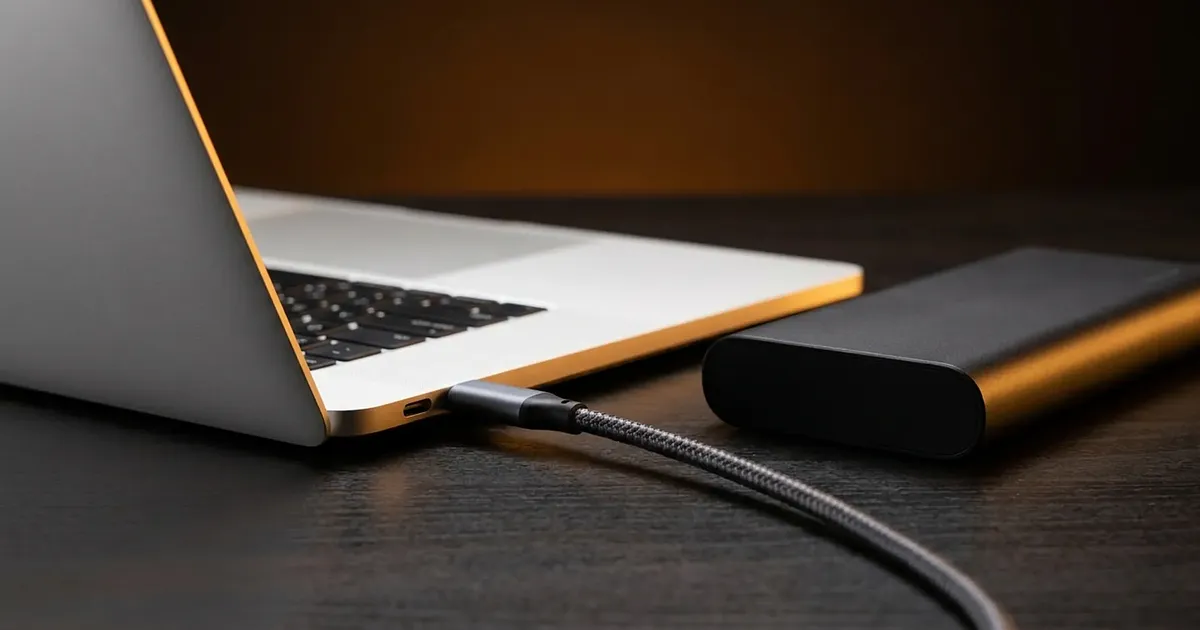
Two numbers with the same prefix decide this purchase, and they do not measure the same thing. 100 watts is a rate: how fast energy flows. 100 watt-hours is a reservoir: how much is in there at all. Treat one as the other and you end up with a device that charges too slowly — or one that is not allowed to fly with you.
How tightly the two collide is shown by Apple, of all companies. The battery in the MacBook Pro 16″ is listed in Apple's own tech specs at exactly 100 watt-hours — precisely the figure the German Luftfahrt-Bundesamt names as the approval-free ceiling for batteries in passenger baggage. Two pages fetched independently, one laptop battery and one regulatory limit, the same number.
That is not coincidence but design: manufacturers build right up to the line and not a millimetre past it, because anything above needs the operator's permission. So you need both numbers when you buy — and the second is rarely printed where you go looking for it.
What 100 watts actually is
100 watts is not a rounded marketing number. It is the top of the Standard Power Range in the USB Power Delivery spec: 20 volts at 5 amps. Granite River Labs, a USB-IF authorised test lab, writes in its PD 3.1 introduction of 14.09.2021 that this SPR ceiling stayed at 100 watts, and that only the Extended Power Range, with its 28 V, 36 V and 48 V steps, reaches 240 watts. (usb.org itself could not be fetched for this research, so this cites the authorised lab rather than the consortium.)
For those 5 amps to be allowed to flow at all, the cable has to say so. heise online put it plainly on 10.04.2020: anything above 60 watts needs an electronically marked USB-C cable. This is where a lot of charging attempts quietly fail. It does charge. Just slowly.
One cable in that class is NIMASO USB-C auf USB-C Kabel 100 W 20V/5A mit E-Mark Chip (1 m), rated by its maker at 20 volts / 5 amps with an E-Mark chip. If you are aiming at PD 3.1 and the EPR steps, you need a cable that declares more, such as UGREEN USB-C Kabel 240 W PD 3.1 mit E-Marker und Display (2 m) at 240 watts with an E-Marker.
The second trap sits in that same heise piece. Supplies below 60 watts top out at 15 volts, including the very common 45-watt tier: the 20 volts you need arrive reliably only from 60 watts upwards. A laptop expecting 20 volts will not get them from a 45-watt device. That is not slightly less power. It is the wrong voltage step.
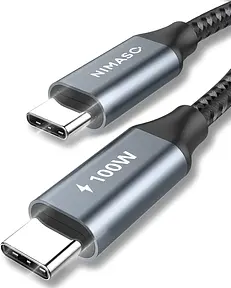
NIMASO USB-C auf USB-C Kabel 100 W 20V/5A mit E-Mark Chip (1 m)
View at Amazon (as of Aug 11)Affiliate link. Buying through it earns us a commission; the price stays the same for you.
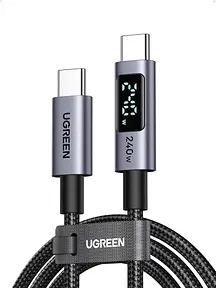
UGREEN USB-C Kabel 240 W PD 3.1 mit E-Marker und Display (2 m)
View at Amazon (as of Aug 11)Affiliate link. Buying through it earns us a commission; the price stays the same for you.
The watt-hours that decide whether you fly
The Luftfahrt-Bundesamt sets the limit at 100 watt-hours of rated energy. In the authority's own wording, a battery may exceed 100 Wh with the operator's approval but "höchstens 160 Wh haben" — never more than 160 Wh — and in that band a maximum of two spare batteries per person is allowed. Two further rules from the same page bite more often than the watt-hour figure itself: every battery must be disconnected with its terminals insulated, and loose spares never go into checked baggage.
That wording is a hard ceiling: above 160 Wh there is no place in passenger baggage, with approval or without.
How many milliamp-hours that works out to can be derived from the measurements heise published on 16.01.2026, where 20,000 mAh corresponds to a rated 74 watt-hours, implying a 3.7 V nominal cell voltage. Extrapolated, the 100 Wh line sits at roughly 27,000 mAh. We wrote the conversion up separately in both directions, including why it is 3.7 volts and not the 5 volts on the port.
And here is the part almost nobody checks: right at that line, the conversion stops being reliable.
Take the Anker Prime at 27,650 mAh. The rule of thumb, 3.7 V × 27,650 mAh ÷ 1000, gives 102.3 watt-hours — over the free limit. Yet the manufacturer's own description on the retail listing declares 99.54 watt-hours, putting the device under it, and says so with explicit reference to the sub-100 Wh cabin rule. Meanwhile Anker's own product page states "Total Capacity: 27,650 mAh" and not a single watt-hour. One device, and the number that decides whether it flies is missing from the manufacturer's own page.
A second example makes it starker. A portable POWKEY power station at 30,000 mAh carries its watt-hour figure in the product title: 96 Wh, where the rule of thumb would produce 111.0. The answer is the cell chemistry: 96 ÷ 30 = 3.2 volts, LiFePO4 rather than the 3.7 volts of a conventional lithium-ion cell. It appears here purely as arithmetic, not as a recommendation — its rating sits below the threshold at which we link a product.
Both times the rule of thumb reads high, and both times it would wrongly flag an airline-legal device as needing approval — the less dangerous of the two possible errors, but an error. So the correct instruction is not "convert it" but "read the watt-hour figure printed on the casing". The labelling requirement is exactly why it is there.
| Device | Capacity | Rated energy | Where the Wh figure comes from | Max power on one USB-C port | Cabin baggage verdict |
|---|---|---|---|---|---|
| Anker Prime, 26,250 mAh | 26,250 mAh | 99.75 Wh | printed, manufacturer text | 140 W | under 100 Wh, no approval needed |
| Anker Prime, 27,650 mAh | 27,650 mAh | 99.54 Wh | printed, manufacturer text | not stated | under 100 Wh, no approval needed |
| Anker laptop power bank, 25,000 mAh | 25,000 mAh | 90 Wh | printed, manufacturer text | 100 W | under 100 Wh, no approval needed |
| UGREEN Nexode Pro, 20,000 mAh | 20,000 mAh | 74.0 Wh | derived: 3.7 V × 20,000 mAh ÷ 1000 | 100 W | under 100 Wh, no approval needed |
| UGREEN Nexode, 20,000 mAh | 20,000 mAh | 74.0 Wh | derived: 3.7 V × 20,000 mAh ÷ 1000 | 100 W | under 100 Wh, no approval needed |
| POWKEY, 30,000 mAh (arithmetic example only) | 30,000 mAh | 96 Wh | printed, title and manufacturer text | 100 W | under 100 Wh, no approval needed |
The unit behind that worked example is the Anker Prime Powerbank 27.650 mAh (250 W) — the largest capacity in the table, and the one where the rule of thumb gives the wrong answer. For the two UGREEN models further down the table, the watt-hour figure is our calculation, not a manufacturer statement. It is still printed on the casing, and that is the number that counts.
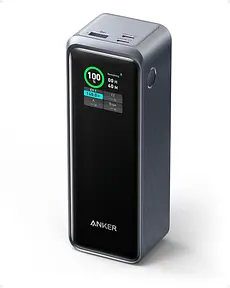
Anker Prime Powerbank 27.650 mAh (250 W)
View at Amazon (as of Aug 10)Affiliate link. Buying through it earns us a commission; the price stays the same for you.
What actually happens on board since 15 January 2026
First the regulator, then the airlines — the two do not govern the same thing.
| Level | Approval-free | With approval | Spare batteries | Use and charging on board |
|---|---|---|---|---|
| Luftfahrt-Bundesamt (Germany) | up to 100 Wh | 100 to 160 Wh, operator's approval required | max. 2 per person in the 100 to 160 Wh band | not regulated, the page does not mention it at all |
That last cell is the real finding. The authority page governs carriage, not use — read only that and you know half the rules, specifically the half that does not help you in seat 24A. The usage bans come from the airlines, and they are stricter than the regulator.
| Airline | Wh limit | Max. number | Use on board | Charging on board | Source checked |
|---|---|---|---|---|---|
| Lufthansa Group (LH, SWISS, Austrian, Eurowings, Discover, Brussels, Edelweiss, Air Dolomiti) | 100 Wh, above that pre-notification and approval | 2 per person | forbidden | forbidden | not the airline's own page: Euronews 18.01.2026, fvw 14.01.2026 |
| Condor | 100 Wh free, 100 to 160 Wh only with approval | 2 spare batteries per person | forbidden | forbidden | own hazardous goods page, carries no date |
| TUI fly | max. 100 Wh per battery | up to 20 lithium batteries | not stated | forbidden | own page, carries no date |
| Emirates | under 100 Wh | 1 per person | forbidden | forbidden | not the airline's own page, press reports only, treat as unconfirmed |
| Ryanair | not stated | not stated | not stated | not stated | help centre could not be fetched |
| easyJet | not stated | not stated | not stated | not stated | page returned no content |
| Turkish Airlines | not stated | not stated | not stated | not stated | request timed out |
That right-hand column is deliberately awkward. Condor and TUI were checked on their own pages; Lufthansa Group was not, because all three group pages refused the request. A table that looked equally confident in every row would be lying at exactly that point.
None of the three reachable airline pages carries a date of its own, and neither does the Luftfahrt-Bundesamt, so we maintain this table ourselves: every row was last re-checked against the linked sources on 03.08.2026. Carriers also tighten these rules with no lead time, as the Lufthansa Group did in January 2026 — before a flight, your airline's own page wins over this table.
Since 15 January 2026, power banks may be neither used nor charged on Lufthansa Group flights. Euronews reported on 18.01.2026 that the rule covers SWISS, Eurowings, Austrian, Discover, Brussels Airlines, Edelweiss and Air Dolomiti alongside Lufthansa: at most two devices up to 100 watt-hours, on your person or in the bag under the seat in front, explicitly not in the overhead bin. Trade title fvw flagged the ban on 14.01.2026.
Condor spells it out on its own hazardous goods page: "it is forbidden to use power banks for charging other electronic devices on board. Charging power banks via onboard power outlets is also forbidden." So neither your phone off the power bank nor the power bank off the seat socket. TUI bans charging on its own page too, from seat or aircraft power, during any phase of the flight.
If you still want a unit that stays cleanly inside that limit, the Anker Laptop Powerbank 25.000 mAh, 165 W carries its 90 watt-hours in its own product description and points explicitly at the 100 Wh cabin rule there. That is a manufacturer statement, not an independent measurement — but it is the number that counts at the gate, and it is on the device.
So what is left? The airport before departure. The gate during a layover. The train afterwards, the hotel room with one reachable socket behind the bed. Not the seat. Buying a laptop power bank purely for the flight itself means buying, on these carriers, for a use case that no longer exists.
Which airline runs which limit, and how to check one yourself, is in our guide to power banks on flights; the international decision behind it is in our post on the ICAO rules.
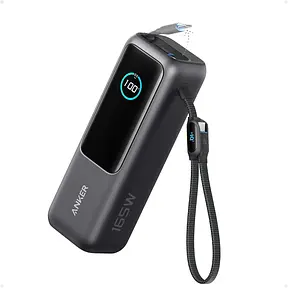
Anker Laptop Powerbank 25.000 mAh, 165 W
View at Amazon (as of Aug 11)Affiliate link. Buying through it earns us a commission; the price stays the same for you.
Why 250 watts is not 250 watts per port
The total output of a power bank is not the output of one socket, and the gap gets expensive exactly when you use the device as you bought it for.
For the Prime 27K, Anker states "Total Output 250 W Max" on its own product page, plus 28 V at 5 A per USB-C port and 10 V at 6.5 A for USB-A. All manufacturer specifications, no independent measurement.
What a single port delivers while the others are occupied is not stated there — and that is the only figure you care about the moment a phone hangs off the device next to the laptop. Nothing solid exists on it, so no number appears here.
The voltage gives away the device class: 28 volts is the first EPR step above the Standard Power Range (Granite River Labs, 14.09.2021), so this is a PD 3.1 device rather than a 100-watt one — even if plenty of laptops end up drawing exactly 100 watts from it.
Practical consequence: if you want the laptop charging at full tilt, hang nothing else on the unit. If you must, plan with less than the number on the box.
It does work the other way round too: the Anker Prime Powerbank 26.250 mAh (300 W Max, 140 W Single-Port) states its 140 watts of single-port output in the product title itself. That still says nothing about the split under load, but it is a single-port figure at all — and in this class that is the exception.
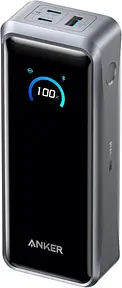
Anker Prime Powerbank 26.250 mAh (300 W Max, 140 W Single-Port)
View at Amazon (as of Aug 11)Affiliate link. Buying through it earns us a commission; the price stays the same for you.
How many charges are really in there
The power bank has a rated capacity printed on it. Less than that reaches your laptop.
heise measures usable energy with an FNIRSI FNB58 meter against an electronic load, charging fully and then discharging fully. For a 20,000 mAh unit on 16.01.2026 it reports 66.32 watt-hours usable out of 74 watt-hours rated, roughly 89 percent. For a smaller 12,000 mAh model the same source gives around 30 watt-hours usable out of 44 watt-hours rated.
Stiftung Warentest tested 24 power banks from 18 manufacturers on 07.01.2026 and puts usable energy, in the freely visible portion, at 28.5 to 35.8 watt-hours in the 10,000 mAh class and 58.3 to 69.9 watt-hours in the 20,000 mAh class. Output ratings run from 18 up to a striking 200 watts, and per the free teaser every unit tested can charge compatible laptops.
The full results table sits behind a €4.90 paywall. The winners are not publicly visible, so none is named here — anyone quoting you one from this test without having paid for it is guessing.
Now the arithmetic nobody does in the shop. Heise's measured 66.32 watt-hours against manufacturer battery ratings:
| Laptop | Battery per manufacturer | 66.32 Wh usable covers at most |
|---|---|---|
| MacBook Air 13″ | 53.8 Wh | 1.2 charges |
| ThinkPad X1 Carbon Gen 12 | 57 Wh | 1.2 charges |
| MacBook Air 15″ | 66.5 Wh | 1.0 charge |
| MacBook Pro 14″ | 72.4 Wh | 0.9 charges, not even one full one |
| MacBook Pro 16″ | 100 Wh | 0.7 charges |
Those battery figures come from Apple for the Air models, Apple for the Pro models, and Lenovo's product specification for the ThinkPad. All manufacturer statements.
The words at most carry that whole table. It assumes every watt-hour leaving the power bank arrives losslessly in the laptop battery, and it does not: charging electronics and heat cost more on top. No reliable measurement of that second stage could be found, and nothing here is estimated. The real figures sit below these, by an amount nobody publishes.
What does that mean for the purchase? With a MacBook Air or an ultrabook in that class, 20,000 mAh — a UGREEN Nexode Pro Powerbank 20.000 mAh (165 W, 100 W Einzelausgang, integriertes Kabel), say — is the honest boundary for one charge. From a MacBook Pro 14″ upwards you need the 25,000 or 27,000 mAh class. And more than two charges is not available inside the approval-free band at all: the 100 Wh limit arrives first.
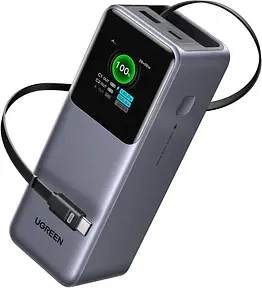
UGREEN Nexode Pro Powerbank 20.000 mAh (165 W, 100 W Einzelausgang, integriertes Kabel)
View at Amazon (as of Aug 11)Affiliate link. Buying through it earns us a commission; the price stays the same for you.
Laptops with a barrel connector
Not every laptop charges over USB-C. For machines with a classic barrel plug there are adapters, and heise described on 29.05.2025 how they work: a Power Delivery trigger chip requests 20 volts from the supply or power bank and passes it through to the laptop.
The ceiling, per the same source, is 100 watts — at most 5 amps at 20 volts. A 200-watt power bank changes nothing about that. The adapter is the bottleneck, and how much current is actually drawn is decided by the laptop.
When the power is not enough, it does not look like a fault. It looks like a loose connection. heise describes the pattern: the voltage collapses, the laptop falls back to its own battery, the load disappears, 20 volts return, the laptop switches back, and it overloads the power bank again — "und so fort", on and on.
So if your battery percentage refuses to climb while the machine insists it is charging, that oscillation is what you are looking at — not a broken cable.
Because the adapter caps at 100 watts anyway, a bigger power bank buys no extra speed on a barrel-connector laptop. A class like the UGREEN Nexode Powerbank 20.000 mAh (100 W, 2x USB-C + 1x USB-A), with 100 watts on one USB-C port, is enough here — anything above that is reserve the adapter will not pass through.
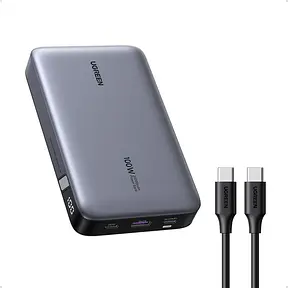
UGREEN Nexode Powerbank 20.000 mAh (100 W, 2x USB-C + 1x USB-A)
View at Amazon (as of Aug 10)Affiliate link. Buying through it earns us a commission; the price stays the same for you.
The short version
A power bank for a laptop is chosen on two numbers that have nothing to do with each other. The power figure decides whether it charges at all, and there the cable class above 60 watts matters as much as the 20 volts. The energy figure decides how often — and whether you may fly with it — and there the Luftfahrt-Bundesamt's 100 Wh line is the frame.
Three sentences that save the purchase when in doubt. Read the watt-hours off the casing instead of calculating them from mAh. Budget for roughly 89 percent usable energy rather than the rated capacity, and treat even that as a ceiling. And check your airline's own page before the flight, not just the regulator's, because the usage bans live there and nowhere else.
All products from this post
The ones we named above are marked; the rest are alternatives in the same category.
Affiliate notice: As an Amazon Associate, we earn from qualifying purchases. Product prices and availability are subject to change.
Frequently Asked Questions
How many watt-hours can a power bank have on a plane?
100 watt-hours. The Luftfahrt-Bundesamt names that as the approval-free ceiling in passenger baggage. Between 100 and 160 watt-hours you need the operator's approval, and a maximum of two spare batteries per person. Loose spares never belong in checked baggage, and terminals must be insulated.
Can I charge my laptop from a power bank during a flight?
Not on Lufthansa Group. Use on board has been banned since 15 January 2026, as reported by Euronews on 18.01.2026 and by the trade title fvw on 14.01.2026. Condor bans both use and charging on its own hazardous goods page, and TUI bans charging during any phase of the flight. For Ryanair, easyJet and Turkish Airlines no retrievable statement was available.
Is a 20,000 mAh power bank enough for one full laptop charge?
For small ultrabooks, only just. On 16.01.2026 heise measured 66.32 watt-hours usable from a 20,000 mAh unit rated at 74 watt-hours. Per Apple, a MacBook Air 13″ holds 53.8 watt-hours and a MacBook Pro 14″ holds 72.4. For the Pro that is not even one full charge on paper, before losses inside the laptop.
Can I just convert mAh into watt-hours?
As a rough approximation yes, at the 100 Wh line no. The formula assumes a 3.7 V nominal cell voltage. An Anker Prime at 27,650 mAh would come out at 102.3 watt-hours, yet 99.54 watt-hours is declared. A POWKEY at 30,000 mAh would come out at 111 watt-hours, while 96 watt-hours is printed, because LiFePO4 cells run near 3.2 volts. Read the printed figure.
My laptop has no USB-C port. Can it still work?
Only with a barrel connector adapter. heise described on 29.05.2025 how these contain a Power Delivery trigger chip that requests 20 volts and passes it to the laptop. The ceiling is 100 watts, i.e. 20 volts at 5 amps. A stronger power bank changes nothing — the adapter is the bottleneck.
Do I need a special cable for 100 watts?
Yes. heise stated on 10.04.2020 that electronically marked USB-C cables are required above 60 watts, because only the E-Marker releases the 5 amps. A cable without that chip still charges, just capped. For the EPR steps up to 240 watts, the E-Marker has to report 50 volts at 5 amps according to Granite River Labs.
Which power bank is the test winner?
That cannot be answered from public sources. Stiftung Warentest tested 24 power banks from 18 manufacturers on 07.01.2026, but the full results table sits behind a €4.90 paywall. Only the usable-energy ranges and the manufacturer list are free. So no winner is named here.
Sources
- MacBook Pro 16″ is listed in Apple's own tech specs apple.com
- Luftfahrt-Bundesamt lba.de
- Granite River Labs graniteriverlabs.com
- heise online heise.de
- heise heise.de
- Anker's own product page anker.com
- Euronews reported on 18.01.2026 euronews.com
- fvw fvw.de
- own hazardous goods page condor.com
- TUI tui.com
- Stiftung Warentest test.de
- Apple apple.com
- Lenovo's product specification psref.lenovo.com
- heise described on 29.05.2025 heise.de