Jackery, EcoFlow, Bluetti and Anker Solix: What the Independent Tests Actually Found
 20 min read
Last verified: 06 May 2026
Four brand names that surface in almost every power station search. And one question that has no answer as asked: which brand is best? Each of these four sells units from under 300 watt-hours to over five kilowatt-hours, from a camping battery to a whole-house backup. A brand is not a product class.
There is a version of the question that can be answered: which unit scored what, in the same test, on the same day, by the same method. Exactly one German institution has done that for all four brands at once.
It is not Stiftung Warentest. It is the ADAC, and its result of 11 June 2025 contains a finding that is simply missing from most brand comparisons online: two of the eight units tested failed outright, and one of them carries a name from the headline.
Why "which brand" is the wrong question
A brand comparison assumes something like brand quality that holds across an entire range. For power stations, that is not even roughly true. These four build units in classes that have little to do with one another: a 300 Wh box for a tent, a 1 kWh unit for a blackout, a 5 kWh system with expansion batteries. Within a single brand the inverter, charging electronics, app and cooling differ completely. A test result for a 1 kWh model tells you almost nothing about its 3 kWh sibling.
So the comparison here rests on a cohort, not on logos: eight units, one test, one date, one method. Anything beyond that gets its own source alongside it.
The one cohort where all four are directly comparable
The ADAC tested eight portable power stations in spring 2025 at the ADAC Technik Zentrum in Landsberg am Lech and published on 11 June 2025. All eight use LFP cells. The test is free — no paywall.
Every cell carries its unit, and every value comes from the test itself. Nothing here is estimated, rounded or converted.
| Unit | Overall grade | RRP per ADAC | Rated capacity | Continuous output | Measured usable AC | Measured usable DC | Weight |
|---|---|---|---|---|---|---|---|
| Bluetti AC180P | 2.0 | €1,499 | 1440 Wh | 1800 W | 1341 Wh | 1301 Wh | 16.0 kg |
| Ecoflow Delta 3 Plus | 2.1 | €999 | 1024 Wh | 1800 W | 935 Wh | 898 Wh | 12.5 kg |
| Allpowers R1500 | 2.5 | €1,000 | 1152 Wh | 1800 W | 1000 Wh | 1004 Wh | 16.7 kg |
| Anker Solix C800 Plus | 2.5 | €699 | 768 Wh | 1200 W | 630 Wh | 663 Wh | 10.9 kg |
| DJI Power 1000 | 2.6 | €999 | 1024 Wh | 2200 W | 879 Wh | 845 Wh | 13.0 kg |
| Fossibot F1200 | 2.7 | €699 | 1024 Wh | 1200 W | 910 Wh | 971 Wh | 11.5 kg |
| Ective BlackBox 10 | 5.0 | €1,000 | 1037 Wh | 1000 W | 918 Wh | 969 Wh | 15.0 kg |
| Jackery Explorer 1000 v2 | 5.0 | €999 | 1070 Wh | 1500 W | 943 Wh | 930 Wh | 10.8 kg |
All figures per the ADAC, published 11 June 2025. German grades run 1.0 (best) to 5.0 (worst). Prices are the manufacturer's recommended price at the time of testing, not street prices.
Two things stand out immediately. The two units graded 5.0 do not have the worst measurements — the Jackery delivers more usable energy than the runner-up Ecoflow, and the Ective more than the Anker. And the most expensive station is the largest, but not automatically the most frugal with its own capacity.
What actually comes out of the rated capacity
The ADAC gives a rule of thumb: real-world usable net capacity ran "on average a good 10 to 15 percent" below the gross figure the manufacturer states.
That spread can be worked out per unit, because the ADAC publishes both numbers. The table below is exactly that: our own arithmetic on the ADAC's measured values. Not our measurement, and not an ADAC figure.
| Unit | Usable AC as % of rated | Usable DC as % | € per measured AC watt-hour |
|---|---|---|---|
| Bluetti AC180P | 93.1 % | 90.3 % | €1.12/Wh |
| Ecoflow Delta 3 Plus | 91.3 % | 87.7 % | €1.07/Wh |
| Fossibot F1200 | 88.9 % | 94.8 % | €0.77/Wh |
| Ective BlackBox 10 | 88.5 % | 93.4 % | €1.09/Wh |
| Jackery Explorer 1000 v2 | 88.1 % | 86.9 % | €1.06/Wh |
| Allpowers R1500 | 86.8 % | 87.2 % | €1.00/Wh |
| DJI Power 1000 | 85.8 % | 82.5 % | €1.14/Wh |
| Anker Solix C800 Plus | 82.0 % | 86.3 % | €1.11/Wh |
The €/Wh column uses the recommended price at test time, not a street price.
As an average, the ADAC's rule of thumb holds. What it hides is the spread: the best unit loses just under 7 percent, the worst 18. For the Anker Solix C800 Plus that means 630 watt-hours arrived at the 230-volt socket out of 768 stated — the ADAC lists "usable AC energy only adequate" as a weakness of that unit.
One detail rewards a second look. Four of the eight deliver more at their DC outputs than at the 230-volt socket — the Anker at 663 against 630 watt-hours, alongside the Fossibot, Ective and Allpowers. It matters most on the Anker, because its 230-volt figure is the weakest in the field. Run it mostly on USB-C and the 12-volt socket and you lose considerably less than 82 percent suggests. Plug in a kettle and you lose more. The inverter is the difference.
How to turn watt-hours into actual runtime for your own gear is covered in from watt-hours to real runtime. Why the number on the case is rarely the number that arrives is in converting mAh to watt-hours.
The finding that sank the Jackery
Now the part that brand comparisons almost never carry. It demands precision.
The ADAC's press release of 11 June 2025 states, in the original German:
"Sowohl die Ective BlackBox 10 als auch die Jackery Explorer 1000 v2 landen mit einer Gesamtnote von 5,0 auf dem letzten Platz. Beide Produkte wurden in der Kategorie Sicherheit abgewertet. Denn werden die Stationen zum Laden parallel an einen Pkw und ein Solarpanel angeschlossen, drohen Überspannungen, die Schäden am Fahrzeug verursachen können. Der Nutzer wird weder an den Geräten noch in den Gebrauchsanweisungen darauf hingewiesen, dass die beiden Anschlüsse nicht gleichzeitig genutzt werden dürfen."
In English: both units finish last with an overall grade of 5.0, downgraded in the safety category, because charging in parallel from a car and a solar panel risks overvoltage that can damage the vehicle — and neither the device nor the manual warns that the two inputs must not be used simultaneously.
On the unit page for the Jackery Explorer 1000 v2 the technical core appears as a listed drawback: the DC charging inputs are "nicht voneinander entkoppelt", not decoupled from one another. The voltage of a connected PV system — permitted up to 60 volts and 400 watts — therefore sits directly on the second DC input, and vice versa. For the Ective BlackBox 10 the figures are 30 volts and 200 watts.
This is a safety finding by a named body, about a named unit, on a named date. It is explicitly not a statement about the Jackery brand, and not about other Jackery models. The test covered exactly one Jackery unit.
How far the finding skews the grade
The ADAC weights handling at 35 percent, function at 35 percent and features at 30 percent. Safety carries 0 percent weight but acts as a knockout: a 5.0 on safety drags the overall grade to 5.0 regardless of the rest.
Recompute those three weighted sub-grades for all eight units and six of them land exactly on the published overall grade. Two do not — and they are precisely the two that were downgraded. Again our own arithmetic on the ADAC's published sub-grades, not an ADAC figure:
| Unit | Handling | Function | Features | Computed from those three | Published overall |
|---|---|---|---|---|---|
| Bluetti AC180P | 1.8 | 2.5 | 1.6 | 2.0 | 2.0 |
| Ecoflow Delta 3 Plus | 2.4 | 2.1 | 1.9 | 2.1 | 2.1 |
| Jackery Explorer 1000 v2 | 1.8 | 2.9 | 2.1 | 2.3 | 5.0 |
| Anker Solix C800 Plus | 2.6 | 3.2 | 1.7 | 2.5 | 2.5 |
| Allpowers R1500 | 2.8 | 2.6 | 2.0 | 2.5 | 2.5 |
| DJI Power 1000 | 2.3 | 2.8 | 2.6 | 2.6 | 2.6 |
| Fossibot F1200 | 2.2 | 3.1 | 2.8 | 2.7 | 2.7 |
| Ective BlackBox 10 | 2.5 | 3.1 | 3.7 | 3.1 | 5.0 |
Without the safety finding the Jackery Explorer 1000 v2 would sit at 2.3 and rank third in this cohort, ahead of the Anker Solix C800 Plus and the Allpowers R1500. It holds the best handling grade in the field, level with the Bluetti, and the ADAC praises its reliable operation, its "very good app" and its illuminated buttons.
None of that cancels the finding. It places it: what failed here is not a weak machine but a good one, at a single point of construction. If you never charge from a vehicle and a solar panel at the same time, this point does not reach you. If you run a camper van, where doing both is the obvious thing, it does.
What the manufacturers say about it
Short version: nothing we could find.
As of 06 May 2026, no public statement from Jackery or Ective on this result was locatable. We checked the ADAC overview and unit pages, the ADAC press release, Jackery's German product page and knowledge base, Ective's website including the BlackBox manual, and the German coverage of the test — among it ifun.de of 12 June 2025, Caschys Blog of 11 June 2025 and giga.de of 11 June 2025. None of them quotes a manufacturer response. The ADAC has neither updated nor corrected the test since 11 June 2025; both units still carry 5.0 and no retest has been published.
Three limits belong here rather than in a footnote. chip.de and computerbild.de were unreachable for our research, so they are unchecked. The Ective manual PDF was only partly machine-readable, and its modification date of 06 June 2025 predates the test anyway. And "no public statement locatable" is not "the manufacturer declined to comment" — a reply sent directly to the ADAC, printed in a magazine, or behind a paywall would be invisible from outside.
What Stiftung Warentest and heise measured
The ADAC is not the only address. It is only the one with all four brands in a single cohort. The others tested something else, and that is precisely why the search results look contradictory.
| Body | What was tested | Class | Date | Free or paid | Covers the four brands? |
|---|---|---|---|---|---|
| ADAC | 8 portable power stations | 768 to 1440 Wh | published 11 June 2025 | free | yes, all four |
| Stiftung Warentest | 11 power stations, bought February 2023 | 400 to 644 Wh per manufacturer | issue 8/2023, published 20 July 2023 | headline data free, results table €4.90 | yes, but 2023 models |
| heise online | best-of list across all classes | 155 to 5120 Wh | as of 30 December 2025 | free | none of the four in the readable positions |
| Öko-Test | no power station test locatable | — | — | — | no |
Stiftung Warentest never ran the comparison in this class. Its test covered 11 units of 400 to 644 watt-hours per manufacturer at €470 to €825, five of which earned "good". All four brands were present, but with the models of their day: Anker 535 PowerHouse, Bluetti EB55, Jackery Explorer 500 and the winning Ecoflow River 2 Max at roughly €520. The decisive point: the two cohorts do not overlap at all. Warentest's largest unit holds 644 watt-hours; the ADAC's smallest holds 768. There is not a single unit both bodies have anything to say about.
Worth knowing, because it is misquoted constantly: on 07 January 2026 test.de published a news item carrying a current date, prompted by the Berlin power outage at the start of the year. It contains no new test and no new measurements, and names the same 2023 models at the same 2023 prices. Cite it as "Stiftung Warentest 2026" and you are citing a three-year-old test.
heise online measures freely and continuously, but keeps no lists split by capacity. As of 30 December 2025 its list is topped by the Ecoflow Delta Pro 3 at 4096 Wh rated — four times the size of the ADAC cohort. None of the four ADAC-tested models appears in the portion of that list we could read; positions four to ten could not be retrieved, so we can say nothing about those.
One heise figure does map straight onto the table above. heise budgets 15 percent conversion loss on average, and measured the Delta Pro 3 at 96 percent usable capacity above 2000 watts, 95 percent at 500 watts and around 88 percent in mixed operation. Two independent bodies land on the same order of magnitude as the ADAC's 10 to 15 percent — and heise shows what drives it: the loss tracks the load, not the logo.
We searched Öko-Test, Chip, TÜV and university labs and found no comparative power station test. Öko-Test has published on PV modules, solar installations and balcony storage batteries, but nothing locatable on portable power stations. TÜV certifies storage against standards, which is certification rather than comparative testing and must not be read as the latter.
Warranty and service in Germany
The point where these four differ far more sharply than in any measurement. Two things first. Germany's statutory two-year warranty under § 438 BGB is owed by the seller, independently of any manufacturer guarantee. And guarantee terms change while most of these pages carry no revision date — check the manufacturer's current page before you buy.
What stands out on the German-language manufacturer pages is less the duration than the structure behind it:
EcoFlow is the only one that is unambiguous. The Delta 3 Plus is named in the warranty table with a flat term and no registration condition. The page states Germany's statutory two-year period explicitly and carries its own revision date, 01 March 2023. The responsible entity per the imprint is EcoFlow Germany GmbH in Düsseldorf.
Jackery has the best legal footing and the worst documentation. There is a genuine German subsidiary in Düsseldorf, and the clearest postage rule of the four: on a valid defect, Jackery pays return shipping. But two German pages from the same manufacturer contradict each other — the warranty page states a flat 24 months, the service policy dated 01 January 2023 up to five years depending on model. There is also a clause almost nobody knows: per that page the guarantee does not cover the battery cell unless the unit is fully charged within seven days of purchase and at least once every six months thereafter.
Bluetti quotes 24 to 72 months for portable energy storage but maps no model to a point inside that range, and the promised detail table is not linked from the German page at all. The guarantor is BLUETTI Power Inc., not the German distributor.
Anker Solix is the most striking case: its German-language warranty pages do not list portable power stations as a category at all. One is an older Anker consumer-electronics table with no power station row; the other covers balcony-solar hardware only. The five-year figure for the C800 Plus appears solely in the product page's spec block, not in any warranty term. The responsible entity per the imprint is a Dutch company in Rotterdam.
Which station for which job
No brand winner, no crown. Three units from the same test, each with the figure that qualifies it.
Two notes first. We deliberately link no offer for the Bluetti AC180P or the Anker Solix C800 Plus, even though the Bluetti won: for neither could we confirm an offer matching the exact unit that was tested, and linking another model in the same series would be a different unit with different measurements — the Bluetti AC180 without the P, for instance, holds 1152 Wh rather than 1440 Wh. And every grade below comes from a 2025 test, not from today.
When connectivity and charging power matter
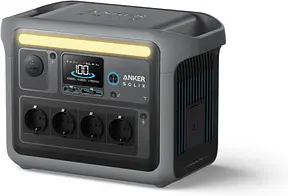
The EcoFlow Delta 3 Plus Powerstation, 1024 Wh is the best-graded unit we can link at 2.1. The ADAC records four 230-volt sockets for it, two USB-C ports at 140 watts and PV charging at twice 500 watts. Measured: 935 watt-hours from 1024 Wh rated. The ADAC highlights that it takes an expansion battery, but criticises the charging ports sitting at the rear and the missing PV cable.
Not available in your region — closest match
Anker SOLIX C1000 Powerstation, LiFePO4, 1800 W
View at Amazon (as of Aug 11)Affiliate link. Buying through it earns us a commission; the price stays the same for you.
When price per watt-hour matters
The cheapest energy in the test comes from none of the four headline brands but from the FOSSiBOT Tragbare Powerstation F1200, 1024Wh LiFePO4 Solargenerator, 1200W at €0.77 per measured AC watt-hour, graded 2.7. Its features score is weaker than the brand units', but at 971 watt-hours from 1024 Wh it holds the highest DC efficiency in the whole cohort. Run a station mainly on USB-C, a cool box and 12-volt gear and this is the most usable energy per euro here.
Not available in your region — closest match
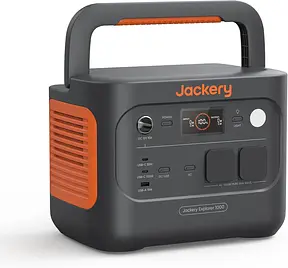
Jackery E1000 v2 Tragbare Powerstation, 1070Wh, 1500W AC-Ausgang, LiFePO4
View at Amazon (as of Aug 11)Affiliate link. Buying through it earns us a commission; the price stays the same for you.
When you want the failed unit in context
The Jackery E1000 v2 Tragbare Powerstation, 1070Wh, 1500W AC-Ausgang, LiFePO4 is the unit this article is largely about. We link it because the piece assesses it at length, and hiding the offer helps nobody. But the finding belongs beside it: 5.0 from the ADAC on 11 June 2025 for DC charging inputs that are not decoupled, with no public manufacturer statement as of this article's verification date. On the arithmetic above it would sit at 2.3 and third place without that single point. If you know for certain you will never charge from vehicle and solar panel simultaneously, the finding does not reach you. If you own a camper van, it does.
Jackery E1000 v2 Tragbare Powerstation, 1070Wh, 1500W AC-Ausgang, LiFePO4
View at Amazon (as of Aug 11)Affiliate link. Buying through it earns us a commission; the price stays the same for you.
In short
If you take one thing away: comparing these four brands rests on exactly one solid German foundation, a test of eight units in a single class published on 11 June 2025. Everything beyond that compares product ranges, not products. Warentest is stuck in 2023 and in a class half the size; heise measures continuously but none of these four models.
Within the ADAC cohort the Bluetti AC180P wins narrowly from the Ecoflow Delta 3 Plus. The Anker Solix C800 Plus is the cheapest brand unit and loses the most at its 230-volt socket. And the Jackery Explorer 1000 v2 is the lightest unit in the whole field at 10.8 kg — and would have finished third but for a single point of construction.
That nobody has publicly addressed that point in nearly a year is, in the end, the most conspicuous number in this comparison.
All products from this post
The ones we named above are marked; the rest are alternatives in the same category.
Not available in your region — closest match
Anker SOLIX C1000 Powerstation, LiFePO4, 1800 W
View at Amazon (as of Aug 11)
Not available in your region — closest match
Jackery E1000 v2 Tragbare Powerstation, 1070Wh, 1500W AC-Ausgang, LiFePO4
View at Amazon (as of Aug 11)
Affiliate notice: As an Amazon Associate, we earn from qualifying purchases. Product prices and availability are subject to change.
Frequently Asked Questions
Which power station won the test?
The most recent free German test covering all four major brands is the ADAC test published on 11 June 2025, with eight units from 768 to 1440 watt-hours. The Bluetti AC180P won with a grade of 2.0, ahead of the Ecoflow Delta 3 Plus at 2.1. The Anker Solix C800 Plus scored 2.5 and the Jackery Explorer 1000 v2 scored 5.0. There is no cross-brand winner spanning all classes and all testing bodies.
Why did the Jackery Explorer 1000 v2 get 5.0 from the ADAC?
Because of a safety finding on its two DC charging inputs. Per the ADAC they are not decoupled from one another, so charging simultaneously from a vehicle and a solar panel risks overvoltage that can damage the vehicle. Neither the unit nor the manual warns about it. The safety grade acts as a knockout and pulls the overall grade to 5.0, even though handling, function and features were rated 1.8, 2.9 and 2.1.
Does that make Jackery a bad brand?
That cannot be derived from this test. One Jackery unit was tested. The finding concerns a specific construction detail of that model, not the range. Its measured usable energy, 943 of 1070 watt-hours, was higher than the runner-up's, and its handling grade was the best in the field.
Has Jackery responded to the ADAC finding?
As of 06 May 2026 no public statement from Jackery was locatable, neither on its German site nor in the German coverage of the test. The ADAC has not updated or corrected the test either. That does not mean no response exists, only that none was publicly findable.
Has Stiftung Warentest tested power stations?
Yes, but most recently in issue 8/2023, published on 20 July 2023, covering 11 units of 400 to 644 watt-hours per manufacturer. The winner was the Ecoflow River 2 Max at around €520. No newer Warentest power station test exists. The test.de news item of 07 January 2026 carries a current date but is a re-surfacing of the 2023 test with no new measurements.
How much of a power station can you actually use?
The ADAC puts the loss at a good 10 to 15 percent on average against the manufacturer's figure, and heise budgets 15 percent conversion loss on average. Recomputing the ADAC's published per-unit measurements gives a wider spread: 82.0 to 93.1 percent at the 230-volt socket, so a loss between 7 and 18 percent. Those percentages are our arithmetic on someone else's measurements, not our own measurement.
What is the difference between AC and DC capacity?
AC is the energy available at the 230-volt socket, after conversion by the inverter. DC is the energy at the direct-current outputs such as USB-C or the 12-volt socket, without that conversion. The DC figure is usually higher. For the Anker Solix C800 Plus the ADAC measured 630 watt-hours AC against 663 watt-hours DC.