Balcony Solar and German Home Contents Insurance: Reporting, Theft and What Storm Cover Really Says
 17 min read
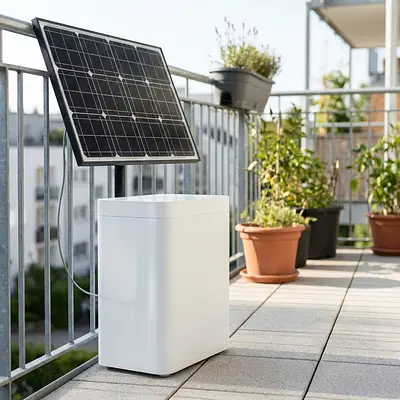
A balcony solar system hangs outdoors, weighs about twenty kilos and costs roughly what a decent bicycle costs. That makes it the one household purchase that can be contents, building fixture and a hazard to the neighbours all at once — depending on who you ask and which contract you signed.
The good news first: since late 2023, the model policy wording published by Germany's insurance association, the GDV, names balcony solar explicitly. The less good news: model wordings are non-binding, the single most important figure in the relevant clause is left blank, and the most likely way one of these systems disappears — somebody simply lifting it off a ground-floor balcony — is not among the insured perils as the wording stands.
This guide works through the four questions that actually decide who pays: where the system is covered, whether you have to report it, what happens in a storm, and what happens in a theft. Every clause number below refers to the GDV model conditions. Your own policy can differ, and if it does, your policy wins.
What changed in November 2023 — and what it does not mean
On 27 November 2023 the GDV announced that balcony solar had been written into the model conditions for home contents insurance. The association's press release puts it plainly: the home contents policy most tenants already hold is enough to cover a balcony system, and no dedicated photovoltaic policy is needed.
In the wording itself this lives in the Allgemeine Hausrat Versicherungsbedingungen VHB 2022, version dated June 2026, at clause A 8.3.3. Household contents include, in the original German, „privat genutzte Antennenanlagen, Markisen und Balkonkraftwerke (sog. Plug & Play Solar für die Steckdose), die ausschließlich der versicherten Wohnung nach A 10 dienen. Diese müssen sich auf dem Grundstück befinden, auf dem die versicherte Wohnung liegt." In English: privately used aerials, awnings and balcony solar systems that serve the insured home exclusively, and that sit on the property the insured home is on.
Two details in that paragraph get missed almost everywhere.
First, the location condition. The system has to be on the property of the insured home. A panel producing power in a rented allotment garden three streets away does not satisfy A 8.3.3. That would be a case for the away-from-home extension in A 12, which under A 12.1.2 only covers items that are outside the insured location temporarily. A permanently mounted system is not temporary.
Second, the blank. Directly beneath A 8.3.3 the model wording reads: „Die Entschädigung für Balkonkraftwerke ist je Versicherungsfall auf ____ Euro begrenzt." The payout for balcony solar is limited, per claim, to blank euros. The underscore is not a typo. The model conditions are an explicitly non-binding publication by the GDV, and the sub-limit is a placeholder each company fills in itself. There is therefore no universal figure to quote here — and anyone quoting one did not get it from the model conditions. That number is in your own policy documents.
Contents or buildings? Both wordings name balcony solar
The question sounds academic and is not. It decides whose contract pays: yours or the owner's.
| Wording | Clause | What it says |
|---|---|---|
| VHB 2022 (contents), June 2026 | A 8.3.3 | Balcony solar is household contents when it serves the insured home exclusively and sits on its property |
| VGB 2022 (buildings), June 2026 | A 7.3 | Balcony solar counts as building accessories, alongside bin stores and doorbell and letterbox systems, when on the insured property |
| VGB 2022, June 2026 | A 7.6.1 | Photovoltaic systems including modules, mounting frames, inverters and cabling are excluded from buildings cover — and the wording then states that this exclusion does not apply to balcony solar |
That is the real point of the Allgemeine Wohngebäude Versicherungsbedingungen VGB 2022: a proper rooftop PV array is not included in standard buildings cover and has to be insured separately. Balcony solar is carved out of that exclusion. If you have read that buildings insurance covers photovoltaics anyway, the clause has been read backwards.
In practice:
Tenant with a plug-in system on the railing: contents. Your policy, your claim.
Owner, system bolted to the building: usually building accessories under A 7.3 — but contents and buildings can overlap here. If you hold both policies, declare the system on both and ask which one leads in a claim.
Condominium association: the buildings policy belongs to the association, not to you. A system on your own balcony almost always stays your contents.
Whether the battery is covered is not something the model wordings settle. A 8.3.3 names the balcony system, not its storage unit. The ADAC, in its guide to PV insurance dated 24 March 2026, writes that small balcony systems up to 2 kilowatts of installed capacity and their associated batteries can be covered. That is a statement about market practice, not a clause. If a battery is attached, name it explicitly when you report the system — it is the single most expensive component. What a battery does to the economics is a separate question, covered in our piece on whether balcony storage actually pays back.
Reporting it: obligation or recommendation?
Nearly every guide says you must report a balcony system "immediately". The wording gives a more precise picture.
Clause A 23.1 VHB 2022 describes which circumstances count as a reportable increase in risk. It lists: a change to a circumstance the insurer asked about before the contract was concluded; a change to such a circumstance when moving home; an unusually long period during which an otherwise permanently occupied home is left empty and unsupervised; and agreed security measures being removed or rendered unusable. Installing balcony solar does not appear in that list as a case of its own.
It becomes reportable the moment your insurer asked about it on the application form, because A 23.1.1 then bites directly. Plenty of application forms now do ask.
Independently of that, all three relevant bodies recommend reporting:
The GDV, in its 27 November 2023 release, advises every owner of a balcony system to talk to their contents insurer about their existing contract, noting that older policies can usually be switched over to the new conditions.
The consumer advice centre for Rhineland-Palatinate, in a press release dated 28 September 2023, advises informing both the contents and the liability insurer so the system is taken into cover.
The GDV's own consumer portal wrote on 17 March 2026 that anyone commissioning a mini solar system should inform their insurers without delay.
The practical reason is less about obligation than about evidence. A system the insurer knows about is not an argument in a claim. One it first hears about from the claim form can become one — particularly on contracts written before the end of 2023 that have not been switched to the new conditions.
How to report it usefully: in writing, by email or letter, with the output in watts, the purchase price, the mounting method and whether a battery is attached. Put two questions in the same message: what is the payout limit for balcony solar in my tariff, and is the battery included? Keep the answer. It is worth more than any amount of clause interpretation.
Storm damage: Beaufort 8 is a threshold, not a figure of speech
Storm is defined precisely in A 6.1.1 VHB 2022: a weather-related air movement of at least wind force 8 on the Beaufort scale, meaning a wind speed of at least 62 kilometres per hour.
That is a hard threshold. A module that slips off a railing in a force 6 gust is not a storm claim as the wording defines it, and the contents policy has no separate peril for gusts below the line.
Because measured wind force at the scene is rarely available, the conditions offer two substitutes. Under A 6.1.1.1, storm is assumed if the air movement caused damage in the vicinity of the property to buildings in sound condition, or to equally resistant objects. Under A 6.1.1.2 it is enough to show that, given the sound condition of the building, the damage can only have been caused by storm. Photographs of the neighbour's roof, a news report about the storm system, weather data from the nearest station — that is the currency this is settled in.
A 6.3.4 also covers the reverse case: storm or hail throwing building parts, trees or other objects onto insured items. The roof tile that smashes the module is covered.
One detail matters for anything mounted outdoors. For the extended natural hazards — flood, backwater, earthquake, snow pressure, avalanches — clause A 6.5.7 excludes damage to items located outside buildings as a matter of principle. And then makes exactly three exceptions: aerials, awnings and balcony solar systems under A 8.3.3. Balcony solar is one of very few outdoor items that runs inside the natural-hazards module at all. That module is normally an optional add-on, though — no add-on, no exception.
Theft: the gap almost nobody writes about
This is where it gets uncomfortable, and where many guides drift away from the wording.
Under A 4 VHB 2022, home contents insurance covers burglary, vandalism following a break-in, and robbery. Burglary exists under A 4.1.1 where the thief breaks into, climbs into, or enters a room of a building using a false key or other tools. Every further variant in A 4.1.2 through A 4.1.5 also presupposes a room of a building.
A balcony is part of the insured location under A 10.1.2 — loggias, balconies and terraces directly adjoining the building are expressly part of the home. It is not a room of a building. Someone reaching over a low railing and walking off with a module has broken into nothing.
The model wording has a name for that case but no cover for it: A 4.4.1 mentions plain theft and sleight-of-hand theft only to make clear that neither counts as robbery. There is no insured peril called plain theft in the model wording at all. Some insurers offer it as an add-on, often with a sub-limit of its own; without that agreement, the gap stays open.
The Rhineland-Palatinate consumer advice centre phrases its list just as narrowly: the contents policy pays for damage from lightning strike, hail, surge and burglary. Theft from an open balcony is not on that list, and that is not an oversight.
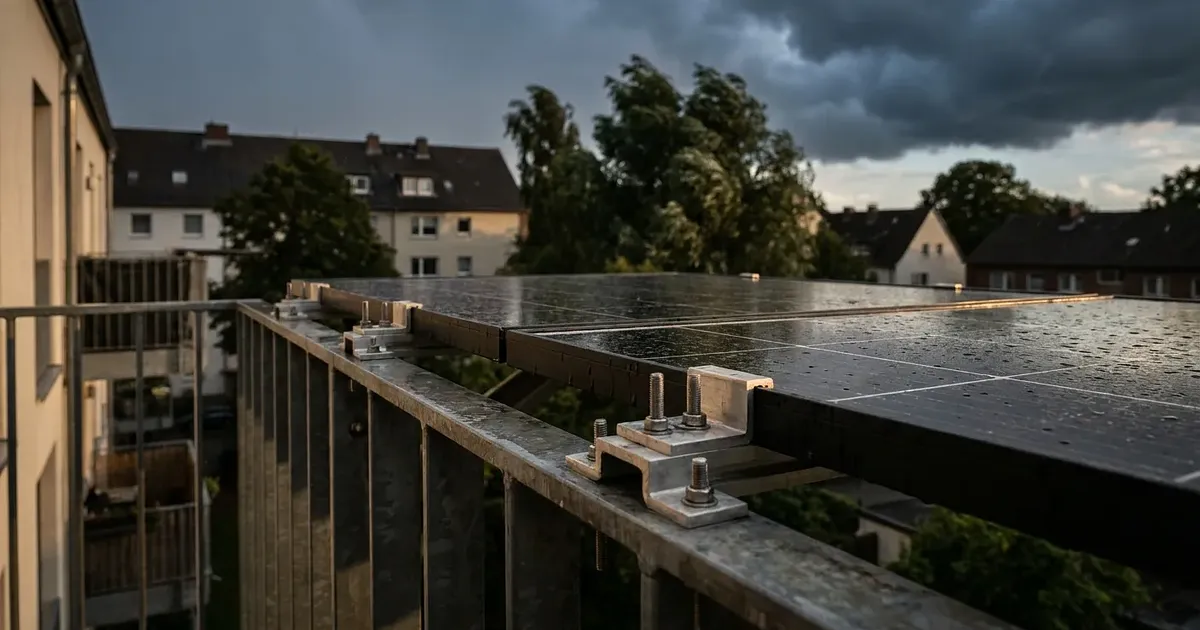
What follows is unglamorous and effective. On ground floors, in front gardens and on accessible flat roofs, the mounting decides whether there is a claim at all. Bolted rather than hooked brackets, security screws, and a module nobody can unhook in thirty seconds are the cheaper insurance here. Systems that bolt firmly to the railing instead of hanging off it — the SolarFuture railing mount SolarFuture Balkonkraftwerk Halterung Silber Standard, Geländermontage among them — make reaching over the parapet a good deal harder. If you do want cover, ask your insurer specifically about the plain-theft add-on rather than about "theft cover" in general — the general question gets answered yes, and the answer means burglary.
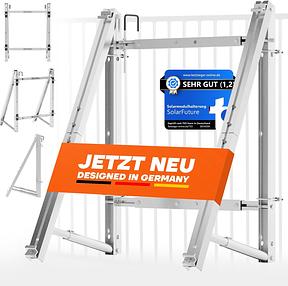
SolarFuture Balkonkraftwerk Halterung Silber Standard, Geländermontage
View at AmazonAffiliate link. Buying through it earns us a commission; the price stays the same for you.
Liability: it does not pay for your module, it pays for the damage next door
Contents insurance replaces your property. Anything your system does to other people is a matter for private liability insurance. The GDV gives the standard example in its 27 November 2023 release: if a module works loose and damages the neighbours' balcony, that is a private liability case. The Rhineland-Palatinate consumer advice centre adds damage caused by a defect in the system or by the system falling.
Liability insurance only pays to the extent that you are actually liable. The basis is the duty to make safe: whoever creates a hazard has to control it. Mounting that is done properly and rated for the wind load at your specific location, plus regular visual checks, is therefore not optional polish — it is the precondition for anyone standing behind you at all. Gross negligence during installation can see a payout reduced or refused.
Which makes the bracket the last component to economise on. Tilting brackets such as the SAVOLAR set SAVOLAR Solarmodul Halterung Balkonkraftwerk, 2 Sets, Winkel 0-90° einstellbar, bis 117 cm clamp to the railing and let you adjust the angle; other systems rely on a fixed bolted connection to the railing itself. Which design fits depends on your railing. What matters is that the instructions state a wind load rating, that you stay inside it, and that you keep the paperwork. It is your evidence of proper installation if it is ever disputed.
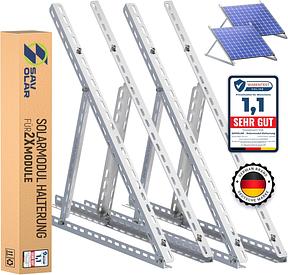
SAVOLAR Solarmodul Halterung Balkonkraftwerk, 2 Sets, Winkel 0-90° einstellbar, bis 117 cm
View at Amazon (as of Aug 21)Affiliate link. Buying through it earns us a commission; the price stays the same for you.
What replacement costs — and why the sub-limit matters more than the sum insured
Under the model conditions, contents insurance pays the replacement-as-new value: the amount needed to buy an item of the same kind and quality. For a three-year-old system that is not a depreciated value, it is today's price of a comparable set.
That price can be pinned down. A 1000 Wp complete set with bifacial modules and an inverter, the Solarway kit Solarway 1000Wp Balkonkraftwerk Komplettset mit EcoFlow Stream 800 W Wechselrichter, was listed at €299.99 on amazon.de on 7 August 2026, rated 4.5 out of 5 from 533 reviews. The two brackets above were at €59.99 that same day (SAVOLAR, 4.6 stars from 327 reviews) and €99.90 (SolarFuture, 4.6 stars from 186 reviews). Amazon prices move daily; these are a snapshot, not a standing price.
So a typical system sits in the low-to-mid hundreds of euros, and considerably higher with a battery. Two figures decide whether that amount actually arrives:
The payout limit in A 8.3.3. It is the hard cap, and a placeholder in the model wording. If it sits below what your system costs to replace, the difference is yours.
The sum insured. Under the square-metre model in VHB 2022 it is derived from floor area, and choosing an adequate sum per square metre normally comes with a waiver of the under-insurance defence. Without that waiver: if the actual value of your total contents exceeds the agreed sum plus the provision amount, the payout can be cut proportionally — even when only part of the contents was affected. A purchase in the hundreds rarely tips that calculation on its own, but it adds to everything else.
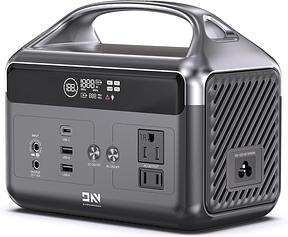
Not available in your region — closest match
View at Amazon (as of Aug 15)Affiliate link. Buying through it earns us a commission; the price stays the same for you.
Tenants: a legal claim since October 2024, but the insurance question stays
Since 17 October 2024, plug-in solar devices have been listed in § 554 of the German Civil Code as a privileged measure. Tenants can require consent to structural changes serving the operation of a plug-in solar device, and consent can only be refused where the change cannot reasonably be expected of the landlord after weighing both sides' interests. The current statutory text is at dejure.org.
The claim concerns permission, not insurance. In practice, landlords often tie consent to two pieces of evidence: an existing private liability policy and proper installation. Both can be arranged in advance, and both are worth having anyway. If you also need to settle whether your connection calls for a standard Schuko socket or a Wieland one, the current position is in our piece on what Germany's VDE standard allows. And on the much-quoted 800-watt ceiling, less changed in 2026 than is widely claimed: the 800-watt limit was not lifted.
Five questions to put to your insurer
One email, five questions, one answer worth filing:
- Is my balcony solar system, rated (output in watts), covered under the conditions currently applying to my contract — and since when?
- What is the per-claim payout limit for balcony solar in my tariff?
- Is a connected battery included, or does it need separate cover?
- Is plain theft from a balcony included, and if not: at what premium and with what limit can it be added?
- Is the extended natural-hazards module in place, and does it apply to items outdoors?
Question 4 is the important one. It is also the one where a general answer over the phone is routinely too optimistic, which is why it belongs in writing.
What this article is not
Legal or insurance advice. Every clause quoted here comes from the GDV's non-binding model conditions in the version dated June 2026; they describe the industry standard, not your contract. Only the conditions you signed, including any add-ons, govern your cover. Where it matters, the German consumer advice centres and independent insurance advisers are the places to go.
All statements and clause citations as of 7 August 2026. Product prices retrieved the same day from amazon.de.
All products from this post
The ones we named above are marked; the rest are alternatives in the same category.
Affiliate notice: As an Amazon Associate, we earn from qualifying purchases. Product prices and availability are subject to change.
Frequently Asked Questions
Is my balcony solar system automatically covered by home contents insurance?
Not automatically, but usually in newer contracts. The GDV model conditions VHB 2022 have counted balcony solar as household contents since late 2023, in clause A 8.3.3, provided the system serves the insured home exclusively and sits on its property. Older contracts that have not been switched to the new conditions are an open question. The GDV therefore advises talking to your insurer about your existing contract.
Do I have to report a balcony solar system to my insurer?
The list of reportable increases in risk in A 23.1 VHB 2022 does not name installing balcony solar as a case of its own. It does become reportable once the insurer asked about it on the application form. The GDV, the consumer advice centres and the ADAC all recommend reporting it regardless. Report in writing and get cover and the payout limit confirmed in writing too.
Does contents insurance pay if my module is stolen from the balcony?
Usually not. What is insured under A 4.1.1 VHB 2022 is burglary, which requires entering a room of a building. A balcony is part of the insured location under A 10.1.2, but it is not a room of a building. Plain theft from an open balcony is not an insured peril in the model wording. Some insurers offer it as an add-on with its own limit.
From what wind speed does storm cover apply?
From wind force 8 on the Beaufort scale, meaning at least 62 kilometres per hour. That is the definition in A 6.1.1 VHB 2022. If the wind force at the scene cannot be established, storm is assumed where nearby buildings in sound condition were damaged, or where the damage can only have been caused by storm. Photographs and weather data from the day matter for exactly this reason.
Is the battery of my balcony solar system covered?
The model conditions do not say. A 8.3.3 VHB 2022 names the balcony system, not its battery. The ADAC writes in its guide dated 24 March 2026 that small balcony systems up to 2 kilowatts and their associated batteries can be covered, which describes market practice rather than a clause. Name the battery explicitly when you report the system and get its inclusion confirmed.
Who pays if my module falls on a neighbour's car?
Private liability insurance, to the extent that you are liable. The basis is the duty to make safe: the system has to be installed properly, rated for the wind load at your location, and checked regularly. Gross negligence during installation can see a payout reduced or refused. Keep the installation instructions and wind load ratings as evidence.
Does cover extend to a balcony system in an allotment garden?
Not under A 8.3.3 VHB 2022. The clause requires the system to be on the property the insured home is on. A permanently mounted system on a different property also falls outside the away-from-home extension in A 12, because A 12.1.2 only covers items that are outside the insured location temporarily.