No, Germany's 800-Watt Limit for Balcony Solar Was Not Lifted in 2026
 9 min read
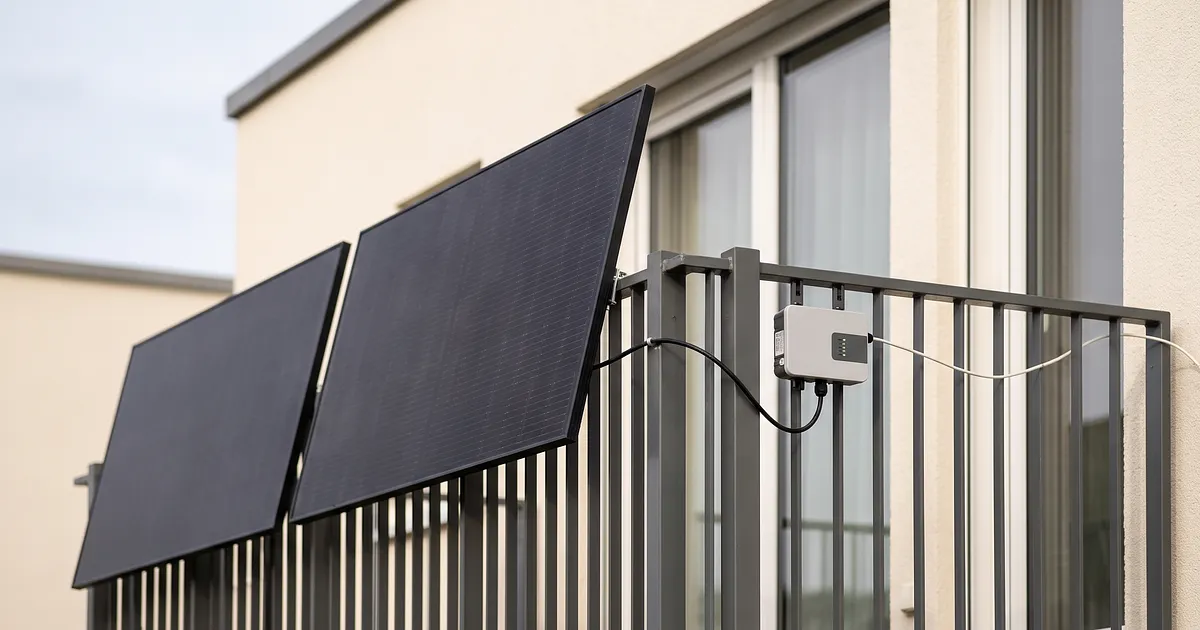
It has been circulating in forums, shop guides and comment threads for months: the 800-watt ceiling for balcony solar has supposedly fallen, you may now feed in 2000 watts, the law has been changed. Anyone who configures a system on that basis is running it outside the very conditions that make it exempt from approval in the first place.
The confusion is understandable, because a great deal genuinely did change for balcony solar between May 2024 and March 2026. Four of those changes are real, dated and easy to look up. None of them is the one being claimed.
What the law actually says
The decisive sentence sits in section 8(5a) of the EEG 2023. It names two figures, and that is the root of almost every mix-up:
| Quantity | Limit | What it refers to |
|---|---|---|
| Installed capacity | 2 kilowatts (2000 Wp) | The module capacity on the balcony - what the panels could deliver under standard conditions |
| Inverter capacity | 800 volt-amperes | What the inverter may put into the house circuit |
The Bundesnetzagentur draws the same distinction even more plainly in its FAQ on balcony solar systems (as of 21.02.2025): the installed capacity "may not exceed 2,000 watts (2 kW)", while the inverter capacity "is limited to a total of 800 VA".
Both figures apply at the same time. This is not an either/or and not a choice. And the unit on the smaller figure is volt-amperes, not watts - for a grid-tied inverter the two come out practically the same, but the statute says VA, and it does not say 2000.
Where the myth comes from: four real changes
1. From 600 to 800 watts - that genuinely happened
Until May 2024 the limit was 600 watts. Solarpaket I, in force since 16.05.2024, raised it to 800 VA. That increase is real, and it still appears on virtually every product listing today: "Instead of the previous 600, you may now feed up to 800 watts into your home circuit without approval."
"The limit was raised" turns very easily into "the limit was removed" on retelling. Same sentence, different verb - and a very large difference.
2. The 2000 watts are real - but they apply to the modules
Headlines like "Balcony solar with 2000 watts: what is allowed in 2026?" are factually correct. They simply concern the other figure from the same provision: module capacity, not feed-in capacity.
Read without the statute next to it, such a headline hands you exactly the wrong half. On our reading this is the main mechanism behind the entire claim.
3. The grid-operator notification really was abolished
Here something genuinely was struck out - just nothing involving watts. Since 16.05.2024, according to the Bundesnetzagentur, "the obligation to notify the grid operator" no longer applies to plug-in solar devices within the stated capacity limits.
What remains is registration in the Bundesnetzagentur's Marktstammdatenregister. That was heavily simplified - since the changeover of 28.03.2024 only five details about the device are required alongside personal information, down from roughly 20. It has not been abolished.
A real abolition, applied to the wrong object: that is the second source of the misunderstanding.
4. Standards did change in 2025 and 2026
Also true, and it explains why "something changed in 2026" sounds so plausible:
DIN VDE V 0126-95 (VDE V 0126-95):2025-12, published in December 2025, defines the plug-in solar device as a product in its own standard for the first time. The Schuko plug is now covered normatively. We go into that in our piece on the Schuko question and the new VDE standard.
VDE-AR-N 4105 was revised and governs the grid connection of plug-in solar devices and the permitted apparent power of their inverters.
The Solarspitzengesetz, in force since 25.02.2025, exempted plug-in solar devices up to 2 kW from the new controllability requirements and the 60-percent rule.
Three real legal and normative changes in 14 months. Not one of them contains a new inverter limit. The DKE, the standards body of DIN and VDE, states in its FAQ on the new product standard, unchanged: "The maximum permitted feed-in power of the inverter is 800 VA."
Why 800 of all numbers
The figure is not arbitrary. It is the threshold from the European network code, Regulation (EU) 2016/631 (RfG). From a maximum capacity of 0.8 kW upwards, a generating unit counts there as "significant" and falls under the full grid connection requirements as Type A. Below that, it does not.
That is precisely why Germany can place its simplified regime for plug-in solar devices at this point. Raising the ceiling above 800 would not be a matter of striking a national number - it would move the device into a different European regulatory class. That is the reason this particular limit does not quietly disappear via an ordinance.
What you may actually do
The module side is more generous than many assume. Two tiers, both from DIN VDE V 0126-95:2025-12:
| Connection | Maximum module capacity | Inverter |
|---|---|---|
| Schuko plug | 960 Wp (800 W + 20 %) | 800 VA |
| Dedicated energy connector (Wieland) | 2000 Wp | 800 VA |
The inverter figure does not move in either row. This is exactly how the common complete sets are built: more module capacity than 800 W, so the system stays at the clipping threshold for longer in poor weather, with an inverter limited to 800 W in front of it.
A set such as the Solarway 920W Balkonkraftwerk Komplettset mit 800 W Envertech Wechselrichter with 920 W of module capacity stays below the 960 Wp threshold, making it the conservative option for a Schuko connection. Push the module side further and you land at sets like the Solarway 1000Wp Balkonkraftwerk Komplettset mit EcoFlow Stream 800 W Wechselrichter - 1000 Wp of modules, 800 W inverter.
Not available in your region — closest match
View at Amazon (as of Aug 15)Affiliate link. Buying through it earns us a commission; the price stays the same for you.
Not available in your region — closest match
View at Amazon (as of Aug 15)Affiliate link. Buying through it earns us a commission; the price stays the same for you.
A 2000 W inverter is purchasable - you may still only feed in 800 VA
This is where most readers stumble, and it is the best evidence that the limit still exists: micro-inverters rated well above 800 W are sold openly, and selling them is entirely legal. What is regulated is not what you buy, but what you actually feed in.
Manufacturers know this and build for it. On the Envertech EVT2000SE Mikro-Wechselrichter 2000 W, Ausgangsleistung per App auf 800 W begrenzbar the product description says so in as many words: the output can be "reduced to 800 W or another range as required" and raised again via the app. A device whose selling point is that it can be capped at 800 W would be hard to explain in a market with no 800-watt limit.
So anyone reading a 2000 W datasheet and concluding that the ceiling is gone is confusing what the hardware can do with the operating point that is permitted.
Not available in your region — closest match
View at Amazon (as of Aug 15)Affiliate link. Buying through it earns us a commission; the price stays the same for you.
Does a battery change any of this?
No. Balcony storage shifts when the electricity reaches the house circuit, not how much goes at once. The 800 VA apply to what is delivered into the circuit, regardless of whether the energy is coming from the module or out of the battery at that moment.
You can see it in the product data itself: the Growatt NOAH 2000 Balkonkraftwerk-Speicher 2048 Wh mit 800 W Ausgangsleistung accepts up to 1800 W of solar input across two PV inputs according to the manufacturer - and delivers up to 800 W. Same logic on the Anker SOLIX Solarbank E1600 Balkonkraftwerk-Speicher, 1,6 kWh, fuer 600/800-W-Wechselrichter, which per Anker works with 600/800 W micro-inverters. Every figure in this paragraph is a manufacturer specification, not an independent measurement.
Whether the battery pays for itself is an entirely separate question - we worked that one through in our payback calculation for balcony solar storage.
Not available in your region — closest match
View at Amazon (as of Aug 15)Affiliate link. Buying through it earns us a commission; the price stays the same for you.
Not available in your region — closest match
View at Amazon (as of Aug 15)Affiliate link. Buying through it earns us a commission; the price stays the same for you.
Bottom line
As of August 2026: up to 2000 Wp of modules, a maximum of 800 VA of inverter capacity, registration in the Marktstammdatenregister, no notification to the grid operator. If you find a source claiming otherwise, test it with a single question - does it cite the provision? Section 8(5a) of the EEG 2023 is publicly available and takes 30 seconds to check.
There is currently no solid evidence of a concrete bill that would raise the 800 VA. So there is no forecast here about when that might change.
All products from this post
The ones we named above are marked; the rest are alternatives in the same category.
Not available in your region — closest match
Anker Powerbank, 20.000mAh tragbares Ladegerät mit integriertem USB-C-Kabel, 87W Max Schnellladung, kompatibel mit MacBook, iPhone, Samsung und mehr
View at Amazon (as of Aug 15)
Not available in your region — closest match
Anker Powerbank, 20.000mAh tragbares Ladegerät mit integriertem USB-C-Kabel, 87W Max Schnellladung, kompatibel mit MacBook, iPhone, Samsung und mehr
View at Amazon (as of Aug 15)
Not available in your region — closest match
Anker Powerbank, 20.000mAh tragbares Ladegerät mit integriertem USB-C-Kabel, 87W Max Schnellladung, kompatibel mit MacBook, iPhone, Samsung und mehr
View at Amazon (as of Aug 15)
Not available in your region — closest match
Anker Powerbank, 20.000mAh tragbares Ladegerät mit integriertem USB-C-Kabel, 87W Max Schnellladung, kompatibel mit MacBook, iPhone, Samsung und mehr
View at Amazon (as of Aug 15)Affiliate notice: As an Amazon Associate, we earn from qualifying purchases. Product prices and availability are subject to change.
Frequently Asked Questions
Was the 800-watt limit for balcony solar lifted in 2026?
No. Section 8(5a) of the EEG 2023 still names a total inverter capacity of up to 800 volt-amperes. The Bundesnetzagentur confirms this in its FAQ on balcony solar systems, dated 21.02.2025, and the product standard DIN VDE V 0126-95 published in December 2025 likewise names 800 VA as the maximum permitted feed-in power. What changed were notification duties and standards, not the inverter ceiling.
Can I then connect 2000 watts of solar modules?
Yes. The 2000 Wp refer to installed module capacity and appear in the same provision. Under DIN VDE V 0126-95:2025-12, however, 2000 Wp is tied to a dedicated energy connector; on a Schuko plug the limit is 960 Wp, that is 800 W plus 20 percent. The inverter stays capped at 800 VA in both cases.
Why do retailers sell inverters rated above 800 watts?
Because the sale is not regulated - the operation is. Such devices can be capped at 800 W via an app and adjusted upwards later, for instance if the system is no longer a plug-in solar device. The Envertech EVT2000SE advertises exactly that: its output power can be reduced to 800 W as required.
Do I still have to register my balcony solar system with the grid operator?
No. Since 16.05.2024, according to the Bundesnetzagentur, notification to the grid operator no longer applies to plug-in solar devices within the capacity limits. Registration in the Marktstammdatenregister remains mandatory, however. Since 28.03.2024 only five details about the device are required for that, alongside personal information.
How do I spot an unreliable source on this topic?
By the fact that it cites no provision. Anyone claiming the limit has fallen ought to be able to name the amending instrument. The current version of section 8(5a) of the EEG 2023 is freely available at gesetze-im-internet.de, and the Bundesnetzagentur FAQ carries a date. Both beat any undated guide.