Schuko vs Wieland: What Germany's New VDE Standard Allows
 5 min read
As of: 06.08.2026 · Status: IN FORCE
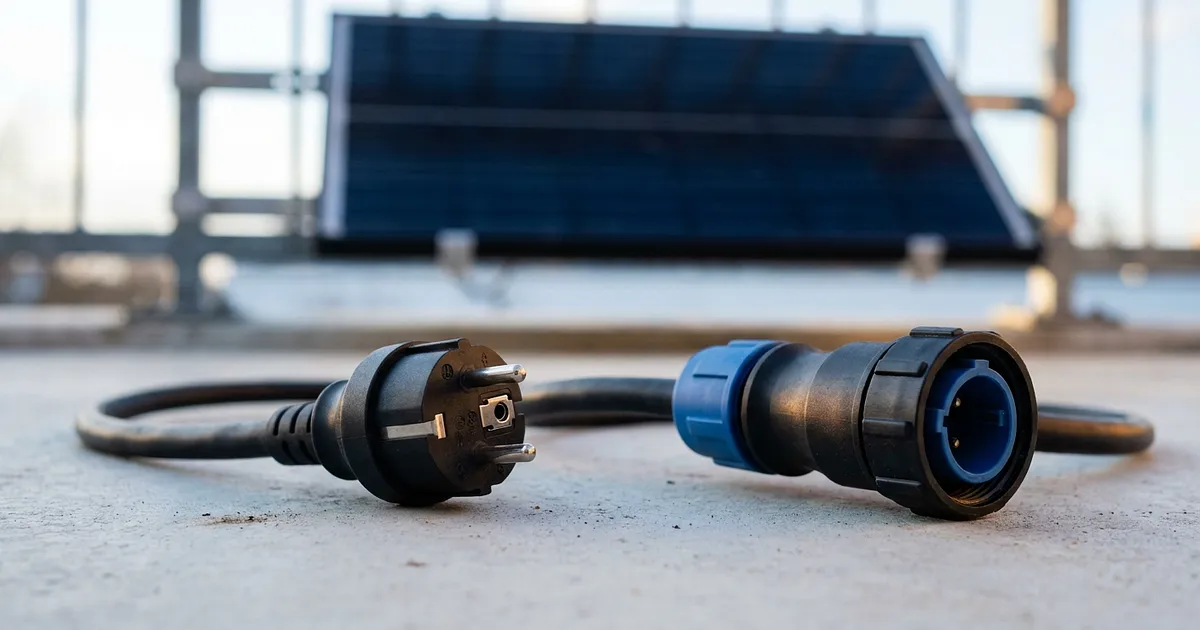
Anyone who bought a balcony solar device two years ago heard the same line from the electrician: not without a special energy socket. That reason is gone since December 2025, settling the Schuko vs Wieland question.
The preliminary standard DIN VDE V 0126-95 (VDE V 0126-95):2025-12 is Germany's first product standard covering a complete plug-in solar device.
What is new: three household-plug variants
Until now, no product standard covered a plug-in solar device as a whole system. That's why buyers were steered to the special energy connector: not forbidden, just uncertified.
The Deutsche Kommission Elektrotechnik (DKE) published its official FAQ on the standard on 17.12.2025, setting out what was added:
"Die Produktnorm enthält neue Anschlussmöglichkeiten, die bisher nicht zulässig waren. Folgende Varianten sind nach Produktnorm neu zulässig: Modifizierter Haushaltsstecker mit Schutzumhüllungen an den Kontakten; Modifizierter Haushaltsstecker mit internem Trennschalter; Haushaltsstecker in Kombination mit Isolierung und sicherer Trennung im Wechselrichter."
DKE, FAQ on DIN VDE V 0126-95, 17.12.2025
Three variants were added. None disappeared.
The third one moves safe isolation into the inverter. That makes the inverter model the deciding component in a Schuko build, something like an 800 VA micro-inverter such as the Hoymiles HMS-800W-2T Mikrowechselrichter mit integriertem WiFi für Balkonkraftwerk.
Not available in your region — closest match
View at Amazon (as of Aug 15)Affiliate link. Buying through it earns us a commission; the price stays the same for you.
Since when, and what kind of document this is
The edition carries the date 2025-12. No VDE source names a calendar day for entry into force. Scope: single-phase, up to 250 V AC, maximum 800 VA apparent power.
This is a Vornorm, a preliminary standard, reviewed within three years, and not a law: "Die Anwendung von Normen ist grundsätzlich freiwillig", the DKE writes: applying standards is voluntary in principle.
The number everything turns on
| Household plug (Schuko) | Energy connector (Wieland type) | |
|---|---|---|
| Max. total module power | 960 Wp | 2000 Wp |
| Max. inverter feed-in power | 800 VA | 800 VA |
| Who installs the socket | no qualified electrician needed | qualified electrician, inspects and adapts the circuit |
| Term used in the standard | Haushaltsstecker | Energiesteckvorrichtung per DIN VDE V 0628-1 |
Where the 960 comes from is stated word for word in the DKE FAQ:
"Die maximal zulässige Gesamtmodulleistung wird auf 800 W + 20 % (also 960 W) festgelegt, wenn das Steckersolargerät mit einem Haushaltsstecker ausgestattet ist. Dies soll vermeiden, dass eine nahezu dauerhafte Einspeisung mit 800 W erfolgen kann."
The 800 VA figure comes from the EEG and the Solarpaket I of May 2024, not from this standard.
Staying under the line is arithmetic done before checkout. Two 460 Wp modules make 920 Wp, as on the Solarway 920W Balkonkraftwerk 800W komplett Steckdose - Envertech Wechselrichter, 2x460W bifaziale Solarmodule, and stay inside the Schuko envelope. Two 500 Wp modules make 1.000 Wp and do not.
Not available in your region — closest match
View at Amazon (as of Aug 15)Affiliate link. Buying through it earns us a commission; the price stays the same for you.
Who it binds
Nobody retroactively. The DKE answers question 7 plainly: "Nein, die Produktnorm hat keine Auswirkung auf bereits in Betrieb befindliche Steckersolargeräte."
The Wieland type wasn't touched: VDE FNN still calls it "die sichere Option, insbesondere dann, wenn die Anforderungen für den Anschluss an eine Haushaltssteckdose nicht erfüllt werden können".
The energy connector itself is just a part you buy, a feed-in box with a Wieland socket like the Anschlussbox Balkonkraftwerk Einspeisedose mit Wieland-Buchse (RST20i3). A qualified electrician still installs it.
Nothing changed for tenants either: under § 554 (1) BGB and § 20 (2) WEG, tenants and flat owners hold a basic entitlement to approval.
Not available in your region — closest match
View at Amazon (as of Aug 15)Affiliate link. Buying through it earns us a commission; the price stays the same for you.
Two rule sets, two numbers
The most common mistake here is conflating 2.000 Watt and 960 Wp.
Registration belongs to the Bundesnetzagentur, FAQ as of 21.02.2025: 2.000 Watt module power, 800 VA inverter power, registration in the Marktstammdatenregister within one month.
The 960 Wp figure is the plug side: a 1.200 Wp system registers fine, but you can't run it standards-compliant on a plain Schuko plug.
The inverter is untouched by either number: 800 VA applies whatever the plug, on a APsystems EZ1-M 800W Mikrowechselrichter mit WLAN & Bluetooth für Balkonkraftwerk as much as on any other unit in that class.
Whether storage is worth adding is a separate calculation, turning on electricity price and self-consumption, and it appears in the payback maths.
Not available in your region — closest match
View at Amazon (as of Aug 15)Affiliate link. Buying through it earns us a commission; the price stays the same for you.
The Bottom Line
Since December 2025 the plug is arithmetic, not opinion. Keep total module power at 960 Wp or under and the household socket does the job, now backed by a product standard. Go above it and you need the energy connector plus a qualified electrician. Unchanged: 800 VA at the inverter and the Marktstammdatenregister entry.
All products from this post
The ones we named above are marked; the rest are alternatives in the same category.
Not available in your region — closest match
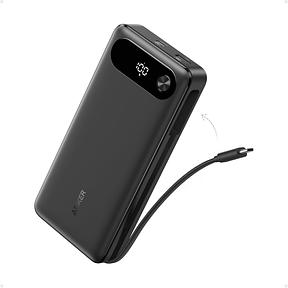
Anker Powerbank, 20.000mAh tragbares Ladegerät mit integriertem USB-C-Kabel, 87W Max Schnellladung, kompatibel mit MacBook, iPhone, Samsung und mehr
View at Amazon (as of Aug 15)
Not available in your region — closest match
Anker Powerbank, 20.000mAh tragbares Ladegerät mit integriertem USB-C-Kabel, 87W Max Schnellladung, kompatibel mit MacBook, iPhone, Samsung und mehr
View at Amazon (as of Aug 15)
Not available in your region — closest match
Anker Powerbank, 20.000mAh tragbares Ladegerät mit integriertem USB-C-Kabel, 87W Max Schnellladung, kompatibel mit MacBook, iPhone, Samsung und mehr
View at Amazon (as of Aug 15)
Not available in your region — closest match
Anker Powerbank, 20.000mAh tragbares Ladegerät mit integriertem USB-C-Kabel, 87W Max Schnellladung, kompatibel mit MacBook, iPhone, Samsung und mehr
View at Amazon (as of Aug 15)Affiliate notice: As an Amazon Associate, we earn from qualifying purchases. Product prices and availability are subject to change.
Frequently Asked Questions
Is a Wieland socket banned now?
No. It stays the only compliant route above 960 Wp.
Do I have to retrofit my existing balcony solar device?
No. Nothing needs swapping or re-certifying if you connected before December 2025.
How much module power may I run on a Schuko plug?
Up to 960 Wp, which is 800 W plus a 20 percent buffer. Above it, you need the energy connector and a qualified electrician.
Is the preliminary standard a law?
No. Applying standards is voluntary; a VDE standard describes the state of the art, not a legal requirement.
Does anything change about registration?
No. The limits stand unchanged: 2.000 Watt module power, 800 VA inverter power, and registration in the Marktstammdatenregister within one month.