Balcony Solar With a Battery: Does the Storage Actually Pay Back?
 16 min read
As of: 20.05.2026
Every product page for a balcony solar battery shows the same chart: one bar for yield without a battery, a taller bar with one, and a payback figure underneath. What almost never appears next to it is the set of input values that produced that figure. And the inputs are the entire difference between five years and twenty-five.
This article does the opposite. It puts every single input on the table, marks each one as sourced or as an assumption, and runs three households through the same arithmetic. None of it comes from our own testing — Ampcarry does not measure hardware. Everything sourced carries its origin and its date right next to the number.
One point up front, because it is where most storage calculations on the German web fall apart: they assume the surplus would earn money if you had no battery. On a registered balcony system under the simplified procedure, it does not.
Zero cents: the number that upends every storage calculation
If you register a plug-in solar device under Germany's simplified procedure, you receive no payment for electricity fed into the grid. That is not fine print, it is the wording of the statute. § 8 Abs. 5a EEG 2023 refers to systems that are "der unentgeltlichen Abnahme zugeordnet" — assigned to uncompensated offtake (statute text at gesetze-im-internet.de). Uncompensated means what it says. The surplus is given away.
For the storage question this inverts the logic. On a rooftop array with a feed-in tariff, the battery competes against a real revenue stream — every stored kilowatt-hour has to beat the tariff it displaces. On a balcony system, the battery competes against zero. Every kilowatt-hour it rescues is worth the full retail price.
That is the strongest argument for buying a battery, and it appears on almost no product page. The reason it still often fails to be enough comes further down: the battery has running costs of its own.
The power limits of the simplified procedure sit in the same paragraph: up to 2 kilowatts of installed module power and up to 800 volt-amperes of inverter power in total. Those figures are unchanged. If you read a report claiming the 800-watt limit was lifted in 2026, check the source's date against the statute.
The payback model, input by input
Here is the whole thing. Every row carries either a source with a date or the word assumption. There is no third category, and no figure appears without its unit.
| Input | Value | Status | Origin |
|---|---|---|---|
| Household electricity price | 37.0 ct/kWh | sourced | BDEW electricity price analysis, as of April 2026, published 15.04.2026 |
| Feed-in payment under the simplified procedure | 0.0 ct/kWh | sourced | § 8 Abs. 5a EEG 2023, "unentgeltliche Abnahme" |
| Annual yield of the array | 700 kWh/year (cases A and B), 1,000 kWh/year (case C) | assumption | replace it with your own figure from HTW Berlin's Stecker-Solar-Simulator |
| Direct self-consumption share without storage | 40 to 45 % | assumption | depends on daily load profile and orientation |
| Direct self-consumption share with a 2 kWh battery | 70 to 80 % | assumption | |
| Round-trip efficiency of the battery | 85 % | assumption | Warentest states it measures "Wirkungsgrad beim Laden und Entladen" but discloses the figure only behind its paywall |
| Standby draw | 5 W | assumption | the range is sourced: 4 to 64 W across the twelve home storage systems in HTW's Stromspeicher-Inspektion, 23.03.2026 |
| Purchase price of the battery | €500 and €1,000 as two scenarios | assumption, anchored to a sourced range | Stiftung Warentest put its test field at "zwischen rund 700 und 1 000 Euro" on 19.03.2026; entry-level models sit below that |
The arithmetic is three steps, so you can repeat it with your own numbers:
- Additional self-consumed energy = annual yield × (share with storage − share without storage)
- Actually usable after losses = that value × round-trip efficiency
- Annual benefit = usable energy × electricity price − standby draw × electricity price
Step three is the one manufacturer charts leave out.
What 5 watts of standby costs per year
A battery that stays ready around the clock draws power around the clock. 5 W × 8,760 h = 43.8 kWh per year — that is arithmetic derived from an assumed wattage, not a measurement. At 37.0 ct/kWh it comes to €16.21 per year that the battery costs before it has rescued a single kilowatt-hour.
What is sourced is the range, and the range is alarming. HTW Berlin's Stromspeicher-Inspektion 2026, published 23.03.2026 together with its spin-off aquu, compared twelve systems from ten manufacturers and measured standby consumption from 4 W to 64 W. Those are home storage systems in the 5 kW and 10 kW classes, not balcony units — the figures do not transfer directly, but they show how far apart a frugal and a wasteful device sit. HTW puts the annual cost advantage of its test winner over the least efficient system in the same field at roughly €200.
Run the sensitivity yourself: at 10 W instead of 5 W, annual self-consumption rises to 87.6 kWh and costs €32.41 per year. That nearly halves the battery's benefit. If the standby figure is not in the datasheet, it is the most important question to put to the manufacturer — more important than any capacity claim.
Three households, three completely different answers
The same arithmetic, applied three times. Every non-price input is an assumption and flagged as one above; the electricity price and the feed-in payment are sourced.
| Case A: single | Case B: couple | Case C: family | |
|---|---|---|---|
| Household annual consumption | 1,200 kWh (assumption) | 2,500 kWh (assumption) | 4,000 kWh (assumption) |
| Annual yield of the array | 700 kWh (assumption) | 700 kWh (assumption) | 1,000 kWh (assumption) |
| Share without storage | 45 % (assumption) | 40 % (assumption) | 45 % (assumption) |
| Share with storage | 70 % (assumption) | 75 % (assumption) | 80 % (assumption) |
| Extra energy via the battery | 175 kWh/year | 245 kWh/year | 350 kWh/year |
| After 85 % round-trip | 148.75 kWh/year | 208.25 kWh/year | 297.50 kWh/year |
| Value at 37.0 ct/kWh | €55.04/year | €77.05/year | €110.08/year |
| Less standby (43.8 kWh) | −€16.21/year | −€16.21/year | −€16.21/year |
| Net benefit | €38.83/year | €60.84/year | €93.87/year |
| Payback at €500 | 12.9 years | 8.2 years | 5.3 years |
| Payback at €1,000 | 25.8 years | 16.4 years | 10.7 years |
Two things jump out.
First: the spread from 5.3 to 25.8 years is not produced by device quality. It is produced by household size and purchase price. If you draw a lot of power in the evening, the battery earns its keep. If you are home during the day and already consume the output directly, what you mostly buy with a battery is its standby draw.
Second: doubling the purchase price from €500 to €1,000 doubles the payback period, and no efficiency difference compensates for that. A device that converts 15 percentage points better saves roughly €13.60 a year in case B. A device that costs €500 less saves €500 immediately. In this category price beats technology, and not narrowly.
If you want to substitute your own annual yield for the assumption, HTW Berlin's Solar Storage Systems research group publishes the Stecker-Solar-Simulator, which computes yield, self-consumption share and payback for your location, orientation and load profile — small battery systems included.
What Stiftung Warentest measured on 19.03.2026
On 19.03.2026, Stiftung Warentest published the first large test of balcony solar batteries, in issue 4/26. Five devices were tested: Anker Solix Solarbank 3 E2700 Pro, EcoFlow Stream Ultra, FoxESS Avocado Orbit M, Growatt Nexa 2000 and Zendure SolarFlow 800 Pro. Warentest puts the test field's price range at "zwischen rund 700 und 1 000 Euro".
The finding, verbatim: "Drei der fünf getesteten Akkus bewerten wir mit der Gesamtnote Mangelhaft, weil sie zu viele elektromagnetische Störsignale aussenden" — three of five batteries were graded deficient for emitting too much electromagnetic interference. Overall grades on test.de range from Befriedigend to Mangelhaft, satisfactory down to deficient. Not one device reached "gut".
In practice, electromagnetic interference means flickering televisions, humming speakers, and Wi-Fi routers that keep dropping their connection. This is not a marginal finding — it is the reason for three of the five grades.
Which device carries which grade sits behind the paywall. Trade outlets that read the full test name the Anker Solix Solarbank 3 Pro as the only device rated satisfactory, with appgefahren.de quoting a grade of 3.3 on 19.03.2026. That is a secondary source, not a primary statement from Warentest, and we label it as such.
Also behind the paywall: the measured charge and discharge efficiency. Which is exactly why the model above carries an assumption there rather than a measurement.
What actually decides yield today
The hardware has converged. All five tested devices are LiFePO4 batteries with an integrated inverter, 800 W output and comparable capacity. What separates them is software: when the battery charges, when it discharges, and how precisely it hits zero export.
That is the lever the payback table abstracts into "share with storage". A rule engine that merely estimates household load discharges too early or too late. One that measures actual draw at the meter point hits it. The difference between a 70 % and an 80 % self-consumption share is about €37 a year in case C — more than a meter costs.
Which is why several systems rely on an external energy meter rather than an estimate. The Shelly Pro 3EM 3CT63, dreiphasiger WLAN- und LAN-Energiezähler, 63 A measures three-phase at the meter point and is listed as a compatible measurement source by several storage manufacturers. Installation in a German consumer unit belongs in the hands of a qualified electrician. Before buying, check your battery's compatibility list for which meters it supports — the lists differ between manufacturers and sometimes between firmware versions.
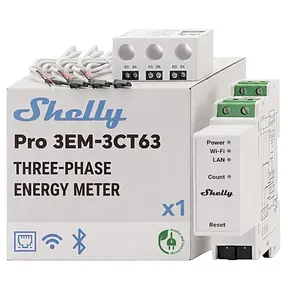
Shelly Pro 3EM 3CT63, dreiphasiger WLAN- und LAN-Energiezähler, 63 A
View at Amazon (as of Aug 11)Affiliate link. Buying through it earns us a commission; the price stays the same for you.
The devices from the Warentest field
The four devices below are from the test field of 19.03.2026 or are immediate sibling models. All technical figures are manufacturer specifications from the respective datasheets — not our own measurements and not a verdict from us. Prices move daily, which is why the payback table above uses two round scenarios instead of one day's price.
Anker Solix Solarbank 3 E2700 Pro
The most expensive device in the field, and per the secondary sources above the only one rated satisfactory. 2.68 kWh nominal, four MPP trackers, 1,200 W bidirectional charging, expandable to 16 kWh per the manufacturer. The Anker SOLIX Solarbank 3 E2700 Pro, Balkonkraftwerk-Speicher 2,68 kWh, 4 MPPT is therefore the option for case C households — high evening draw, larger array. In the €1,000 scenario it still needs 10.7 years even there.
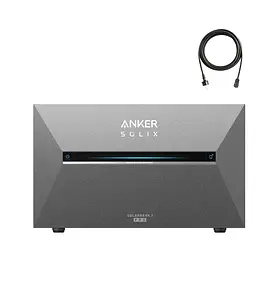
Anker SOLIX Solarbank 3 E2700 Pro, Balkonkraftwerk-Speicher 2,68 kWh, 4 MPPT
View at Amazon (as of Aug 11)Affiliate link. Buying through it earns us a commission; the price stays the same for you.
EcoFlow Stream Ultra
1.92 kWh, four MPPTs, 2,800 W solar input, two AC connections totalling 2,300 W, expandable to 11.52 kWh per the manufacturer. Present in the Warentest field. The EcoFlow Stream Ultra Balkonkraftwerk-Speicher 1,92 kWh, 4 MPPT, 2800 W Solareingang sits in the middle of the price band and is the obvious pick if the array is meant to grow later.
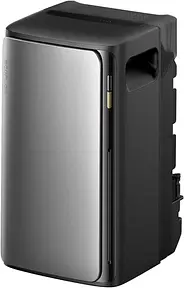
EcoFlow Stream Ultra Balkonkraftwerk-Speicher 1,92 kWh, 4 MPPT, 2800 W Solareingang
View at Amazon (as of Aug 11)Affiliate link. Buying through it earns us a commission; the price stays the same for you.
Growatt Nexa 2000
An all-in-one unit with integrated inverter, 2,048 Wh, four MPP trackers, Wi-Fi. Also part of the Warentest field of 19.03.2026. The Growatt NEXA 2000 Wechselrichter-Speicher, All-in-One Balkonkraftwerk-Lösung mit WLAN is the most compact of the four and needs no separate inverter.
Not available in your region — closest match
Anker SOLIX Solarbank 3 E2700 Pro, Balkonkraftwerk-Speicher 2,68 kWh, 4 MPPT
View at Amazon (as of Aug 11)Affiliate link. Buying through it earns us a commission; the price stays the same for you.
Zendure SolarFlow 800 Plus
⚠️ Not the tested device. Warentest examined the SolarFlow 800 Pro; this is the cheaper 800 Plus at 1,920 Wh. The grade from the test explicitly does not apply to this model. The Zendure SolarFlow 800 Plus Balkonkraftwerk-Speicher 1920 Wh, modular erweiterbar represents the lower price scenario: if you do not need the Anker's 2.68 kWh and its expandability, case B payback becomes 8.2 years instead of 16.4.
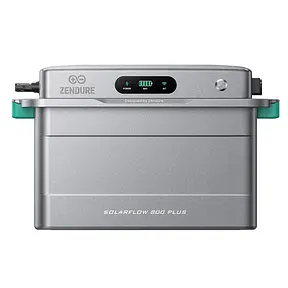
Zendure SolarFlow 800 Plus Balkonkraftwerk-Speicher 1920 Wh, modular erweiterbar
View at Amazon (as of Aug 11)Affiliate link. Buying through it earns us a commission; the price stays the same for you.
Law and registration, briefly and with dates
Three points that matter for the purchase decision and that are routinely reported wrongly:
The limits are unchanged. § 8 Abs. 5a EEG 2023 states 2 kW of module power and 800 VA of inverter power, applied cumulatively per grid connection point. If you read that the limit was abolished in 2026, check the report against the statute.
Schuko is permitted, but the standard does not cover batteries. With DIN VDE V 0126-95, announced in November 2025 and published with a December 2025 edition date, a standard Schuko plug is normatively provided for plug-in solar devices up to 960 Wp of module power and 800 VA of inverter power, provided the device carries the required protective measures — as pv magazine described on 14.11.2025. Two caveats: the "V" stands for Vornorm, a preliminary standard, and batteries are not within its scope. Combinations with storage carry their own requirements. A VDE standard is also not a law.
The battery is registered separately. In the Bundesnetzagentur's Marktstammdatenregister the battery is its own unit with its own entry, and is not captured automatically alongside the solar array.
What we could not verify
Four things are deliberately absent from this article:
No measured efficiency for the five Warentest devices. The figure sits behind the paywall. The 85 % in the model is an assumption, not a measurement.
No standby figure for balcony batteries. HTW's 4 to 64 W refers to home storage in the 5 kW and 10 kW classes. The 5 W in the model is an assumption.
No primary-source mapping of individual Warentest grades to individual models. The 3.3 for the Anker comes from appgefahren.de, not from test.de.
A widely quoted percentage for actually retrievable capacity that we could not attach to a specific model. Publishing a figure like that without naming the model would be an allegation against a manufacturer.
For how nominal capacity in milliamp-hours becomes actually usable watt-hours, and why the gap is not a defect, see the conversion step by step.
Every calculation path is shown so you can repeat it with your own numbers. Test results and legal positions are as dated above.
In short
The honest answer to "does the battery pay back" is: somewhere between 5.3 and 25.8 years, and the spread is created in your household, not in the device. Three numbers decide it — your evening consumption, the purchase price, and the standby draw. Round-trip efficiency, the number product pages most like to talk about, is the least important of the four.
All products from this post
The ones we named above are marked; the rest are alternatives in the same category.
Not available in your region — closest match
Anker SOLIX Solarbank 3 E2700 Pro, Balkonkraftwerk-Speicher 2,68 kWh, 4 MPPT
View at Amazon (as of Aug 11)
Affiliate notice: As an Amazon Associate, we earn from qualifying purchases. Product prices and availability are subject to change.
Frequently Asked Questions
Is a balcony solar battery worth it?
That depends almost entirely on your evening consumption and the purchase price, not on the device model. In this article's model, a 500-euro battery pays back after 5.3 years in a four-person household but only after 12.9 years for a single-person household. At a 1,000-euro purchase price those become 10.7 and 25.8 years. Electricity price 37.0 ct/kWh per BDEW, as of April 2026; every other input is flagged as an assumption in the article.
Do I get paid for the electricity I export?
No, not under the simplified registration procedure. § 8 Absatz 5a EEG 2023 assigns plug-in solar devices up to 2 kilowatts of module power and 800 volt-amperes of inverter power to uncompensated offtake. The surplus fed into the grid is taken without payment. That is precisely why a battery is arithmetically more attractive here than on a rooftop array earning a feed-in tariff.
How much electricity does a balcony solar battery consume on its own?
This is the most commonly overlooked line item. What is sourced is a range of 4 to 64 watts of standby consumption across twelve home storage systems in HTW Berlin's Stromspeicher-Inspektion of 23.03.2026. At a continuous 5 watts that is 43.8 kilowatt-hours per year, roughly 16.21 euros at 37.0 ct/kWh. At 10 watts it doubles. Ask for the figure before buying if it is not in the datasheet.
Which balcony solar battery won the 2026 test?
Stiftung Warentest tested five batteries in issue 4/26 on 19.03.2026 and awarded no device a "gut". Three of five were graded "mangelhaft" for emitting too much electromagnetic interference. Overall grades range from satisfactory down to deficient. Which device carries which grade sits behind the paid part of the test; trade outlets that read it name the Anker Solix Solarbank 3 Pro as the only device rated satisfactory.
Can I plug a balcony system with a battery into a standard Schuko socket?
DIN VDE V 0126-95, edition date December 2025, provides for Schuko connection of plug-in solar devices up to 960 watt-peak of module power and 800 volt-amperes of inverter power. Important: batteries are not within the scope of that standard, and combinations with storage carry their own requirements. A VDE standard is also not a statutory requirement. When in doubt, ask a qualified electrician.
Do I have to register the battery separately?
Yes. In the Bundesnetzagentur's Marktstammdatenregister the battery storage unit is its own entity with its own entry and is not captured automatically alongside the solar array. The power limits of the simplified procedure still refer to module power and inverter power, not to storage capacity.