A New Balcony Solar System Every 73 Seconds: Inside Germany's Balcony Solar Boom
 8 min read
As of 02.09.2026
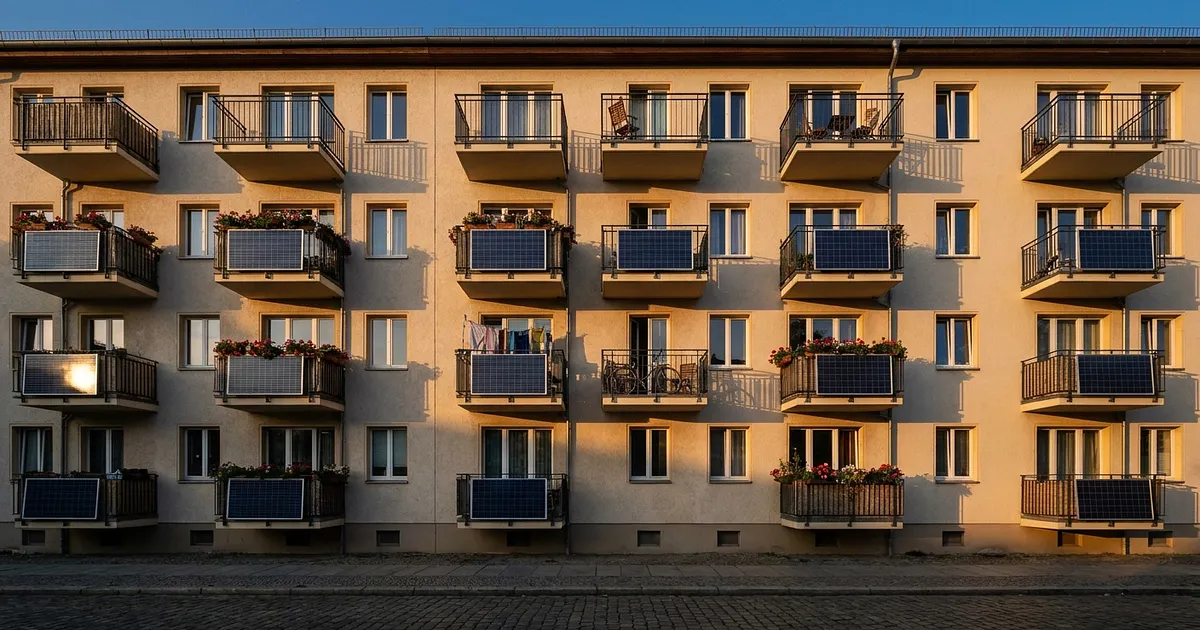
One line travelled through half the German solar trade in 2025: a new balcony solar system gets registered every 73 seconds. It sounds like a number somebody invented for a press release. It isn't. You can recalculate it yourself, and that's exactly where the balcony solar boom gets more interesting than the usual million-unit milestone stories.
Here's the arithmetic. 429,808 newly registered systems in calendar year 2025, divided by 365 days, gives 1,178 registrations per day. A day has 86,400 seconds. 86,400 divided by 1,178 is 73.4. The underlying analysis comes from GfK Solar, built on Germany's Marktstammdatenregister (the federal power-plant registry), and was published among others by energyload.eu. The balcony-solar market report from strom-report.com puts the same year at 435,344 units, which works out to 72.4 seconds. Two independent sources, one second apart.
How many balcony solar systems are there really?
Officially, 1,311,919 plug-in solar devices were recorded as operational in the Marktstammdatenregister on 15.04.2026 according to strom-report.com, adding up to roughly 1.34 gigawatts. GfK Solar counted about 1.33 million on 19.05.2026. Two measurement dates, same order of magnitude. We broke the installed base down in detail, regional distribution included, in a separate look at how many balcony solar systems Germany actually has.
Except that's the registered count.
How many are actually hanging off German balconies, nobody knows. strom-report.com estimates the real installed base at 1.5 to 4 million devices. If that range holds, more than half of all systems were historically never registered at all, especially the ones installed before April 2024, when registering was still genuinely tedious. And before anyone turns that into a grid emergency: GfK Solar works out that even at double the registered count, unregistered systems would still sit in the single-digit percentage range of German PV output. Balcony systems are 22 percent of all registered solar installations by unit count, but only 1.1 percent by installed capacity. Lots of devices, each one tiny.
The turning point: April 2024
If you want to know why the curve went steep, look at a date rather than an electricity price.
On 1 April 2024 the Bundesnetzagentur, Germany's federal network agency, cut the registry form down hard: five required fields instead of roughly 20. President Klaus Müller explained the move with a sentence that's surprisingly unbureaucratic for a regulator:
"Menschen sollen so leicht wie möglich bei der Energiewende mitmachen können." (People should be able to take part in the energy transition as easily as possible.)
Shortly after, when the Solarpaket I legislation took effect on 16.05.2024, the second hurdle fell. Anyone running a standard device, meaning up to 2,000 W of panel capacity and 800 W of inverter output with no feed-in tariff claimed, no longer has to notify their grid operator separately. Registry entry is enough, and the operator gets told automatically.
Two bureaucratic steps removed. That's the whole trick. A third piece landed the same year: tenants gained a statutory right to their landlord's consent under § 554 BGB.
The before-and-after is fairly blunt: 68,754 new registrations in 2022, then 286,812 in 2023, then 445,732 in 2024. Plus 317 percent, then another 55 percent, all per the annual tables at strom-report.com.
Why now, though?
The rule change explains why it suddenly became easy. It doesn't explain why so many people wanted it.
Price is part of it. Complete kits have got much cheaper since the energy crisis, and the 800-watt ceiling makes the device big enough to visibly shave a household's base load. Then there's a motive that's harder to measure. Trade association BSW-Solar attributes the current surge in residential solar mostly to special effects, according to pv magazine: buyers pulling purchases forward ahead of announced subsidy cuts from 2027, plus a growing appetite for energy independence. That refers to rooftop PV, not balcony solar, so treat it as mood music for the same household rather than a balcony-solar statistic.
The geography is worth a look too. By absolute count North Rhine-Westphalia leads with 253,052 systems, ahead of Bavaria at 193,512 and Baden-Württemberg at 166,773, per a regional analysis by infranken.de dated 10.06.2026. Per household, though, the leaders are Bremen at 1.79 percent, Dresden at 1.73 percent and Dortmund at 1.72 percent. Munich manages 0.84 percent, Hamburg 0.85. So the big metros aren't the centre of this thing. They're the laggards.
The catch: the balcony solar boom is already cooling
This is where the success story stops behaving.
From 2024 to 2025, new registrations didn't keep climbing. 445,732 systems in 2024, then somewhere between 429,808 and 435,344 in 2025 depending on the source. That's sideways at best, mildly down at worst. GfK Solar itself calls 2024 to 2025 a plateau at around 430,000 new installations a year.
And 2026? The first quarter added 64,633 systems, per strom-report.com. 90 days is 7,776,000 seconds; divided by 64,633 that's one new system roughly every 120 seconds. Against 2025's 73 seconds, the pace has dropped by about two thirds.
What is still growing is size. Between 85 and 89 percent of devices registered in 2026 run the full 800 W inverter, even though the ceiling itself was never actually raised, persistent rumours notwithstanding. So installed capacity keeps rising while unit numbers flatten. Fewer buyers, bigger systems.
Whether 73 seconds ever comes back is anyone's guess. Probably it was simply the peak of a catch-up effect: everyone who had been put off by the paperwork got served fairly quickly once the paperwork went away.
The next wave: balcony solar storage
The question in this market has flipped completely in three years. An industry figure summed it up at presseradar.de on 13.08.2026: "Three years ago the question was whether such a device makes any sense at all. Today it's whether storage belongs with it."
The registry data backs that up. Roughly one in five registered balcony systems now has its own battery, and the storage segment itself grew by about 97 percent to around 222,000 units. Industry estimates put the retrofit market at just under €1.2 billion in 2026. That market-size figure is trade-press estimation, not a registry count, so treat it accordingly.
Prices have moved a long way, helped since 2026 by zero percent VAT on balcony solar storage. An AC-coupled LiFePO4 unit such as the Marstek B2500 Speicher 2240Wh für Balkonkraftwerke sits at around €317 per its Amazon listing as of 02.09.2026, while a Hoymiles Hoymiles HiBattery AC 1,92 kWh Solarbatterie für Balkonkraftwerk runs about €549. Both sit behind the existing micro-inverter, so a retrofit doesn't need an electrician.
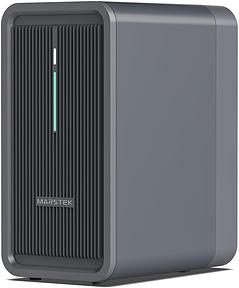
Marstek B2500 Speicher 2240Wh für Balkonkraftwerke
View at AmazonAffiliate link. Buying through it earns us a commission; the price stays the same for you.
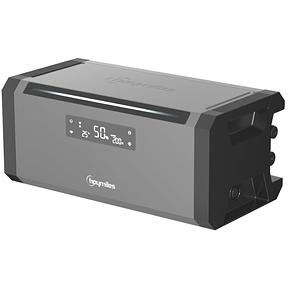
Hoymiles HiBattery AC 1,92 kWh Solarbatterie für Balkonkraftwerk
View at AmazonAffiliate link. Buying through it earns us a commission; the price stays the same for you.
When it's the full bundle instead
People starting from scratch often buy the whole thing at once now, panel, inverter and battery together, such as the Anker SOLIX Solarbank 3 Pro + Smart Meter, Plug&Play Balkonkraftwerk mit Speicher at around €1,099, also an Amazon listing dated 02.09.2026. Whether the battery pays for itself is a separate calculation, and the storage unit's standby draw matters far more in it than the product pages suggest. We ran that one through in a separate piece on whether a balcony battery pays for itself.
There's a neat irony in all this. A balcony solar boom that started because registering finally got easy is moving into a phase that isn't about more systems at all, but about getting more out of the same system. One every 120 seconds is still a remarkable number. It just isn't an acceleration any more.
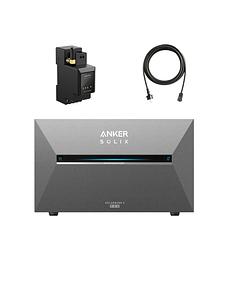
Anker SOLIX Solarbank 3 Pro + Smart Meter, Plug&Play Balkonkraftwerk mit Speicher
View at AmazonAffiliate link. Buying through it earns us a commission; the price stays the same for you.
All products from this post
The ones we named above are marked; the rest are alternatives in the same category.
Affiliate notice: As an Amazon Associate, we earn from qualifying purchases. Product prices and availability are subject to change.
Frequently Asked Questions
How big is the installed base after the boom?
The boom has pushed the installed base up sharply: on 15.04.2026, strom-report.com recorded 1,311,919 systems totalling roughly 1.34 gigawatts as operational in the Marktstammdatenregister. GfK Solar counted about 1.33 million on 19.05.2026. The real installed base is likely higher, estimated at 1.5 to 4 million devices.
Is the "one every 73 seconds" figure accurate?
For 2025, yes, as an annual average: 429,808 registrations divided by 365 days is 1,178 per day, and 86,400 seconds divided by 1,178 is 73.4 seconds. For 2026 it no longer holds. The first-quarter average was closer to 120 seconds.
Why are balcony solar systems booming now?
The clearest trigger is regulatory. Since 1 April 2024, registering in the Marktstammdatenregister takes five fields instead of roughly 20, and since 16.05.2024 the separate grid-operator notification is gone. Falling kit prices and a wish for independence from electricity prices did the rest.
How large is the undercount of unregistered systems?
strom-report.com estimates the real installed base at 1.5 to 4 million against roughly 1.3 million registered devices. That is an estimate, not a count. GfK Solar notes that even at double the registered figure, unregistered systems would stay in the single-digit percentage range of German PV output.
Is the balcony storage market growing faster than balcony solar itself?
Yes. While new system registrations plateaued at around 430,000 a year across 2024 and 2025, the storage segment grew by roughly 97 percent to about 222,000 units. Around one in five registered balcony systems now includes its own battery.