Power Bank Fast Charging: The Race to Full in Under an Hour
 9 min read
As of: 02.09.2026
Forty-nine minutes from empty to full. Forty-five minutes to 80 percent. Seventy minutes to 80 percent. Three brands, three numbers, all of them on the front of the product listing. Anyone shopping for power bank fast charging already knows this pattern from the small end of the category: one brand advertises minutes instead of hours, then everyone else follows. Power stations are running the same race, with bigger numbers and three marketing names that almost nobody keeps straight.
The interesting part isn't who wins. It's that those three numbers aren't measuring the same thing.
GaN lives in the wall brick, not in the power station
The most common mix-up first, because it's almost everywhere.
GaN stands for gallium nitride, a semiconductor material. As Cubenest explains, GaN semiconductors run cooler than conventional silicon chips because they're more efficient, which is why GaN chargers come out smaller and lighter than the bricks we used to carry. That's a charger story. Not a battery story.
How fast a power station charges is decided inside the power station: the voltage architecture of its AC input, and the BMS behind it. You could set the best GaN charger in the world next to it and nothing would change. Your power bank is a different case, though. It charges over USB-C, and there the wall adapter genuinely can be the bottleneck, so a stronger GaN adapter does help.
So "gan charger" is a search term about power adapters. "Power bank fast charging" is one about batteries. The race described here happens on the battery side.
Three names, one promise: X-Stream, HyperFlash, TurboBoost
EcoFlow describes X-Stream on its own technology page as a technique that shortens charge times through controlled higher voltage and current flow. No exotic material, no new cell type. More watts going in, plus a controller keeping watch.
Anker Solix has two names in circulation and they get confused constantly. HyperFlash is the speed. InfiniPower is the durability. According to Anker's own SOLIX C1000 product page, the unit charges from 0 to 100 percent in 49 minutes using HyperFlash, at 1,600 W input. InfiniPower is Anker's umbrella term for LFP cells, BMS and component quality, which is a cycle-life claim rather than a speed one. Treat them as the same thing and you'll probably end up buying for the wrong property. Anker officially dates the Solix C1000 Gen 2 launch to 19 August 2025.
Bluetti calls its version TurboBoost, or just Turbo Charging depending on the model.
Now the honest caveat. Who moved first can't be documented cleanly. The Solix C1000 Gen 2 has a hard date confirmed by several outlets at once. X-Stream and Turbo Charging as technologies don't have a first-appearance date that holds up, as far as we can tell, so there's no timeline here. Call it a chain of responses, not a chronology.
Charging time compared: three figures, three yardsticks
Here's what the marketing images leave out. The three numbers are not comparable. Independent lab testing of Jackery, EcoFlow, Bluetti and Anker Solix backs that up, putting manufacturer claims next to actually measured charge times.
| Model | Charging time (manufacturer spec) | Target state | AC input | Source, checked 02.09.2026 |
|---|---|---|---|---|
| Anker Solix C1000 Gen 2 | 49 minutes | 100 % | 1,600 W | Anker product page |
| EcoFlow Delta 3 Classic | 45 minutes | 80 % | not stated | EcoFlow product specs |
| Bluetti Elite 100 V2 | 70 minutes | 80 % | 1,200 W | Amazon product description |
Forty-nine minutes to 100 percent against 45 minutes to 80 percent looks like a photo finish, and it isn't one. The final 20 percent are the slowest part of any lithium charge curve, because the BMS deliberately tapers current there. A figure quoted to 80 percent flatters itself. Then there's the input: 1,600 W against 1,200 W is a third of a difference before any proprietary technology gets involved at all.
All three units sit at roughly 1 kWh. That's honestly the only clean point of comparison in the table.
Anker Solix C1000 Gen 2: 49 minutes, with conditions attached
Those 49 minutes aren't just sitting there waiting for you. Anker notes on the same product page that UltraFast mode has to be switched on in the app and works optimally above 20 °C battery temperature. For November camping, or for a power station living in an unheated garage, the advertised figure simply doesn't apply.
Anker SOLIX C1000 Gen 2 Tragbare Powerstation, 1024Wh LiFePO4, 2000W Solargenerator
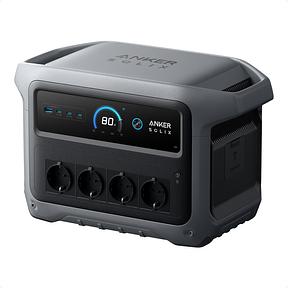
Anker SOLIX C1000 Gen 2 Tragbare Powerstation, 1024Wh LiFePO4, 2000W Solargenerator
View at Amazon (as of Aug 27)Affiliate link. Buying through it earns us a commission; the price stays the same for you.
EcoFlow Delta 3 Classic: X-Stream in the mid range
EcoFlow quotes 45 minutes to 80 percent for the Classic. The matching input wattage isn't stated in the specs we checked, so that cell stays empty rather than estimated. Something else stands out though: within the Delta 3 line, figures vary noticeably between sub-models. If you're carrying a number over from a review, it's worth checking which exact model that review had on the bench.
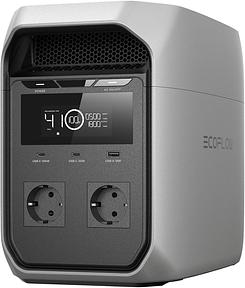
EF ECOFLOW DELTA 3 Classic Tragbare Powerstation 1024 Wh
View at AmazonAffiliate link. Buying through it earns us a commission; the price stays the same for you.
Bluetti Elite 100 V2: the number that doesn't agree with itself
Two figures circulate for this unit. The Amazon product description says 70 minutes to 80 percent at 1,200 W TurboBoost input. Bluetti's own product page carries a considerably lower figure for the same device. We're using the number from the listing that's actually linked here, and naming the discrepancy instead of quietly picking the prettier one. It hasn't been resolved.
BLUETTI Elite 100 V2 (2025) Tragbare Power Station, 1024Wh LFP, 1800W AC
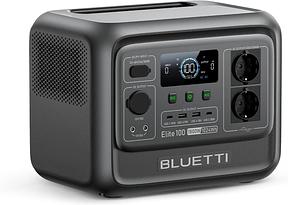
BLUETTI Elite 100 V2 (2025) Tragbare Power Station, 1024Wh LFP, 1800W AC
View at Amazon (as of Aug 27)Affiliate link. Buying through it earns us a commission; the price stays the same for you.
Does fast charging damage the battery?
The obvious worry, and the answer is more layered than a yes or a no.
According to Battery University, one of the most widely cited battery-education resources in the industry, LFP chemistry tolerates high charge currents well during the bulk stage. What it flags as critical is the high-voltage stage at the end, which should be kept short, and holding a pack at 100 percent indefinitely. Put differently: the fast first hour probably isn't your problem. The power station that's been sitting plugged in and full since March is closer to one.
The second documented risk factor is exceeding the manufacturer's rated charge current, typically through a third-party charger that was never approved for the unit. That's precisely what the BMS behind X-Stream, HyperFlash and TurboBoost exists to prevent.
A 2024 study published in the journal Applied Energy looked specifically at how fast charging affects degradation and safety in LiFePO4 cells. The full text is paywalled, so no figure from it appears here. It does show the question is being studied seriously rather than being a marketing talking point.
What this actually means for you
In daily use the minute count matters less often than the advertising suggests. Overnight, every one of these units is full, whether it took 49 minutes or 90.
It gets interesting in specific situations. Topping up a balcony-solar battery after an overcast afternoon, before the evening load hits. Announced grid maintenance, where the window is short. And packing day, when the power station is still at 30 percent two hours before you leave.
The race has moved beyond the wall socket too. As Notebookcheck reported, Bluetti's Charger 1 accessory pulls up to 560 watts out of a vehicle battery into the power station. Useful on the road, where there's no grid to plug into. How little the race stands still shows in what EcoFlow, Bluetti and Anker Solix showed at IFA 2026. The next model generation is already lining up.
What's missing is an independent measurement that charges all three units under the same conditions, at the same starting temperature, to the same percentage. Until that exists, this is a comparison of advertising claims, labelled as such. That's as far as the published evidence honestly goes.
All products from this post
The ones we named above are marked; the rest are alternatives in the same category.
Affiliate notice: As an Amazon Associate, we earn from qualifying purchases. Product prices and availability are subject to change.
Frequently Asked Questions
What is the difference between HyperFlash and InfiniPower?
HyperFlash is Anker Solix's name for its fast-charging technology, so it describes charging speed. InfiniPower covers longevity instead: LFP cells, battery management and component quality. The two get confused often, but they describe opposite properties. If charging speed is what you're after, HyperFlash is the label to look for.
Does a GaN charger make my power station charge faster?
No. GaN is a semiconductor material used in power adapters and chargers, allowing smaller and cooler designs. How fast a power station charges over its AC input is determined by its own charging electronics and BMS. For a power bank charging over USB-C, though, a stronger GaN adapter genuinely can make a difference.
Is fast charging bad for a LiFePO4 battery?
Battery University reports that LFP chemistry tolerates high charge currents well during the bulk stage. The factors it treats as more critical are the short high-voltage stage at the end of a charge, holding a pack at 100 percent long term, and charge currents above the manufacturer's rating, usually from an unapproved third-party charger. The supplied charging method is the safe route.
Which brand charges fastest?
The published figures don't answer that. Anker Solix quotes 49 minutes to 100 percent at 1,600 W, EcoFlow 45 minutes to 80 percent, and Bluetti 70 minutes to 80 percent at 1,200 W. Different target states and different input wattages make those numbers incomparable. Until someone measures all three under the same conditions, it's a race with no shared finish line.
Why doesn't my power station hit the advertised charging time?
Temperature is the usual reason. Anker states that UltraFast mode on the Solix C1000 Gen 2 has to be enabled in the app and works optimally above 20 °C battery temperature. The target state matters too: a figure quoted to 80 percent will never be met if you're charging all the way to 100 percent.
Sources
- Cubenest explains cubenest.de
- its own technology page ecoflow.com
- Anker's own SOLIX C1000 product page ankersolix.com
- officially dates the Solix C1000 Gen 2 launch to 19 August 2025 globenewswire.com
- Battery University batteryuniversity.com
- 2024 study published in the journal Applied Energy sciencedirect.com
- Notebookcheck reported notebookcheck.com