Does the EU USB-C Mandate Apply to Power Banks? What the Directive Actually Says
 11 min read
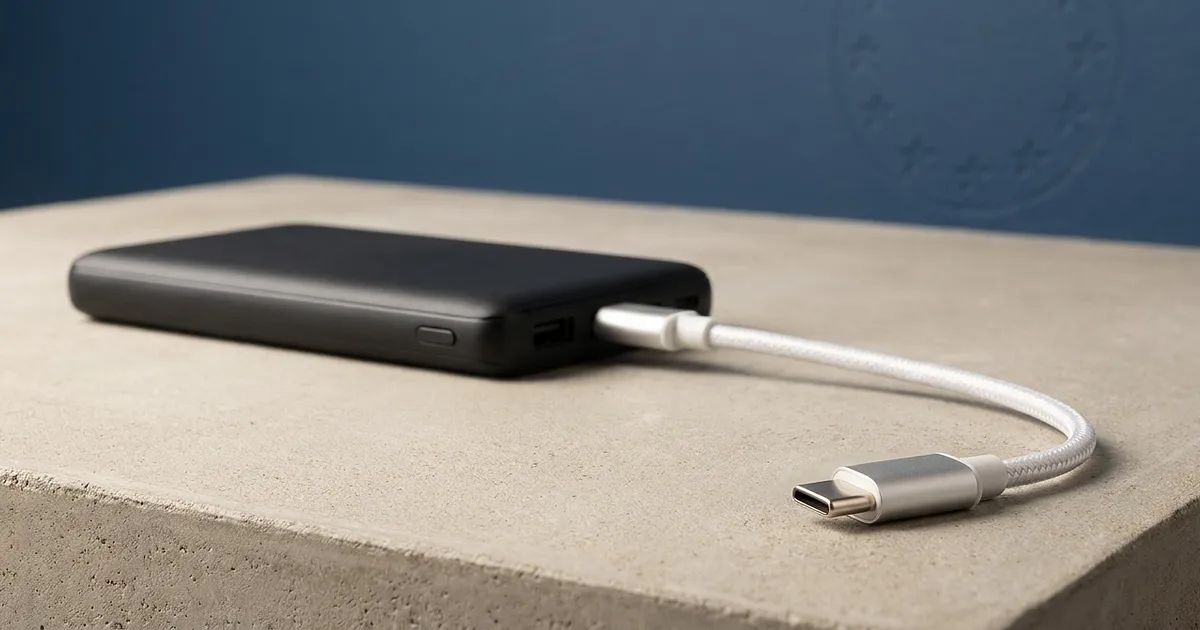
Since the end of 2024, virtually every new phone sold in the EU has a USB-C socket, so most buyers assume the same rule covers the power bank in their drawer. Then a freshly ordered model arrives that still charges over Micro-USB — perfectly legal, and a neat demonstration of how narrowly the EU rule is actually drawn.
The distinction is not legal hair-splitting. It decides what you have to check yourself at the point of purchase, because on this particular question the law does not do the work for you.
What the directive actually requires
The legal basis is Directive (EU) 2022/2380. It is not a standalone regulation but an amendment to the Radio Equipment Directive 2014/53/EU, usually shortened to RED. That is the first clue as to why power banks stay outside it: whatever the RED does not reach, the amendment does not reach either.
The European Commission sets out the scope verbatim on its common charger page (as of 2026-08-07):
| Device category | USB-C required since |
|---|---|
| Handheld mobile phones | 28 December 2024 |
| Tablets | 28 December 2024 |
| Digital cameras | 28 December 2024 |
| Headphones, headsets, earbuds | 28 December 2024 |
| Portable speakers | 28 December 2024 |
| Handheld videogame consoles | 28 December 2024 |
| E-readers | 28 December 2024 |
| Keyboards and mice | 28 December 2024 |
| Portable navigation systems | 28 December 2024 |
| Laptops and notebooks | 28 April 2026 |
| Power banks | no requirement |
The German federal government reproduces the same list and the same two dates for the national implementation. Power banks appear in neither source.
Why power banks fall outside: two hurdles, not one
In Germany the directive is implemented by the Funkanlagengesetz, the radio equipment act, with market surveillance handled by the Bundesnetzagentur. The statute makes the two conditions easy to lay side by side, and a device has to clear both.
Hurdle 1 — it has to be radio equipment at all. Section 3(1)(1) defines radio equipment as a product that intentionally emits or receives radio waves for the purpose of radio communication or radiodetermination. An ordinary power bank does neither. It is therefore not radio equipment, and the act does not reach it in the first place.
Hurdle 2 — it has to be on the list. Section 4(4) imposes the common charging interface only on radio equipment belonging to the categories or classes named in Annex Ia Part I of Directive 2014/53/EU. That is exactly the table above, and power banks are not in it.
The edge case is worth stating plainly, because it is often told wrong. A power bank with Bluetooth or app connectivity does emit radio waves, so it clears hurdle 1 and is radio equipment. It then falls under the RED — but only under the RED's general requirements. Its charging socket is unaffected, because hurdle 2 is still not met. That device may also charge over Micro-USB.
Also not required: the unbundled sale and the pictogram
Two lesser-known obligations travel with the USB-C rule, and both have the same restricted set of addressees. Section 4a of the Funkanlagengesetz requires that consumers always be offered the option of buying a device without a charging power supply, and that a pictogram on the packaging shows whether a power supply is included.
The wording ties both duties to radio equipment "within the meaning of section 4(4)" — the category list again. Neither applies to a power bank. If you see such a pictogram on power bank packaging, that is a manufacturer's courtesy rather than evidence of compliance, and it tells you nothing about the device's sockets.
What happens in practice anyway
The rule does reach power banks indirectly, and forcefully. Since 28 December 2024 every phone, tablet and pair of headphones newly sold in the EU charges over USB-C. That settles the question of which connector a power bank needs on its output: a USB-C output, or it cannot charge the devices its own buyers own.
The open flank is the input. That is exactly where Micro-USB persists, mostly at the cheapest end of the market — and nobody is breaking any rule by shipping it. In practice this means you have to check on a power bank what the law checks for you on a phone.
Three things genuinely differ here, even though the packaging says "USB-C" in all three cases:
USB-C on the output only. It charges your device; you charge it over Micro-USB.
USB-C in both directions. One cable for everything, usually marketed as bidirectional.
USB-C plus Power Delivery. The protocol is what determines charging power; the shape of the socket says nothing about it.
How much energy actually arrives is a separate question again — converting capacity ratings into usable watt-hours is covered in our piece on converting mAh to Wh.
Five devices that show the difference
The examples below are from amazon.de, with prices and ratings retrieved on 2026-08-07. They are not test winners and we did not test them — the figures are manufacturer specifications and platform data, not measurements of our own.
| Model | Capacity | Max output | Cable built in | Price (as of 2026-08-07) |
|---|---|---|---|---|
| UGREEN Nexode 20,000 mAh | 20,000 mAh | 45 W | yes, USB-C | €27.49 |
| Anker Zolo 20,000 mAh | 20,000 mAh | 45 W | yes, two cables | €32.99 |
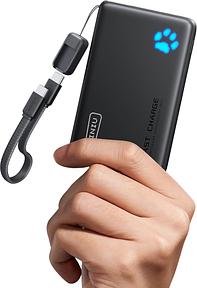
| INIU 10,000 mAh | 10,000 mAh | 45 W | yes, USB-C | €21.68 |
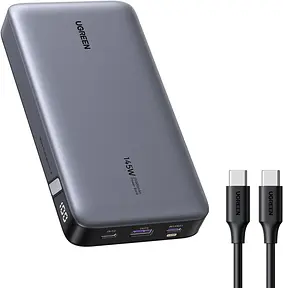
| UGREEN Nexode 25,000 mAh | 25,000 mAh | 145 W | no | €51.99 |
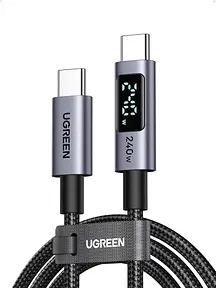
| UGREEN USB-C cable (240 W) | not stated | 240 W | not applicable | €13.59 |
Bidirectional, with a fixed cable
The UGREEN Nexode Power Bank 20000mAh 45W mit integriertem USB-C Kabel holds 20,000 mAh and delivers up to 45 W according to the manufacturer. Its integrated USB-C cable works in both directions, so it also recharges the power bank itself — the layout that sidesteps the Micro-USB question entirely. Rated 4.6 out of 5 stars across 3,745 ratings (amazon.de, as of 2026-08-07).
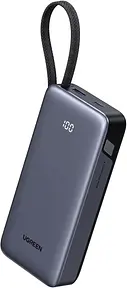
UGREEN Nexode Power Bank 20000mAh 45W mit integriertem USB-C Kabel
View at Amazon (as of Aug 11)Affiliate link. Buying through it earns us a commission; the price stays the same for you.
Two fixed cables instead of one loose one
The Anker Zolo Powerbank 20.000 mAh, 45 W Max carries two attached cables, one USB-C and one USB-A, again at 20,000 mAh and up to 45 W. Rated 4.6 out of 5 stars across 1,579 ratings (amazon.de, as of 2026-08-07).
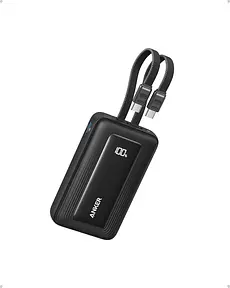
Anker Zolo Powerbank 20.000 mAh, 45 W Max
View at Amazon (as of Aug 11)Affiliate link. Buying through it earns us a commission; the price stays the same for you.
The compact class
The INIU Power Bank, Kleiner 45W Schnellladen 10000mAh Powerbank mit Abnehmbar USB C Kabel, Flugtauglich & Reise-Essential, Externe Handyakkus is the smallest here at 10,000 mAh and likewise quotes 45 W. Rated 4.6 out of 5 stars across 6,461 ratings (amazon.de, as of 2026-08-07). This class is generally not enough for a notebook — we treat power banks for laptops separately.
Affiliate link. Buying through it earns us a commission; the price stays the same for you.
When notebook power is the point
The UGREEN Nexode Power Bank 25000mAh 145W, 2X USB-C+1x USB-A quotes 25,000 mAh and up to 145 W across two USB-C ports. Rated 4.4 out of 5 stars across 7,403 ratings (amazon.de, as of 2026-08-07). One note for flying: 25,000 mAh at 3.7 V works out to roughly 92.5 Wh, below the widely applied 100 Wh threshold we set out in power banks in carry-on baggage.
UGREEN Nexode Power Bank 25000mAh 145W, 2X USB-C+1x USB-A
View at Amazon (as of Aug 10)Affiliate link. Buying through it earns us a commission; the price stays the same for you.
The cable is the quiet bottleneck
A UGREEN USB-C Kabel 240 W PD 3.1 mit E-Marker und Display (2 m) rated 240 W under PD 3.1 is the part most people underestimate: a cable without a matching e-marker caps charging power regardless of what the power bank and the notebook could manage between them. Rated 4.7 out of 5 stars across 1,843 ratings (amazon.de, as of 2026-08-07).
UGREEN USB-C Kabel 240 W PD 3.1 mit E-Marker und Display (2 m)
View at Amazon (as of Aug 11)Affiliate link. Buying through it earns us a commission; the price stays the same for you.
What is coming for power banks instead
Power banks are regulated — just under a different instrument. Article 11 of the EU Battery Regulation (EU) 2023/1542 requires from 18 February 2027 that portable batteries be readily removable and replaceable by the end user at any time during the product's lifetime.
Whether that catches power banks was not settled as of 2026-08-07. The Commission has published a draft delegated act that would expressly take rechargeable power banks and charging cases outside the scope of Article 11; the consultation on it ran to 26 May 2026 (Cooley Productwise, 15 May 2026). A draft is a draft — nothing about the legal position follows from it until adoption, and we are not filling in a figure that has not been decided.
Alongside that sit the substance limits and take-back duties that apply to batteries in any case. What happens to the device at the end of its life is covered in our piece on disposing of a power bank.
Will the list be extended?
The directive has a review built into it. The Commission is to report on which further categories of radio equipment could accommodate the common charging requirements, with a first report to Parliament and Council envisaged by 28 December 2025, and a further report on possibly extending the unbundling obligation to cables by 28 December 2026 (European Parliament Legislative Observatory).
The category list published on the Commission's page was unchanged on 2026-08-07 and contained no power banks. Whether that changes is open; an extension would take its own legal act rather than following automatically from the existing directive.
Status of the figures
Legal position and all prices: 2026-08-07. The category list and the two dates come from the European Commission and the German federal government; the statutory citations are from the Funkanlagengesetz as published on gesetze-im-internet.de. Prices, ratings and rating counts were retrieved from amazon.de on 2026-08-07 and change continuously. No devices were tested or measured by us.
All products from this post
The ones we named above are marked; the rest are alternatives in the same category.
Affiliate notice: As an Amazon Associate, we earn from qualifying purchases. Product prices and availability are subject to change.
Frequently Asked Questions
Does a power bank have to have USB-C in the EU?
No. Directive (EU) 2022/2380 reaches only the equipment categories listed in it, such as phones, tablets, headphones, e-readers, keyboards, mice, navigation systems, speakers and games consoles since 28 December 2024, plus laptops since 28 April 2026. Power banks are not named there. A power bank may therefore still be charged over Micro-USB without breaching EU law.
Why are power banks excluded?
Because two conditions have to be met and a power bank fails both. Under section 3(1)(1) of the Funkanlagengesetz, radio equipment is a product that intentionally emits or receives radio waves for radio communication or radiodetermination, which an ordinary power bank does not. And section 4(4) imposes the common charging socket only on the categories listed in Annex Ia Part I of Directive 2014/53/EU.
Does the rule apply to a power bank with Bluetooth or an app?
Such a device is radio equipment and falls under the Radio Equipment Directive's general requirements. That changes nothing about its charging socket: the USB-C requirement additionally depends on the category list in Annex Ia Part I, and power banks are not on it. A power bank with a radio module may also be charged over Micro-USB.
Since when has the USB-C mandate applied to laptops?
Since 28 April 2026. For the other covered categories it has applied since 28 December 2024. The European Commission gives both dates on its common charger page, and the German federal government cites the same dates for the national implementation.
Does power bank packaging have to carry the charger pictogram?
No. Section 4a of the Funkanlagengesetz ties both the pictogram and the offer to buy without a charging power supply expressly to radio equipment within the meaning of section 4(4), meaning the category list. A power bank does not fall under it. A pictogram on power bank packaging is voluntary and says nothing about the device's ports.
What changes for power banks from February 2027?
Article 11 of EU Battery Regulation 2023/1542 requires from 18 February 2027 that portable batteries be removable and replaceable by the end user. Whether power banks are caught was open as of 2026-08-07: a draft delegated act would expressly exempt them, and the consultation on it ran to 26 May 2026. No binding requirement can be derived from that until it is adopted.
What should I look for when buying a power bank?
Three things, all of which come from the datasheet rather than from the law. First, whether USB-C is on the output only or on the input as well. Second, whether Power Delivery is supported, since the shape of the socket alone says nothing about charging power. Third, whether the cable you use actually carries the power you want, which above 60 W requires an e-marker in the cable.
Sources
- Directive (EU) 2022/2380 eur-lex.europa.eu
- European Commission single-market-economy.ec.europa.eu
- German federal government bundesregierung.de
- Funkanlagengesetz gesetze-im-internet.de
- EU Battery Regulation (EU) 2023/1542 eur-lex.europa.eu
- Cooley Productwise, 15 May 2026 products.cooley.com
- European Parliament Legislative Observatory oeil.europarl.europa.eu