
Power Bank in a Hot Car: What Summer Heat in the Glovebox Actually Does to the Battery
 14 min read
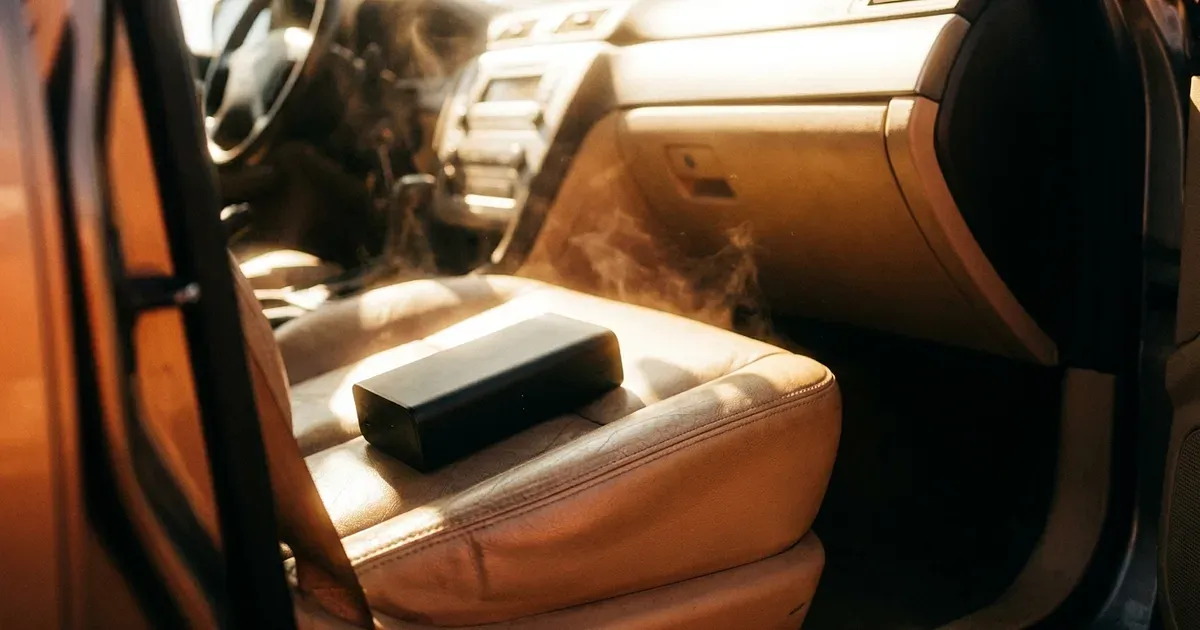
The power bank has been in the glovebox since May. It bothers nobody there, it is available in an emergency, and it is, after all, just a piece of electronics in a closed compartment. That reasoning falls apart in high summer, and not because the battery bursts into flames on a Tuesday afternoon, but because a parked car spends hours at temperatures no manufacturer clears its cells for.
What makes this worth writing up is the gap between two sets of numbers you rarely see side by side: what measurements inside a parked vehicle actually record, and what the battery makers print in their own specifications. This piece puts them next to each other, every figure with its source, and then says what that means in practice.
One limitation up front, because it matters for how much weight to give any of this: there is no publicly available measurement series that logs the temperature inside a glovebox over a summer day. The solid figures below cover cabin air and interior surfaces. Where a number is missing, this piece says so rather than estimating one.
How hot does a parked car actually get?
The ADAC has published two measurements that complement each other nicely.
The first comes from the release "Vorsicht vor Hitze im Auto" of 21 May 2026. The starting conditions are the striking part: the outside temperature stayed "dauerhaft unter 30 Grad", permanently below 30 degrees. Even so, the interior climbed above 50 degrees after half an hour, and after ninety minutes a peak of 59.1 degrees was recorded. You do not need a record-breaking heatwave for these numbers. An ordinary warm day is enough.
The second is the comparison test "Hitze im Auto – was hilft wirklich?" of 10 August 2021, in which seven identical vehicles sat in the sun for roughly four hours around midday. The unprotected reference car reached 53 degrees of cabin temperature. More relevant to our question is a different figure from the same test: the steering wheel and dashboard got hotter than 70 degrees. Surfaces inside a car run well above the air, and a power bank sitting on the dashboard or in a sunlit tray is resting on exactly such a surface.
| Measurement (source, date) | Temperature |
|---|---|
| Outside temperature during the measurement (ADAC, 21 May 2026) | permanently below 30 degrees |
| Cabin after 30 minutes (ADAC, 21 May 2026) | above 50 degrees |
| Cabin after 90 minutes, peak (ADAC, 21 May 2026) | 59.1 degrees |
| Cabin unprotected, after approx. 4 hours (ADAC, 10 Aug 2021) | 53 degrees |
| Cabin under a half-cover, after approx. 4 hours (ADAC, 10 Aug 2021) | 43 degrees |
| Steering wheel and dashboard, surface (ADAC, 10 Aug 2021) | above 70 degrees |
| Glovebox interior | not stated (no public measurement series found) |
That last row is not sloppiness, it is the honest state of the evidence. A glovebox is shaded and sits lower than the dashboard, so it should stay cooler than the 70-degree surfaces. How much cooler is not documented. What is documented: the air it warms up from reached 59.1 degrees in the May 2026 measurement.
What the manufacturers actually clear
The interesting number is not how hot the car gets. It is where the manufacturer stops signing off. And that range is narrower than most people assume.
In its Power Bank Safety Guide, Anker states an ambient temperature of "32°F and 95°F (0°C and 35°C)" and gets unusually blunt about cars: "Avoid direct sunlight and high-temperature environments (such as inside a parked car)." The parked car appears as a named negative example in the manufacturer's own safety document.
It gets tighter still in Anker's Battery's lifespan and temperature FAQ. There the optimised operating range is given as "32°F to 77°F (0℃ to 25℃)". For storage, Anker publishes a staggered figure: "14°F to 113°F (-10°C to 45°C)" for one month, but only "14°F to 95°F (-10°C to 35°C)" for three months. The longer something sits, the narrower the permitted corridor. A power bank spending an entire summer in a car is by definition a storage case, not a brief operating one.
Power stations look similar. EcoFlow lists an "Optimal Operating Temperature" of 68 °F to 86 °F for the RIVER 3, which is 20 °C to 30 °C, and a "Storage Temperature" in the same window of 68 °F to 86 °F. For charging it permits 32 °F to 113 °F, for discharging 14 °F to 113 °F.
| Device (source) | Operating | Storage |
|---|---|---|
| Anker power banks, general (Safety Guide) | 0 °C to 35 °C ambient | not stated in that document |
| Anker batteries, optimised (Temperature FAQ) | 0 °C to 25 °C | 1 month: -10 °C to 45 °C; 3 months: -10 °C to 35 °C |
| EcoFlow RIVER 3 (manufacturer specification) | optimal 68 °F to 86 °F (20 °C to 30 °C) | 68 °F to 86 °F (20 °C to 30 °C) |
Hold the two tables next to each other. The highest storage figure any of these makers still publishes is 35 °C to 45 °C. The ADAC cabin peak was 59.1 degrees. That is not a grey area, it is comfortably outside the specification.
What heat does to capacity
The damage heat does is usually not dramatic, it is gradual. It shows up in October, when the power bank suddenly charges the phone twice instead of three times.
The reference figures come from Battery University (BU-808), which tabulates recoverable capacity after one year of storage by temperature and state of charge. At 25 °C, 96 % remains at a 40 % charge and 80 % at a full charge. At 40 °C it is 85 % and 65 %. At 60 °C the source gives 75 % at a 40 % charge and 60 % at a full charge, the latter after only three months rather than a year.
| Storage temperature (Battery University, BU-808) | at 40 % charge | at 100 % charge |
|---|---|---|
| 0 °C | 98 % | 94 % |
| 25 °C | 96 % | 80 % |
| 40 °C | 85 % | 65 % |
| 60 °C | 75 % | 60 % (after 3 months) |
Two things stand out. First, state of charge matters almost as much as temperature: a half-full power bank handles warmth far better than a brimming one. Second, going from 40 °C to 60 °C halves the timescale over which the loss arrives. A summer in a car is not an edge case here, it is precisely the case this table describes.
What is deliberately not here: a projection of the form "after X weeks in a car your power bank is at Y percent". The table describes constant laboratory storage temperatures, whereas a car swings by dozens of degrees between night and midday. Converting one into the other would be invention, not measurement.
The safety side: what the TÜV association says
Capacity loss is the likely outcome. The rare but serious one is described by the TÜV-Verband, Germany's technical inspection association, in its release "Abseits der Steckdose: Sichere Nutzung von Powerbanks" of 6 July 2023.
Its recommendation leaves little room for interpretation: power banks should not be kept in a closed car, and certainly not on the dashboard in direct sunlight. More generally, the release states that power banks must not be exposed to extreme temperatures, neither in use nor in storage.
The mechanism behind that is thermal runaway. Once a lithium-ion battery overheats, the release says, an electrochemical reaction sets in during which the battery can heat itself to as much as 1,000 degrees in a very short time. That is not a temperature the surroundings have to supply. It is one the cell generates itself once the reaction is running.
The same text names the signs of a battery that has already been damaged: swollen or deformed housings, melted spots, and discoloured metal parts. And for everyday use it offers the simplest rule in the whole piece. If the unit gets so hot while charging that you can no longer hold it comfortably, stop the charge.
Honesty requires the counterweight: the TÜV-Verband gives no probability that a power bank in a hot car will actually go into runaway, and no credible figure for that exists elsewhere either. This is precautionary advice, not an alarm. The capacity loss in the section above is the part that will realistically affect you.
What to do instead
The fix is unglamorous: the power bank should not stay in the car. For that to survive contact with real life, it has to be small enough that taking it along is automatic rather than a decision. That is exactly where most car power banks fail. They are too bulky for a pocket, so they stay put.
A note on the four models below before anyone reads too much into them. None of these is a "heat-proof" battery, and none of the three manufacturers publishes a model-specific temperature range on the product page. For Anker, the general 0 °C to 35 °C figure quoted above applies; for UGREEN and INIU no equivalent specification was available, so none is claimed here. Prices, ratings and review counts are the amazon.de listings as of 7 August 2026 and will move.
Small enough that it comes along by default
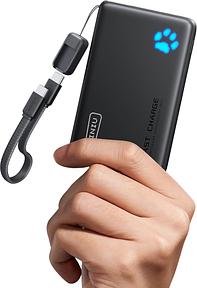
The INIU 45W with 10000 mAh is the kind of battery that disappears into a pocket, which is why whether to take it never becomes a question in the first place. Capacity is comfortable for a phone across a full day, and not enough for a notebook. Price €21.68, rated 4.6 out of 5 stars across 6,461 ratings, as of 7 August 2026.
Affiliate link. Buying through it earns us a commission; the price stays the same for you.
The 20000 mAh compromise
Anyone who wants a reserve in the car for several devices or several days usually lands at 20000 mAh. The Anker Zolo at 45 W Max carries two built-in USB-C cables, which is the detail that matters in practice: never forgetting a cable also means never having a reason to park it in the car. Price €32.99, rated 4.6 out of 5 stars across 1,579 ratings, as of 7 August 2026.
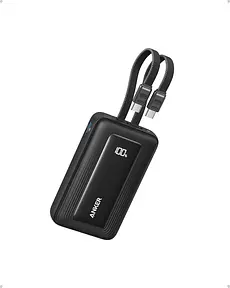
Anker Zolo Powerbank 20.000 mAh, 45 W Max
View at Amazon (as of Aug 11)Affiliate link. Buying through it earns us a commission; the price stays the same for you.
Same class, different manufacturer
The UGREEN Nexode with 20000 mAh and 45 W sits in the same category, likewise with a built-in USB-C cable, and its bidirectional 45 W means it also refills itself quickly. Price €27.49, rated 4.6 out of 5 stars across 3,745 ratings, as of 7 August 2026.
UGREEN Nexode Power Bank 20000mAh 45W mit integriertem USB-C Kabel

UGREEN Nexode Power Bank 20000mAh 45W mit integriertem USB-C Kabel
View at Amazon (as of Aug 11)Affiliate link. Buying through it earns us a commission; the price stays the same for you.
When it really does have to be the laptop
Notebook-grade charging leaves no way around a large battery. The Anker at 165 W and 25000 mAh brings three USB-C ports and a retractable cable. It is also the model most likely to end up living permanently in the boot, and in summer that is the single worst idea in this entire piece. Price €84.99, rated 4.6 out of 5 stars across 11,089 ratings, as of 7 August 2026.
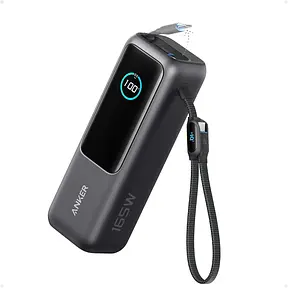
Anker Laptop Powerbank 25.000 mAh, 165 W
View at Amazon (as of Aug 11)Affiliate link. Buying through it earns us a commission; the price stays the same for you.
When it genuinely has to stay in the car
Sometimes there is no alternative, for instance with a power station in the boot. Three things then follow directly from the sources above. First, do not store it fully charged, because the BU-808 table shows better numbers at a 40 % charge than at 100 % across every temperature. Second, get it out of direct sun, since the TÜV-Verband rules out the dashboard in sunlight specifically; the footwell behind a front seat is the coolest spot reachable inside the cabin. Third, take it with you whenever you are leaving the car anyway for any length of time.
Conclusion
The numbers sit far apart, and that is the entire point. Manufacturers clear storage up to 35 °C to 45 °C, the ADAC measured 59.1 degrees inside a parked car, and it did so on a day when the outside temperature stayed under 30. There is no excuse that fits in that gap.
Realistically what happens is not a fire but a quiet loss of capacity, which the Battery University table puts at 65 % remaining after a year at 40 °C on a full charge. You only notice it at the moment you need the thing. Taking it with you avoids both, and the small models are the better car power banks for exactly that reason: because they do not stay in the car.
All figures and sources verified: 7 August 2026.
All products from this post
The ones we named above are marked; the rest are alternatives in the same category.
Affiliate notice: As an Amazon Associate, we earn from qualifying purchases. Product prices and availability are subject to change.
Frequently Asked Questions
How hot is a power bank allowed to get?
In its own Power Bank Safety Guide, Anker states a permitted ambient temperature of 0 °C to 35 °C, and in its Temperature FAQ an optimised operating range of 0 °C to 25 °C. EcoFlow gives an optimal operating temperature of 68 °F to 86 °F for the RIVER 3, which is 20 °C to 30 °C. The binding figure is always the specification of your own manufacturer, never a general rule of thumb.
How warm does a parked car get in summer?
On 21 May 2026 the ADAC measured above 50 degrees inside a car after half an hour and a peak of 59.1 degrees after ninety minutes, with the outside temperature staying permanently below 30 degrees. In a test of 10 August 2021, an unprotected vehicle reached 53 degrees after roughly four hours, with the steering wheel and dashboard above 70 degrees at the surface.
Can I leave a power bank in the glovebox?
The TÜV-Verband advises against it: power banks should not be kept in a closed car or on the dashboard in direct sunlight. There is no public measurement series for the glovebox itself, but it is part of the same heated cabin. In short, take it with you.
How much capacity does heat actually cost?
Battery University gives 96 % remaining capacity after a year of storage at 25 °C and a 40 % charge, 85 % at 40 °C, and 75 % at 60 °C. Fully charged, the figures are 80 %, 65 % and 60 %, the last of those after only three months. A car swings widely in temperature, so no exact figure for one summer in a vehicle can be derived from it.
How do I spot a heat-damaged power bank?
The TÜV-Verband names swollen or deformed housings, melted spots and discoloured metal parts as signs of damage. One more warning sign in everyday use: if the power bank becomes so hot while charging that you can no longer hold it comfortably, the charge should be stopped.
Should I store a power bank full or half full?
Half full. The Battery University table shows better figures at a 40 % charge than at 100 % throughout: at 40 °C, 85 % remains after a year instead of 65 %. The effect is most pronounced in the heat, which is why state of charge and temperature should always be considered together.
Sources
- "Vorsicht vor Hitze im Auto" presse.adac.de
- "Hitze im Auto – was hilft wirklich?" presse.adac.de
- Power Bank Safety Guide service.anker.com
- Battery's lifespan and temperature FAQ service.anker.com
- RIVER 3 us.ecoflow.com
- Battery University (BU-808) batteryuniversity.com
- "Abseits der Steckdose: Sichere Nutzung von Powerbanks" tuev-verband.de