Power Banks in Winter: Why Cold Kills Your Capacity – and What Actually Helps
 10 min read
Last updated: 07/08/2026
The moment is always the same. Ski lift, freezing platform, second hour of a dog walk below zero: your phone shows 20 percent, you plug in the power bank, and instead of the two full charges it normally manages, you get half of one. Or nothing at all. The obvious conclusion is that the thing has died.
Usually it hasn't. The energy is still sitting in the cells — it just can't get out right now. That distinction matters, because you can check it the same evening in a warm room, and it decides whether you need a replacement or simply a different jacket pocket.
What happens inside the cell when it gets cold
A lithium-ion battery doesn't store electricity, it stores a chemical readiness. During discharge, lithium ions travel through an electrolyte fluid from one electrode to the other. How fast that happens depends on how mobile that fluid is.
Germany's TÜV-Verband described the mechanism in a single sentence in its press release of 15 February 2021: the internal resistance of a phone battery rises as the electrolyte fluid becomes more viscous. Exactly the same applies to the power bank in your bag — same cell chemistry, different housing.
Higher internal resistance means part of the energy is lost as heat on the way out, and voltage sags earlier under load. Your phone reads that voltage sag as "empty" and shuts down even though there is still charge in the cell chemically. That is why the loss feels bigger in winter than it is: you don't just lose capacity, you lose it earlier than the percentage display suggests.
How much is actually missing – and why it comes back
The most usable number on this topic comes from Battery University, a reference collection published by battery maker Cadex: "A battery that provides 100 percent capacity at 27°C (80°F) will typically deliver only 50 percent at –18°C (0°F)." For −20 °C the same source states that most batteries sit at "about 50 percent performance level".
Those are lab values for the cell, not promises about your specific device. There is a wide gap between 0 °C and −18 °C, and in practice the outcome depends on how cold the power bank itself got — not on what the outdoor thermometer says. A power bank in the inner pocket of a winter jacket is rarely as cold as the air around it.
The decisive sentence from that same source is a different one, and guides routinely skip it: the reduced capacity at low temperature "only applies while the cell is in that condition and will recover in room temperature". What you lost on the mountain is back that evening in your hotel room. Cold makes your power bank temporarily smaller, not permanently broken.
Charging in the cold is the part that really hurts
This is where it flips. Discharging below freezing is inconvenient but reversible. Charging below freezing is not.
Battery University is unusually blunt about it: "Many battery users are unaware that consumer-grade lithium-ion batteries cannot be charged below 0°C (32°F)." And further: "Although the pack appears to be charging normally, plating of metallic lithium occurs on the anode during a sub-freezing charge that leads to a permanent degradation in performance and safety."
Permanent is meant literally here. That deposit — lithium plating — cannot be undone. It pushes internal resistance up further, costs capacity and, according to the same source, raises the risk of internal short circuits. Its recommendation: fast charging from 5 °C to 45 °C, reduced charge current below 5 °C, and no charging at all at freezing temperatures. How impractical cold charging really is shows in the figure Battery University quotes from research papers: at −30 °C the allowable charge rate is 0.02C, which would stretch charging to over 50 hours.
In practice: taking the power bank straight out of a cold jacket and onto a charger is the one thing worth avoiding all winter. Let it warm up first, then charge.
When the power bank refuses, that's usually protection
Many devices won't even let you make that mistake. Anker documents a low-temperature protection mode for its power banks and gives a one-line instruction: "Increase the power bank's temperature to above 32°F (0°C) to ensure normal operation."
So a power bank that does nothing below freezing is not a defect first — it is a device protecting its own cell. The same goes for the phone that shuts down in the cold for no apparent reason.
The manufacturer temperature windows sit surprisingly close together:
| Source | Temperature range | Applies to |
|---|---|---|
| Anker Support, as of August 2026 | 0 °C to 45 °C in use | Anker batteries and power banks |
| Battery University (BU-410) | 0 °C to 45 °C for charging | Lithium-ion generally |
| Battery University (BU-410) | 5 °C to 45 °C for fast charging | Lithium-ion generally |
| TÜV-Verband, 15 February 2021 | 0 °C to 35 °C in operation | Smartphones |
Anker states a recommended ambient temperature of 32 °F to 113 °F when using its batteries, which is 0 °C to 45 °C. The lower bound is the same number in all four rows, and that is no coincidence: 0 °C is where the range in which a lithium-ion cell can safely be charged ends.
What actually helps in winter
None of this makes the physics go away. It just keeps the cell from experiencing the cold part of the day.
Carry it on your body, not in an outside pocket
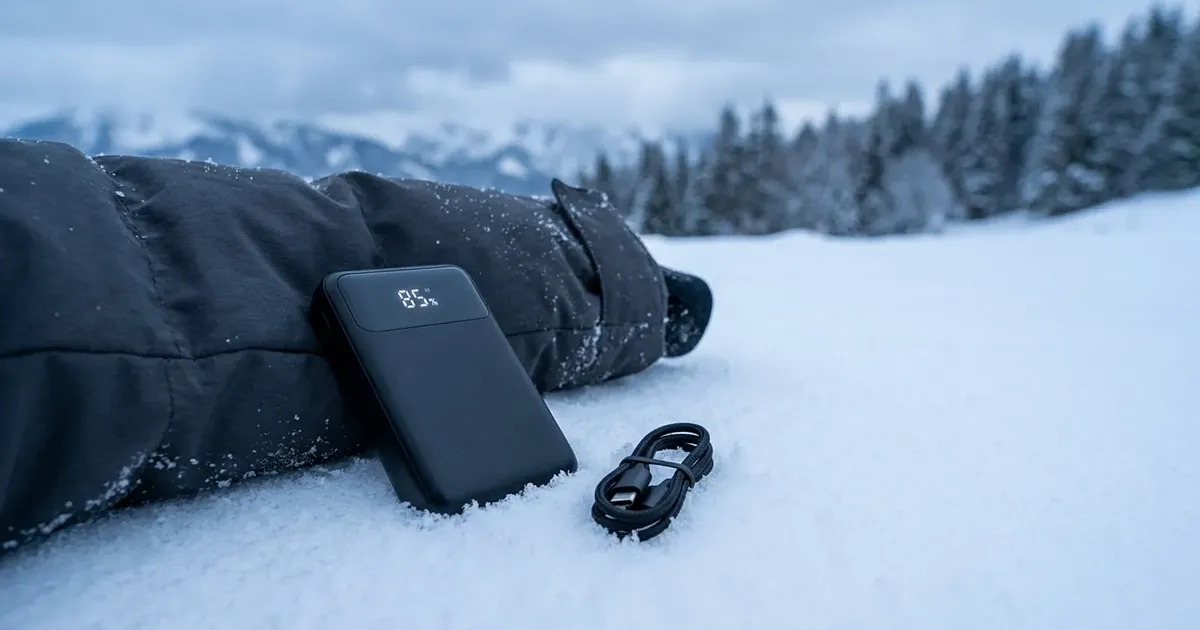
This is the one piece of advice that appears in practically every source, and the only one that needs no accessories. The TÜV-Verband explicitly recommends carrying phones close to the body outdoors. The same applies to a power bank: inner jacket pocket rather than the outside pouch of a backpack.
Which is also an argument for a device small enough to be tolerable there. A compact 10,000 mAh model such as the INIU Powerbank 10000mAh 22.5W Kompakt, listed at 22.5 W output, disappears into an inner pocket where a 25,000 mAh brick would be a nuisance.
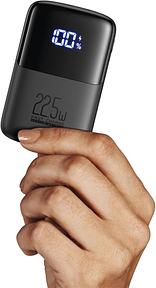
INIU Powerbank 10000mAh 22.5W Kompakt
View at Amazon (as of Aug 10)Affiliate link. Buying through it earns us a commission; the price stays the same for you.
Plan with headroom, not with the printed number
If part of the capacity is temporarily unavailable in the cold, a bigger number on the housing helps more than any trick. If you are outdoors regularly in winter, plan around 20,000 mAh rather than 10,000 mAh — not because the device is more cold-resistant, but because the buffer absorbs the drop. Models in that class such as the Anker Zolo Powerbank 20.000 mAh, 45 W Max with 45 W cost you some size and weight in return.
How much energy actually sits behind an mAh figure, and why the Wh rating is the more honest one, is covered in detail in our piece on converting mAh to Wh.
Anker Zolo Powerbank 20.000 mAh, 45 W Max
View at Amazon (as of Aug 11)Affiliate link. Buying through it earns us a commission; the price stays the same for you.
A display makes the difference visible
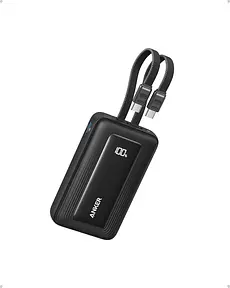
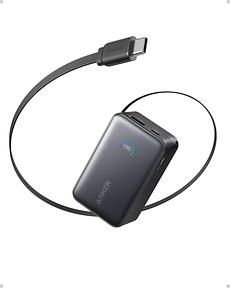
Four LEDs tell you very little in the cold. A percentage readout tells you whether the power bank is back at its old level after warming up — and that single observation separates "it was cold" from "it is getting old". Devices with a readout such as the Anker Nano Powerbank, 10.000mAh Externer Akku mit 70cm Anker InstaCord Einzugskabel, 45W Max Kompakter Akku, Smart-Display, described by the manufacturer as having a smart display and 45 W, are what make that comparison possible at all.
Affiliate link. Buying through it earns us a commission; the price stays the same for you.
Warm it up first, then charge
The most important rule in this whole article, and it costs nothing but twenty minutes of patience. Power bank out of the cold, into the room, leave it lying there, then plug it in. In the same press release the TÜV-Verband warns about the related problem: an abrupt temperature change forms condensation on the cold surface, which can lead to short circuits or corrosion inside the device.
If you would rather not fumble with a separate cable while wearing gloves, a model with a built-in cable such as the UGREEN Nexode Power Bank 20000mAh 45W mit integriertem USB-C Kabel with 45 W helps — that is convenience, not cold protection.

UGREEN Nexode Power Bank 20000mAh 45W mit integriertem USB-C Kabel
View at Amazon (as of Aug 11)Affiliate link. Buying through it earns us a commission; the price stays the same for you.
Storage: frost-free, not brim-full
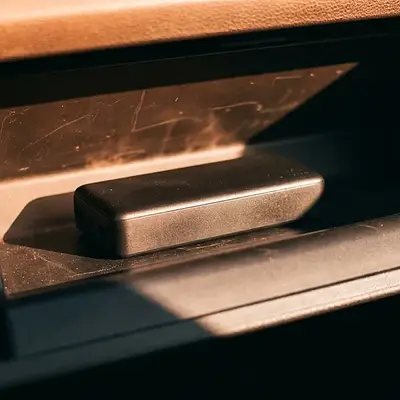
For the power bank that spends the winter in the car or on the balcony, the simplest rule applies: don't. A frost-free indoor spot costs nothing and saves you wondering in spring whether the device still does what it should.
Temporary, or genuine wear?
The test is unspectacular and takes an evening. Bring the power bank to room temperature, charge it fully, then check how many charges it manages again.
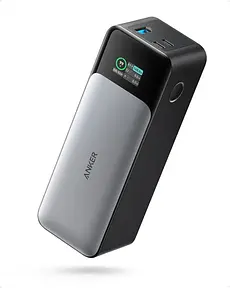
If the old performance returns, it was the cold — exactly what Battery University describes with "will recover in room temperature". If it stays away, you are dealing with ageing, which has different causes: charge cycles, time, and temperature over years. A device with an accurate readout such as the Anker Prime Powerbank 24.000 mAh, 140 W, Display, listed with 140 W and a display, makes that before-and-after comparison far easier than four dots of light.
And if the power bank is going on a plane anyway: the Wh limits and what airlines actually require since 2026 are collected in Power banks in carry-on luggage.
Anker Prime Powerbank 24.000 mAh, 140 W, Display
View at Amazon (as of Aug 10)Affiliate link. Buying through it earns us a commission; the price stays the same for you.
All products from this post
The ones we named above are marked; the rest are alternatives in the same category.
Affiliate notice: As an Amazon Associate, we earn from qualifying purchases. Product prices and availability are subject to change.
Frequently Asked Questions
Does cold damage my power bank?
While discharging, usually not. Battery University describes the low-temperature capacity loss explicitly as a condition that "only applies while the cell is in that condition and will recover in room temperature". Permanent damage comes from charging below 0 °C instead: metallic lithium then plates onto the anode, which the same source says leads to a permanent degradation in performance and safety.
How much capacity does a power bank lose below freezing?
Battery University gives a rule of thumb: a battery delivering 100 percent capacity at 27 °C typically gives only about 50 percent at −18 °C. At −20 °C, the same source puts most batteries at roughly 50 percent performance level. It gives no separate figure for temperatures just below 0 °C — the loss there is considerably smaller than in those extreme examples.
Can I charge a cold power bank straight away?
No. Battery University states a charging range of 0 °C to 45 °C for lithium-ion and holds that no charging should happen at freezing temperatures, with reduced charge current below 5 °C. Anker documents a low-temperature protection mode for its power banks and advises bringing the device above 0 °C first. So let it sit indoors before you plug it in.
Where should I carry a power bank in winter?
Close to your body. The TÜV-Verband recommends exactly that for phones, and a power bank holds the same cell chemistry. An inner jacket pocket keeps the device nearer the recommended operating window than an outside backpack pouch. Watch for condensation when you come indoors: the TÜV-Verband names short circuits and internal corrosion as possible consequences of abrupt temperature changes.
Why does my phone shut down at 30 percent in the cold?
Because internal resistance rises in the cold and voltage sags under load earlier than the charge indicator expects. The device reads that sag as "empty" and shuts down even though energy is still there chemically. The TÜV-Verband states an optimal operating temperature of 0 °C to 35 °C for smartphones. Once warm, the reading usually returns to a plausible level on its own.