Solar Panel Wattage: Balcony Solar or Power Station?
 15 min read
The wattage on the box is the number almost everyone buys on, and it is the number that decides least about whether the panel will work for you. A module can have exactly the right output and still deliver nothing, because its voltage does not fit the window of the device it is plugged into. That figure is not in the product description. It is in the datasheet.
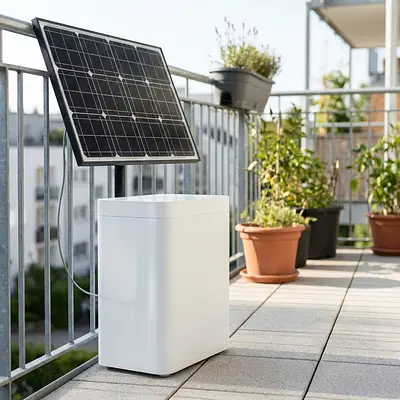
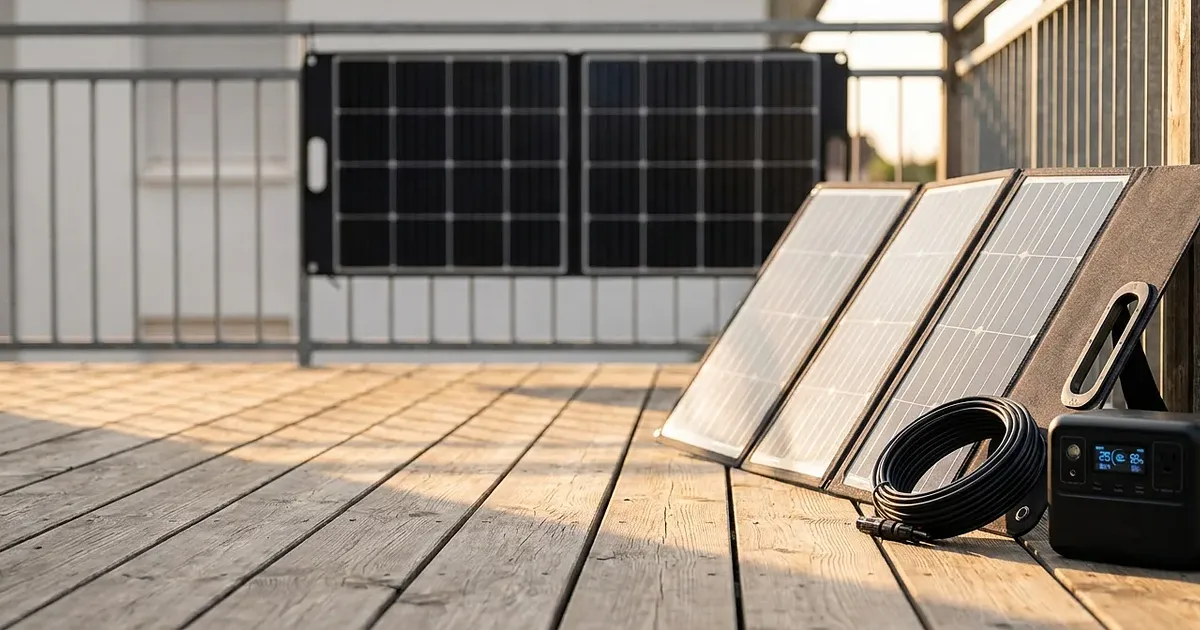
There are also two separate purchase decisions here, not one. A fixed module on a balcony railing and a foldable panel for a power station are different products, with different limits, different connectors and different physics behind them. Mixing them into a single buying guide produces exactly the bad purchases this article is about.
As of 07.08.2026. Every limit below comes from the statutes and manufacturer datasheets linked further down.
Why wattage is the wrong first question
A solar module delivers a voltage and a current. Wattage is the product of the two — and it is a laboratory figure, measured under standard test conditions at 1,000 W/m² and 25 °C cell temperature. Those conditions do not occur on your balcony on a single day of the year.
The device the panel plugs into, however, cares about wattage only third. First the voltage has to fall inside its working window, then the current must not exceed its limit. Only when both hold can the MPP tracker draw any power at all. A panel with too high an open-circuit voltage is not "slightly too big" — it is incompatible.
That order of operations is why a buying guide comparing wattages alone systematically misses the problem.
Balcony solar: 800 VA is the law, 2,000 W is the module ceiling
For plug-in solar devices in Germany the limit sits in the statute, not in a manufacturer's brochure. § 8 (5a) EEG puts it this way:
"Ein Steckersolargerät oder mehrere Steckersolargeräte mit einer installierten Leistung von insgesamt bis zu 2 Kilowatt und einer Wechselrichterleistung von insgesamt bis zu 800 Voltampere …"
That is two different numbers for two different components, and they are constantly confused:
| Component | Limit | Source |
|---|---|---|
| Modules (installed capacity, DC) | up to 2,000 W | § 8 (5a) EEG |
| Inverter (inverter output, AC) | up to 800 VA | § 8 (5a) EEG |
The practically most important consequence follows directly: you may install more module capacity than the inverter can output. This oversizing is neither a trick nor a grey area — it is written into the statute. It pays off because a module rarely reaches its rated output in everyday use: in diffuse light, in winter and at an unfavourable orientation, real output sits well below it. More module area lifts exactly those weak hours, and the 800 VA cap only clips the few peak hours in summer.
How much module capacity makes sense is stated in your inverter's datasheet. For the widely used Hoymiles HMS-800W-2T, the manufacturer datasheet (Europe region, version V202308) gives a "typically used module power" of 320 to 540+ W, with 2 MPP trackers and one input each, at a rated output of 800 VA. Two modules in that class are the intended configuration — not four small ones across two inputs.
The value almost no buying guide names: the voltage window
This is where the actual bad purchase happens. Every device with an MPP tracker — balcony microinverter and power station alike — carries three voltage figures in its datasheet, and all three are different:
| Specification | What it means |
|---|---|
| MPPT voltage range | the window in which the device actually draws power |
| Maximum input voltage | absolute ceiling; above it, damage is possible |
| Min./max. start voltage | the point at which the device starts up in the morning |
For the Hoymiles HMS-800W-2T the datasheet states: MPPT voltage range 16 – 60 V, maximum input voltage 65 V, min./max. start voltage 22/60 V, maximum input current 2 × 14 A.
The figure you have to check on the module side is called open-circuit voltage (Voc), and it lives in the module datasheet, not on the box. It is not a constant either: the temperature coefficient of open-circuit voltage is negative, so Voc rises as it gets colder. The critical moment is therefore not the hot July afternoon but the clear, cold winter morning just after sunrise.
We deliberately do not print a general Voc figure here. It is model-specific, and writing down an average would miscalculate your particular module. Take the value from your module's own datasheet, along with its temperature coefficient — a seller has to supply both.
The power station compatibility matrix
On a power station the window is narrower than on a balcony inverter, and it differs per device. Every value below is a manufacturer specification from official product pages or manuals, retrieved on 07.08.2026 — not an independent measurement.
| Unit | Max. solar input | Voltage window | Max. current | Connector |
|---|---|---|---|---|
| EcoFlow Delta 3 | 1 × 500 W max. | 11 V – 60 V | not stated | XT60i |
| EcoFlow Delta 3 Plus | 2 × 500 W max. | 11 V – 60 V | not stated | XT60i |
| Bluetti AC180P | 500 W max. | VOC 12 – 60 V DC | 10 A | not stated |
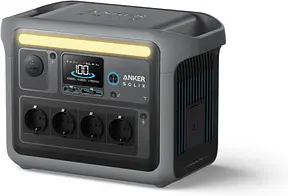
| Anker SOLIX C1000 | 600 W max. | 11 – 60 V | 10 A at 11 – 32 V; 12.5 A at 32 – 60 V | XT-60 |
| Jackery Explorer 1000 v2 | not stated on the German product page | not stated on the German product page | not stated | DC8020 |
Three things stand out in that table.
First: 60 V is the effective ceiling of the entire class. Four of five units stop there. A module whose open-circuit voltage climbs above 60 V when cold fits none of them, no matter how well the wattage matches.
Second: current is the second limit, and it gets overlooked even more often. Anker states it in tiers. The manual for the Anker SOLIX C1000 Powerstation 1056 Wh (1800 W) mit Tragetasche puts it verbatim: "Der Solareingang unterstützt eine 11-60V Solaraufladung über den XT-60 Stecker. Wenn du ein 11-32V Solarladegerät verwendest, werden maximal 10A unterstützt. Wenn du ein 32-60V Solarladegerät verwendest, werden maximal 12,5A unterstützt." In plain terms: two modules in parallel double the current at the same voltage — and that is where you breach the limit, not at the wattage.
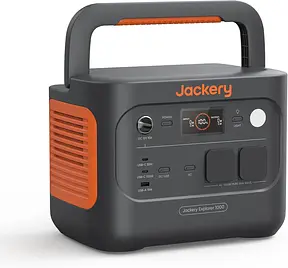
Third: Jackery does not publish the window on its German product page. That is itself a buying argument, because without it you cannot vet a third-party panel at all. The manufacturer instead attaches two explicit warnings, both quoted verbatim from the German product page of the Jackery E1000 v2 Tragbare Powerstation, 1070Wh, 1500W AC-Ausgang, LiFePO4:
"Es ist erforderlich, beim Anschluss von Solarpanels an beide DC8020-Eingänge dieselben Jackery-Solarmodelltypen und die gleiche Anzahl an Panels über Solaranschlusskabel zu verwenden. Andernfalls kann es durch Spannungsunterschiede, die durch unterschiedliche Modelle oder eine ungleiche Anzahl von Panels verursacht werden, zu Schäden am Produkt kommen."
"Nein. Die Powerstation darf nicht gleichzeitig über Solarpanels und das Autoladegerät aufgeladen werden."
The second warning is notable because it touches exactly the point ADAC criticised in its power station test. Which units were affected, how that finding should be read and what the manufacturer has said about it is covered in our brand comparison of the independent test results. The consequence for a panel purchase is the narrow one: on units carrying this restriction, solar is an alternative to car charging, not an addition to it.
The EcoFlow Delta 3 Plus Powerstation, 1024 Wh carries the largest solar budget in this group at the same window: two times 500 W max. at 11 V to 60 V. If you want a bundle where panel and station are matched by one manufacturer, the BLUETTI Elite 100 V2 Powerstation, 1024 Wh, mit 200-W-Solarpanel ships with a 200-W panel — the benefit there is not the output, it is that the voltage check is done for you.
Not available in your region — closest match
Jackery E1000 v2 Tragbare Powerstation, 1070Wh, 1500W AC-Ausgang, LiFePO4
View at Amazon (as of Aug 11)Affiliate link. Buying through it earns us a commission; the price stays the same for you.
Jackery E1000 v2 Tragbare Powerstation, 1070Wh, 1500W AC-Ausgang, LiFePO4
View at Amazon (as of Aug 11)Affiliate link. Buying through it earns us a commission; the price stays the same for you.
Not available in your region — closest match
Anker SOLIX C1000 Powerstation, LiFePO4, 1800 W
View at Amazon (as of Aug 11)Affiliate link. Buying through it earns us a commission; the price stays the same for you.
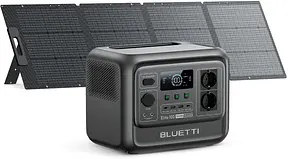
BLUETTI Elite 100 V2 Powerstation, 1024 Wh, mit 200-W-Solarpanel
View at Amazon (as of Aug 11)Affiliate link. Buying through it earns us a commission; the price stays the same for you.
Connectors: MC4, XT60, DC8020, Anderson
Fixed solar modules come with MC4 connectors virtually without exception. Power stations almost never do. The consequence: an adapter cable is mandatory for nearly every third-party-module-to-power-station combination, and it is usually not in the box.
EcoFlow sells it as a separate accessory — the "Solar auf XT60i-Ladekabel" is listed at €21 (as of 07.08.2026, manufacturer price on de.ecoflow.com). Factor that line into a price comparison; it will not flip a close decision, but it regularly surprises people at unboxing.
| Connector | Where it sits | Note |
|---|---|---|
| MC4 | fixed solar modules, balcony modules | de facto standard on the module side |
| XT60 / XT60i | EcoFlow, Anker SOLIX | MC4 → XT60 adapter usually sold separately |
| DC8020 | Jackery | proprietary; mixed configurations prohibited by the manufacturer |
| Anderson | some power stations and accessories | rare in the consumer segment |
An adapter changes the connector shape only. It changes nothing about voltage or current. A cable that physically fits is not evidence that the combination is permitted — that check happens beforehand, in the datasheet.
What a panel actually yields
This is where it gets uncomfortably honest: nobody who does not know your location, tilt, orientation and shading can give you a credible kilowatt-hour figure for your balcony module. What can be stated with confidence are the anchor values.
The Fraunhofer Institute for Solar Energy Systems ISE, in Recent Facts about Photovoltaics in Germany (version 05.05.2026), cites German Weather Service data putting Germany's average annual horizontal global irradiation at 1,102 kWh/(m²·a) for 2001–2020, varying by roughly ±10 % depending on location. At a typical ground-mount tilt of 20° to 25° facing south, irradiation at module level rises to approximately 1,270 kWh/(m²·a).
From that the same source derives the decisive figure: a new, south-facing PV plant with 1,270 kWh/(m²·a) at module level and a performance ratio of 85 % reaches approximately 1,080 full-load hours — and per that source's own definition, specific annual yield in kWh/kWp equals the number of full-load hours.
That is the best case, not your case. It assumes optimal south orientation at roughly 30° tilt. A balcony railing is vertical. HTW Berlin's Stecker-Solar-Simulator models exactly that: per its Dokumentation der Berechnungsgrundlagen (version 3.0, May 2024, Orth/Bergner/Zoll), an installation "an der Hausfassade oder am Balkon" is calculated at a tilt of 90°, a garden-mounted rack at 30° and a building roof at 45°.
That is precisely why we point at that tool for the concrete number instead of at a rule of thumb. Per the same documentation it rests on simulations of more than 17 million system configurations at one-minute resolution, backed by 41 measured annual load profiles and DWD weather data from the Lindenberg observatory for 2017. It models shading in tiers: for light, medium and heavy shading, direct irradiation is disregarded up to a solar elevation of 25°, 35° and 45° respectively.
The same applies to a power station on a smaller scale, with one extra loss stage: between what the panel delivers and what you later pull out of the station sits the charge and discharge efficiency. How that calculation runs from rated capacity to real runtime is covered in our power station sizing method — this article answers the question upstream of it: which panel is allowed on the device in the first place.
Fixed balcony module or foldable panel?
These are two products, not two price tiers of one product.
| Fixed balcony module | Foldable panel | |
|---|---|---|
| Typical output | 400 – 600+ W per module | 100 – 400 W |
| Operation | permanently mounted | set up and packed away |
| Connection | MC4 to the inverter | usually proprietary, to the station |
| Orientation | fixed once, usually suboptimal | re-aimed per use |
| The limit that binds | 800 VA at the inverter | the station's voltage window |
The overlooked advantage of a foldable panel is not mobility, it is orientation: you aim it at the sun instead of bolting it to a railing that happens to face north-west. That offsets a considerable share of its output disadvantage against the larger fixed module.
The reverse also holds: if the panel is meant to stay outdoors permanently, a foldable panel is the wrong product. It is built for setup and teardown, not for year-round weather exposure.
The pre-purchase checklist
- Which device is on the other end? A balcony inverter or a power station — the limits differ.
- Note the voltage window and maximum input voltage from that device's datasheet.
- Hold the module's open-circuit voltage and short-circuit current against them, including the temperature coefficient for the cold winter morning.
- Match the connector type and price in the adapter if one is missing.
- Only then choose the wattage — on a balcony, up to 2,000 W of modules behind a maximum of 800 VA; on a station, up to the stated solar input limit.
Start at step 5 and you buy either a panel that never starts up or one that can damage the device. If you are planning a battery behind the balcony setup as well, read our balcony storage payback calculation first — the battery is the single most expensive decision in the whole build.
In short
Wattage is the last number in the purchase, not the first. On a balcony, § 8 (5a) EEG sets the frame: up to 2,000 W of modules behind a maximum of 800 VA of inverter output. On a power station the voltage window decides, and across every unit checked here it ends at 60 V, with maximum input current right behind it. The connector is the smallest problem, but it costs an extra adapter cable. And if you want a concrete yield figure, no buying guide can give you one — HTW Berlin's Stecker-Solar-Simulator can, with your own inputs.
All products from this post
The ones we named above are marked; the rest are alternatives in the same category.
Not available in your region — closest match
Jackery E1000 v2 Tragbare Powerstation, 1070Wh, 1500W AC-Ausgang, LiFePO4
View at Amazon (as of Aug 11)
Not available in your region — closest match
Anker SOLIX C1000 Powerstation, LiFePO4, 1800 W
View at Amazon (as of Aug 11)
Affiliate notice: As an Amazon Associate, we earn from qualifying purchases. Product prices and availability are subject to change.
Frequently Asked Questions
May I install more module capacity than my inverter can output?
Yes. § 8 (5a) EEG names two separate limits: up to 2 kilowatts of installed module capacity and up to 800 volt-amperes of inverter output. Oversizing is therefore explicitly provided for. It lifts yield during weak hours, while the cap only clips a few peak hours in summer.
What happens if my module's open-circuit voltage is too high?
At best the device will not charge; at worst it takes damage. On common power stations the ceiling is 60 V; the Hoymiles HMS-800W-2T datasheet states 65 V maximum input voltage. The cold morning is the critical case: the temperature coefficient of open-circuit voltage is negative, so voltage rises above the 25 °C datasheet value in the cold.
Will any solar panel fit any power station with an adapter?
No. An adapter changes the connector shape only, not voltage or current. If the open-circuit voltage falls outside the device's window, or the current exceeds its limit, no cable helps. Check both figures in the datasheet before you buy the adapter.
How many kilowatt-hours does an 800-W balcony system produce per year?
There is no credible single number, because location, tilt, orientation and shading dominate the result. For scale: Fraunhofer ISE cites roughly 1,080 full-load hours per year for an optimally south-facing plant, which equals specific yield in kWh/kWp. A balcony railing, by contrast, is vertical — HTW Berlin calculates it at 90° tilt.
Can I connect two panels in parallel to one power station?
Only if the manufacturer allows it and the current stays within limits. Parallel wiring doubles the current at the same voltage, and that is often where the ceiling sits: Anker states a maximum of 10 A at 11 to 32 V for the SOLIX C1000. Jackery explicitly prohibits mixed models or unequal panel counts across its two DC8020 inputs.
Do I need a permit for a larger panel?
Plug-in solar devices within the limits of § 8 (5a) EEG fall under the simplified German procedure; anything above them is subject to the regular registration duties. A foldable panel on a power station does not feed into the grid and falls outside this entirely. Tenancy and homeowner-association questions about mounting are a separate matter.