Jump starter power banks: which ones actually start a car?
 17 min read
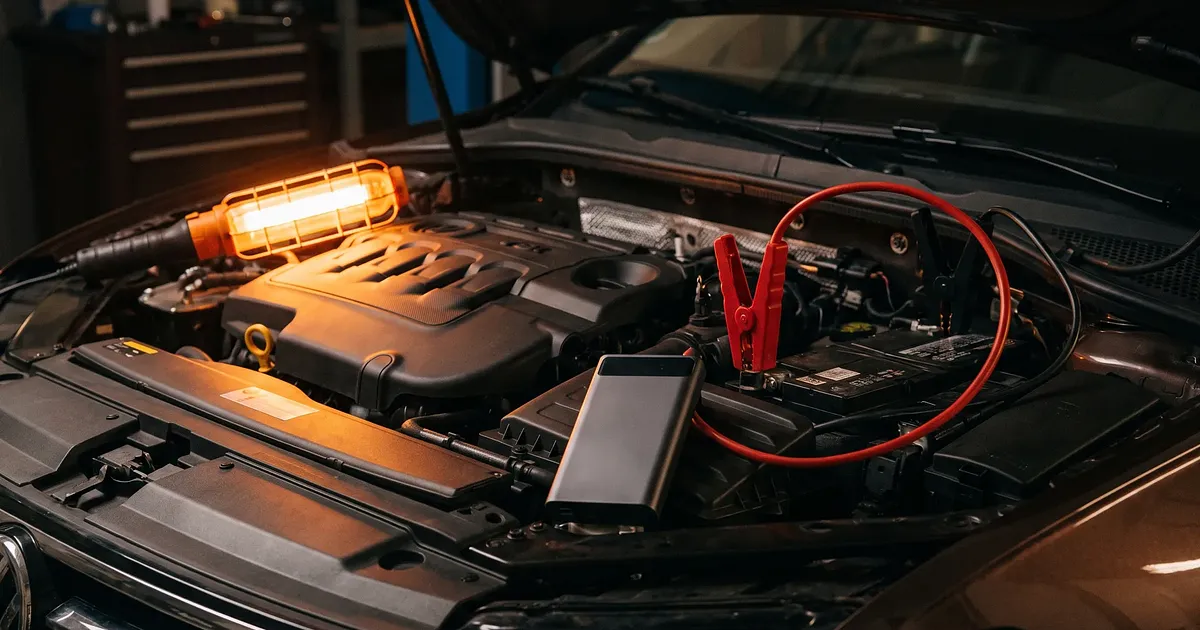
As of 5 March 2026. The box of a jump starter power bank almost always carries one very large number: 1,500 A, 2,000 A, sometimes 8,000 A on the cheaper listings. Next to it sits a second large number, the capacity in milliamp-hours. Those two figures are what shop filters sort by — and both say surprisingly little about whether the device will turn an engine over on a cold morning.
That is not a hunch. It is what the independent measurements keep producing. At the German magazine auto motor und sport, one device rated at 500 A peak failed almost every start attempt, while a second device carrying exactly the same peak and capacity figures passed all of them. This page explains which specifications actually carry weight, what the published tests measured, and where the line runs between "fine for daily use" and "you are still stranded".
Why the amp figure on the box tells you so little
Car batteries have a standard for starting current, which is why you can genuinely compare them from a data sheet. Cold cranking amps under EN 50342 is a defined test condition: the battery is chilled to −18 °C, and the measurement asks what current it delivers for 30 seconds without terminal voltage dropping below 7.5 volts. Three fixed quantities — temperature, duration, minimum voltage. Two batteries rated at 640 A CCA really are comparable.
Nothing of the sort exists for the "peak" figure on a jump starter power bank. There is no test condition behind it: no temperature, no duration, no minimum voltage. The number describes a maximum that can be reached over fractions of a second, and the manufacturer decides for itself under what circumstances it measures. Two devices both printing "2,000 A" on the carton can therefore mean entirely different things.
How far apart they land shows up in the test by auto motor und sport (last updated 4 June 2025). Nine jump starters were judged not on a test bench but on two real vehicles: a 2012 Jeep Wrangler with a 2.8-litre four-cylinder diesel and an aged 94 Ah battery, and a 2019 Ford Focus 1.5 EcoBoost with a new but deliberately drained 65 Ah battery. Each start attempt was capped at five seconds, with 15-second cooldowns in between, and a device only passed after three successful starts per vehicle with no recharge.
The result exposes the amp figure:
| Device | Peak current (manufacturer claim) | Capacity | Successful starts, diesel | Successful starts, petrol |
|---|---|---|---|---|
| Profi Power JSF 4000 | 500 A | 12,000 mAh | 3 of 3 | 3 of 3 |
| Ultimate Speed UMAP 12000 A2 | 500 A | 12,000 mAh | 1 of 3 | 1 of 3 |
| Osram Batterystart 400 | 2,000 A | 16,800 mAh | 3 of 3 | 3 of 3 |
| Osram Batterystart 300 | 1,500 A | 13,000 mAh | 3 of 3 | 3 of 3 |
| Voltcraft Schnellstartsystem | 1,000 A | 13,000 mAh | 3 of 3 | 3 of 3 |
| Norauto Start Plus 2 | 800 A | 15,000 mAh | 3 of 3 | 3 of 3 |
| Dino Kraftpaket 600-12V | 600 A | 18,000 mAh | 3 of 3 | 3 of 3 |
| Einhell CE-JS 18/1 | 600 A | 18,000 mAh | 3 of 3 | 3 of 3 |
| Noco GB50 Boost XL | not stated | 15,000 mAh | 3 of 3 | 3 of 3 |
Source: auto motor und sport, as of 4 June 2025. Prices were not stated consistently in the test report.
Two rows are enough. The Profi Power JSF 4000 and the Ultimate Speed UMAP 12000 A2 carry the same peak rating (500 A) and the same capacity (12,000 mAh). One passed all six start attempts; the other managed one on each vehicle, and auto motor und sport files it accordingly as a motorcycle device. Now look the other way: the Dino Kraftpaket at just 600 A passed as completely as the Osram Batterystart 400 at 2,000 A. The number on the box simply does not sort these devices in the order in which they start engines.
If you want a brand that turns up across several independent test series, you end up at Noco more or less by default. What auto motor und sport actually tested was the GB50 Boost XL, which passed on both vehicles; the compact sibling in the same Boost range is the NOCO Boost Plus GB40, 12 V Starthilfegerät, 1.000 A, and that test result expressly does not transfer to it — the larger GB50 is the unit that was measured.
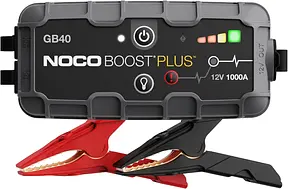
NOCO Boost Plus GB40, 12 V Starthilfegerät, 1.000 A
View at Amazon (as of Aug 11)Affiliate link. Buying through it earns us a commission; the price stays the same for you.
What the starter motor actually draws, and for how long
The reason for the gap lies in what happens during a start. According to Wikipedia's article on starter batteries, cranking a combustion engine briefly demands currents of several hundred up to 1,000 amps. But that spike only exists in the instant the starter breaks the stationary engine loose. After that the current falls away sharply — and it is this lower but sustained current that actually spins the engine up to firing speed.
And it has to hold. The same source puts a car start at "two to five seconds" on well-maintained engines and "up to ten seconds on older vehicles". A diesel with glow-plug preheating sits at the top of that range.
That is why the peak figure misleads. It describes a value lasting fractions of a second, while what is needed is output across several seconds. A device can hit its 2,000 A entirely honestly on paper and still collapse after two and a half seconds — at which point the engine stops turning. This is why the credible tests either use real start attempts, as auto motor und sport did, or a defined sustained load, rather than a maximum reading.
The practical consequence for buying: treat the amp figure as a rough floor, not a ranking. heise online set exactly that floor on 5 January 2026: about 200 A of peak current is enough for petrol engines up to a maximum of two litres, while a two-litre diesel or a three-litre petrol engine calls for a device rated at at least 600 A.
Above that threshold, a bigger number buys no demonstrable benefit. An 8,000 A listing at 40 euros is not eight times the device a 1,000 A model is — it is a device with a more generously measured number. In the heise best-of list of 5 January 2026, the NOCO Boost X GBX45, 12 V Starthilfegerät, 1.250 A sits at rank five with a comparatively sober 1,250 A manufacturer rating — a neat illustration that placement in an editorial ranking and the size of the amp figure do not move together.
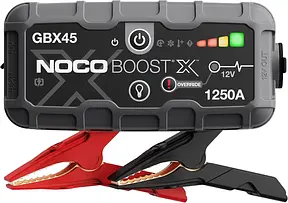
NOCO Boost X GBX45, 12 V Starthilfegerät, 1.250 A
View at Amazon (as of Aug 10)Affiliate link. Buying through it earns us a commission; the price stays the same for you.
Cold: where most devices come apart
A jump starter is almost only ever needed when it is cold. That is precisely where the evidence is most uncomfortable.
On 19 January 2016 the ADAC tested seven lithium jump-start boosters, measuring sustained current at +55, +20, 0 and −20 °C. Its conclusion is unambiguous: none of the tested products met its stated output at −18 °C, and only one did at 0 °C. Of seven devices, in other words, one held its own factory figures at freezing point, and none below it.
The test is visibly old and cell chemistry has moved on since, so it should not be read as a current ranking. As a description of the physical problem it still holds, and the problem is unchanged: in the cold the internal resistance of the cells rises, while the starter needs its highest current precisely then because cold engine oil is viscous. Both effects push the same way.
heise online concedes the same gap rather than papering over it: its own testing ran at low above-freezing temperatures, so the problem did not arise. That is the honest version — the published best-of lists were largely not produced below zero.
Two things follow from that, and both matter more than the purchase decision:
- Storage. ADAC recommends storing the booster at room temperature where possible. A device that sits in the boot through months of frost is at its weakest exactly when it is needed. A hallway cupboard beats the boot.
- State of charge. A half-charged lithium device delivers less current than a full one, and the cold widens the gap. Top it up twice a year — the seasonal tyre change is a good reminder.
On cell chemistry, heise online noted on 5 January 2026 that LiFePO4 (lithium iron phosphate) cells are considered particularly safe because thermal runaway after damage is close to ruled out, making them safer than conventional lithium-ion cells. That is a statement about safety, not about cold-weather output — marketing likes to blur the two. On which chemistry actually delivers more current below freezing, we have no reliable German test measurement, so we leave the question open rather than assert an answer.
A good illustration of how far the advertising figure and the actual starting current diverge is the Osram BATTERYstart 300, 13.000 mAh, 300 A Startstrom, listed by auto motor und sport at 1,500 A peak and 13,000 mAh, which started both vehicles three times out of three. The 300 in the product name is the start current; the 1,500 is the peak. Two numbers for one device, and the smaller one is the more informative.
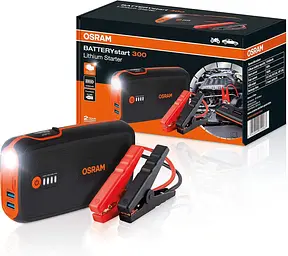
Osram BATTERYstart 300, 13.000 mAh, 300 A Startstrom
View at Amazon (as of Aug 10)Affiliate link. Buying through it earns us a commission; the price stays the same for you.
mAh, Wh, and what reaches the 12-volt side
The second large number on the carton is capacity, nearly always in milliamp-hours. On a jump starter it is weaker than it looks, too.
The reason is the reference voltage. A power bank's mAh figure refers to cell voltage, typically 3.7 volts — not the 12 volts the device then feeds the starter motor with. Twenty thousand mAh therefore works out to roughly 74 watt-hours, and what arrives on the 12-volt side is less again after conversion losses. A device labelled "20,000 mAh" does not have 20 Ah available at 12 volts — it has roughly a third of that, minus losses.
Only watt-hours make these comparable. We derived that in detail for power banks generally in converting mAh to Wh; the same arithmetic applies to jump starters:
Wh = mAh × cell voltage ÷ 1000
What does that mean day to day? The energy a single start consumes is surprisingly small. Wikipedia puts the charge drawn at about 0.2 Ah for a petrol engine over a two-second start, and 0.3 to 0.4 Ah for a diesel over a seven-second start with preheating — at 12 volts, roughly 2.4 to just under 5 watt-hours. That is why the 12,000-to-18,000 mAh devices in the test have arithmetic headroom for many attempts.
So capacity is not the limiting factor. The limiting factor is how much current the device can push out at once without collapsing. That figure appears nowhere on the carton — and it is exactly what separates the two 500 A devices in the table above.
Safety: reverse polarity protection and the short-circuit test
A jump starter is the one charger in the household you hold against a car battery with bare clamps, often in the dark, often in the rain, usually annoyed. The safety question deserves proportional weight.
The 2016 ADAC test is blunter here than any marketing claim: in the short-circuit test the products from Xlayer, APA and Kunzer performed badly, and their housings melted with heavy heat and smoke. Three of seven devices — in a test that reproduces precisely the mistake a hurried user makes in a car park at night.
So here is what to check before you look at the amp figure at all:
Reverse polarity protection with an audible or visual warning. The device must tell you when plus and minus are swapped, rather than simply doing nothing.
Short-circuit protection at the clamp itself, not only inside the housing.
Smart clamps that release current only once both terminals are correctly attached.
A brand an independent test has actually examined. Among the no-name listings with four-digit amp claims, there is nobody around to contradict them.
If you want to check whether your own device is affected by a recall, the continuously maintained overview is at power bank recalls. For use on a vehicle, a model with a documented test history is a considerably calmer choice than the cheapest listing with the biggest number — the Dino KRAFTPAKET 12V-600A, 18.000 mAh, 66,6 Wh, for instance, passed both vehicles at auto motor und sport with three of three attempts each, on the nominally most modest 600 A in the entire field.
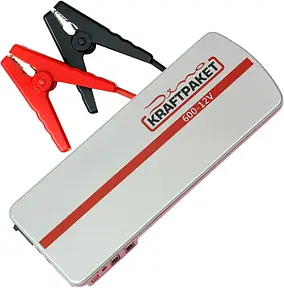
Dino KRAFTPAKET 12V-600A, 18.000 mAh, 66,6 Wh
View at Amazon (as of Aug 11)Affiliate link. Buying through it earns us a commission; the price stays the same for you.
Can a jump starter power bank go on a plane?
Short version: usually not into the cabin without arrangements — and never into a checked bag.
The ordinary aviation lithium framework applies, measured in watt-hours rather than milliamp-hours: up to 100 Wh generally permitted in carry-on without specific approval, 100 to 160 Wh only with airline consent and usually capped at two devices, above 160 Wh not at all. Checked baggage is off limits for lithium power banks in general.
This bites harder for jump starters than for ordinary power banks, because the larger models cross the 100 Wh line: a 24,000 mAh device at 3.7 V cell voltage already works out to around 89 Wh, and a 30,000 mAh device to roughly 111 Wh — squarely in approval territory. The arithmetic and the airline detail are in power banks in carry-on luggage; if you need the same calculation for a laptop supply, that is in power banks for laptops.
In practice: carrying a jump starter abroad for a hire car is usually the worse plan compared with renting one locally.
Buying guide: the order to check things in
| Criterion | What to look for | Why |
|---|---|---|
| Independent test | Model appears at ADAC, auto motor und sport, heise or AUTO BILD | The only specification that does not come from the manufacturer |
| Peak current | ≥ 200 A for petrol up to 2 l; ≥ 600 A for a 2 l diesel or 3 l petrol (heise, 5 Jan 2026) | A floor, not a ranking — above it, more buys nothing demonstrable |
| Capacity | 12,000–20,000 mAh covers many start attempts | One start costs only about 2.4–5 Wh; capacity is rarely the problem |
| Reverse polarity protection | Audible or visual warning, smart clamps | Three of seven devices melted in the ADAC short-circuit test (19 Jan 2016) |
| Charge indicator | Multi-stage, better with a percentage | A half-charged device may not start anything in the cold |
| Weight | Test devices typically came in under 1 kg | It has to live in the car, or it is at home when it is needed |
| Extras | A USB-C output is useful; compressor and torch are nice-to-have | A compressor costs volume and battery without adding starting power |
Take that order seriously and you land on a device an independent test actually ran against an engine. The Osram BATTERYstart 400, 16.800 mAh, 400 A Startstrom is one of those: 16,800 mAh, 2,000 A peak per the manufacturer, three of three start attempts on both the diesel and the petrol car at auto motor und sport. The amp figure is the least interesting of those three specifications.
Not available in your region — closest match
NOCO Boost Plus GB40, 12 V Starthilfegerät, 1.000 A
View at Amazon (as of Aug 11)Affiliate link. Buying through it earns us a commission; the price stays the same for you.
Conclusion
A jump starter is one of the few pieces of car equipment where the most prominent number on the packaging says the least. There is no test standard behind the amp rating, and on 4 June 2025 auto motor und sport measured two devices with identical 500 A ratings that behaved completely differently.
What does carry weight: a model an independent test actually ran against an engine; a peak current above the floor heise quotes, but without paying a premium for four-digit advertising figures; properly implemented reverse polarity protection; and storage at room temperature rather than in the boot — because the ADAC finding that lithium devices miss their own ratings below freezing has not been physically refuted a decade later.
And the honest caveat to close on: publicly available cold-temperature measurements from German testing bodies are scarce. If you regularly drive in hard frost, treat a jump starter as a bridge, not as a substitute for a battery that is due for replacement anyway.
All products from this post
The ones we named above are marked; the rest are alternatives in the same category.
Not available in your region — closest match
NOCO Boost Plus GB40, 12 V Starthilfegerät, 1.000 A
View at Amazon (as of Aug 11)Affiliate notice: As an Amazon Associate, we earn from qualifying purchases. Product prices and availability are subject to change.
Frequently Asked Questions
How many amps does a jump starter power bank need for my car?
heise online gives this orientation as of 5 January 2026: for petrol engines up to a maximum of two litres, a peak current of about 200 A is enough, while a two-litre diesel or a three-litre petrol engine calls for at least 600 A. Read that as a floor rather than a ranking. In the auto motor und sport test of 4 June 2025, a 600 A device passed just as completely as a 2,000 A device, while two devices with identical 500 A ratings performed entirely differently from each other.
Why do two devices with the same amp rating start so differently?
Because the peak current figure is not standardised. Unlike the cold cranking amps of a car battery under EN 50342, where temperature, duration and minimum voltage are all fixed, a jump starter's peak value describes only a brief maximum under conditions the manufacturer chooses itself. What is actually needed is current over several seconds, because a car start takes two to five seconds and up to ten on older vehicles.
Does a jump starter power bank work below freezing?
Only partly. On 19 January 2016 the ADAC tested seven lithium boosters and found that none of the products met its stated output at minus 18 degrees, and only one did at zero. The test is old, but the underlying problem persists: in the cold, the internal resistance of the cells rises while the starter motor needs its highest current because the engine oil is viscous. ADAC therefore recommends storing the device at room temperature where possible, rather than in the boot.
How many start attempts does a jump starter manage?
On paper, considerably more than most people expect. According to Wikipedia, one start draws roughly 0.2 amp-hours on a petrol engine and 0.3 to 0.4 amp-hours on a diesel with preheating, which at 12 volts is about 2.4 to 5 watt-hours. At auto motor und sport, devices had to manage three starts per vehicle with no recharge, and most did. The limiting factor is not capacity but whether the device can hold the required current for several seconds.
Can I take a jump starter power bank on a plane?
Never in checked baggage, where lithium power banks are prohibited outright. In carry-on the watt-hour limits apply: up to 100 Wh without specific approval, 100 to 160 Wh only with airline consent and usually capped at two devices, and nothing above that. Larger jump starters cross this line quickly — 24,000 milliamp-hours at 3.7 volts cell voltage already works out to around 89 watt-hours, and 30,000 milliamp-hours to roughly 111 watt-hours.