Storing and Charging a Power Station Safely: LiFePO4 Battery Fire Risk, and What German Fire Services Actually Say
 16 min read
As of: 28.08.2026
On 25 March 2025 a balcony storage battery caught fire in Neuenhaus, Lower Saxony. 2.4 kWh, LiFePO4 cells, installed two weeks earlier. That is exactly the cell chemistry sitting inside almost every portable power station on sale today, and the one marketed as the safe one. Search for LiFePO4 battery fire risk and you mostly land on manufacturer blogs confirming precisely that.
The people who put these fires out phrase it more carefully. Germany's statutory accident insurance body (DGUV), the German fire protection association (vfdb) and the federal association for technical fire protection (bvfa) have all published on this, one of them freshly revised in July 2025. The catch: those documents are written for workplaces, they live in PDFs, and they read like it. What follows translates them for the situation you probably care about, which is a power station sitting in a basement, a garage or a utility room.
Can a power station really catch fire?
Yes. And the mechanism is well documented.
The DGUV's guidance on workplace fire protection for lithium-ion batteries (FBFHB-018, dated 19.06.2020) describes it this way. Decomposition inside a lithium-ion cell can begin at around 80 °C. Once the reaction is running, the cell surface reaches up to 800 °C. The cell then vents its contents under pressure as a white-grey mist of electrolyte and decomposition products. And because the neighbouring cell is right there, heating up alongside it, the whole thing can cascade. The technical term is thermal runaway.
The uncomfortable part sits in vfdb Merkblatt 10-17 (version 2, July 2025). Between the triggering defect and an actual fire, that document says, you can have "minutes, hours, days, weeks". A defect is "under some circumstances not immediately recognisable", and the effect can show up with a delay, "for example after 30 minutes".
That single sentence is what most of the practical advice below hangs on. A drop off the kitchen table is not an event you watch for ten minutes before declaring everything fine.
How often lithium cells ignite in general is easiest to read off the waste industry. According to an estimate by the German waste management association BDE, cited on TÜV SÜD's fire protection portal, roughly 80 percent of fires in refuse trucks and recycling yards now trace back to lithium-ion batteries. That is a trade body estimate rather than a measured statistic, and it describes wrongly discarded, usually damaged cells. You cannot transfer the number to the unit on your shelf. It only shows how readily these cells ignite under bad conditions.
The Neuenhaus case: what is documented and what isn't
There is one clean source on the March 2025 fire. pv magazine Deutschland reported on 31.03.2025 that a neighbour spotted smoke and called the fire brigade. What burned was a Zendure AIO-2400 with 2.4 kWh of LiFePO4 cells, standing in a utility room in an annexe, next to a 1,780 W balcony solar system installed a fortnight before. The fire was under control after roughly two hours. Heating and hot water in the annexe were badly damaged, the rest of the house stayed habitable.
Now the part forum threads usually drop: the cause was not established at the time of reporting. An independent assessor was still examining it, and Zendure responded with a general statement on product safety plus an internal investigation. So there is no proven causal link between LiFePO4 chemistry and this particular fire.
Which is exactly why the case belongs here. Not as evidence that LiFePO4 is dangerous. As evidence that "safer" and "cannot burn" are two different claims.
LiFePO4 battery fire risk: how much safer is safer?
On the spread of LFP cells, the vfdb document says that lithium iron phosphate cathodes are gaining ground particularly in PV storage systems and electric vehicle batteries, and that they are "particularly suited to applications where safety and longevity matter more than maximum energy density".
So the advantage isn't disputed there. It is just framed correctly, as a deliberate trade. The energy density factors from the same source make that visible.
| Cell type | Energy density factor per vfdb Merkblatt 10-17 (July 2025) |
|---|---|
| Lead (reference value) | 1 |
| Lithium iron phosphate (LFP) | 2.5 |
| Lithium-ion polymer | 3.9 |
| Lithium-ion | 5 |
Weight for weight, LFP stores considerably less energy than a classic lithium-ion cell. That is the price, and it is also the reason for the safety margin: less energy per unit volume means less energy released uncontrolled when something goes wrong.
Two things follow, and marketing tends to skip both.
First, the DGUV does not sort its storage and charging guidance by cathode chemistry. The same rules cover LFP and NMC alike. If LFP could not burn, that equal treatment would be hard to explain.
Second, the vfdb document names water as the primary extinguishing agent, because it cools the battery rather than merely putting out flames, then immediately qualifies it: the way lithium cells are arranged inside modules often means water cannot fully penetrate. An LFP module can only be cooled from the outside up to a point, too.
Honestly, I cannot give you a percentage. None of the bodies cited here publishes a comparable safety figure for portable power stations. Every one of them describes LFP as risk reduction, never as risk elimination. The sources do not support more than that, which is why there is no number in this paragraph.
What the DGUV actually says about storing lithium batteries
FBFHB-018 is a workplace document. It is not a law, and it certainly is not a regulation governing your basement. Anyone searching for lithium battery storage rules and landing in a DGUV PDF is reading occupational safety guidance, not obligations on private households. The physics underneath is the same, though, which is why the translation is worth doing.
Here is what it contains, in plain language.
| DGUV guidance (FBFHB-018, dated 19.06.2020) | What it means for your power station |
|---|---|
| Charge only with chargers approved by the manufacturer | The supplied power brick, not the universal one from the drawer |
| Charge under supervision | Somebody is in the building and could react to an alarm |
| Only on a non-flammable surface, away from combustible material | Tile, concrete, metal. Not the rug, not beside cardboard or paint tins |
| Do not charge a cold battery, for instance below 0 °C | After a night in the car or an unheated shed, let it warm up first |
| Protect from mechanical shock and damage | Not loose in the boot, not balanced on an edge |
| A battery in a disturbed condition belongs immediately in a location free of combustibles | Hot, deformed or swollen means out of the living area |
The last row is the most important one and the one people follow least.
A practical checklist: where the power station belongs at home
Fire safety practice ranks protective measures by the STOP principle: substitution first, then technical measures, then organisational ones, and personal behaviour last. Translated for you: cell chemistry and placement beat any accessory, and an accessory beats good intentions.
So where does it go?
Good: cool, dry room with a non-flammable floor, smoke alarm in the same room, escape route unaffected. Utility room, tiled basement room, detached garage.
Awkward: hallway or stairwell. That is the route you leave by, and in a fire it is the route filling with smoke.
Awkward: bedrooms and children's rooms. Not because a fire is likelier there, but because a fire there starts while you are asleep.
Bad: unheated outdoor space in winter, if you then charge without letting the unit warm up. The DGUV names cold charging explicitly.
Bad: wedged between combustibles. A shelf full of cardboard, a workshop corner with solvents, a paper store.
For small cells and spare packs there are fireproof bags and boxes, the kind model builders have used for years. A bag like that replaces no part of a good location. At best it buys time and contains sparks.
FLASLD Feuerfeste Akku-Sicherheitstasche (Lipo Safe Bag) für Lagerung, Ladung und Transport
There's a real limit to that advice, too: a 1024 Wh power station fits in none of these bags, and for enclosures that size I know of no test standard I could point you at. A bag makes sense for spare packs, small devices and transport. For the big box in the basement, what decides the outcome is the surface underneath it, the clearance to anything combustible, and the smoke alarm.
One number is deliberately missing: the ideal state of charge for long-term storage. Recommendations between 30 and 60 percent circulate, but none of the sources cited here names a value, and manufacturer figures differ. Follow your device's manual. Nothing is estimated here.
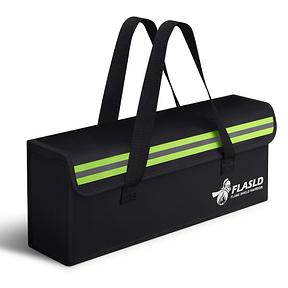
FLASLD Feuerfeste Akku-Sicherheitstasche (Lipo Safe Bag) für Lagerung, Ladung und Transport
View at AmazonAffiliate link. Buying through it earns us a commission; the price stays the same for you.
Safe charging: the charging phase is the critical window
If you take one paragraph away from this piece, take this one.
The IFS Report 1/2024 from Germany's institute for damage prevention and damage research (March 2024) puts numbers on it. Around a third of all damage fires the IFS investigates are electrical in origin, and lithium-ion batteries now account for roughly 20 percent of those. In three out of four battery fires examined, the fire started during charging.
The recommendation in the same report is suitably dry: don't charge batteries completely unsupervised, keep a smoke alarm in the room where charging happens, and make sure somebody can react to the alarm.
Note the wording. Not "never unsupervised", but "not completely unsupervised". Nobody is asking you to sit and watch. What is asked for is a smoke alarm in the charging room and a person in the building who will hear it.
In practice:
- Charge when someone is home, not during the working week in an empty house.
- Put a smoke alarm in the room where charging happens. Basement rooms often have none.
- Skip overnight charging in the bedroom. Charge where a fire would not catch anyone asleep.
- Use the original power supply, as the DGUV puts it. A foreign supply can, in the worst case, bypass how the battery management system expects to be fed.
- Let a cold unit reach room temperature first. Winter solar charging counts here.
Solar operation changes nothing about any of this, with one addition: on a balcony the unit is still standing on something, and that something is often a wooden shelf.
Warning signs: when the unit leaves the building immediately
The DGUV lists a battery as disturbed when it has become hot, has been mechanically damaged, or is swollen or deformed. Add to that a solvent-like smell and the visible white-grey mist that FBFHB-018 describes a venting cell producing.
Then what?
Out of the living area, to a spot with nothing combustible nearby. Not back on the charger. No "let's see if it still works". And because of the vfdb passage on delayed reactions quoted above, not back into the cupboard after twenty quiet minutes either.
A swollen enclosure is the one case where I'd rate a fireproof bag below a slab of concrete outdoors. The bag keeps the device tightly contained. Outside on concrete, distance keeps the fire small.
In an emergency: what the fire service advises
This is where expert practice diverges most sharply from the average advice article. The joint publication by bvfa and the DGUV on extinguishing lithium-ion batteries (dated 22.09.2021) starts by settling who should be fighting the fire at all: fires involving several or larger batteries should be extinguished only by fire service personnel.
A 1 kWh power station is a larger battery. For you that means 112, out, door closed.
If you are standing in front of a small device anyway, the choice of agent is unambiguous.
| Extinguishing agent | Assessment per bvfa/DGUV (dated 22.09.2021) |
|---|---|
| Water, spray jet | particularly suitable, high cooling effect |
| CO2 | not suitable |
| ABC or BC powder | not suitable |
| Metal fire powder | not suitable |
The CO2 extinguisher is the classic wrong reach. It displaces oxygen but does not cool, and cooling is the whole point with a cell in runaway.
Minimum distances apply too, because a venting cell ejects material:
| Equipment | Minimum distance per bvfa/DGUV |
|---|---|
| Portable or wheeled extinguisher with spray jet | at least 1 m |
| Wall hydrant with spray jet | at least 3 m |
| Wall hydrant with full jet | at least 5 m |
And the point almost every guide omits: per the same document, batteries can reignite even after a long delay, and afterwards belong in a water tank or a containment vessel. An extinguished battery fire is not automatically a finished battery fire.
Why the fire brigade turns up in breathing apparatus even for small fires comes down to classification. Under German fire service regulation FwDV 500, lithium battery incidents are handled as chemical hazard operations. The smoke is the real problem, not the flame.
Buying new: cell chemistry is the decision you make in advance
Cell chemistry is printed in the datasheet, and it is the only safety decision you make before purchase. Everything else you decide later, through placement. The units below name LiFePO4 explicitly in their product description. Every capacity and output figure here is a manufacturer specification, not an independent measurement, and I have no test result from Stiftung Warentest, the ADAC or heise for any of the three.
Small and portable: 99 Wh
The Jackery E100 Plus is specified with a 99Wh LiFePO4 battery. Around €49.99 per Amazon.de on 28.08.2026, rated 4.2 out of 5 across 275 reviews. In this size class a fireproof bag is genuinely a sensible addition, because the device actually fits inside one.
Jackery E100 Plus Tragbare Powerstation, 99Wh LiFePO4-Akku
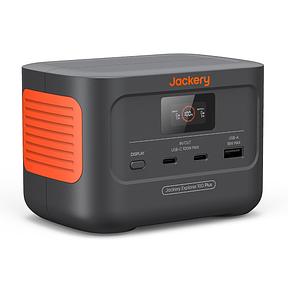
Jackery E100 Plus Tragbare Powerstation, 99Wh LiFePO4-Akku
Affiliate link. Buying through it earns us a commission; the price stays the same for you.
Mid-range: 299 Wh
From 300 Wh upward, "wherever it ends up" stops being good enough. You want a fixed spot on a non-flammable surface. The ALLPOWERS R600 (299Wh LiFePO4, around €249.99 per Amazon.de on 28.08.2026, rated 4.2 out of 5 across 630 reviews) sits right in that size class.
ALLPOWERS R600 Tragbare Powerstation, 299Wh LiFePO4 Batterie Solargenerator
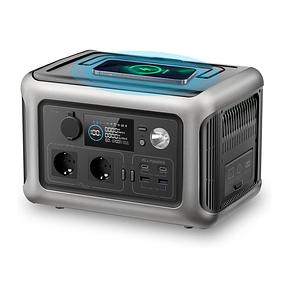
ALLPOWERS R600 Tragbare Powerstation, 299Wh LiFePO4 Batterie Solargenerator
View at AmazonAffiliate link. Buying through it earns us a commission; the price stays the same for you.
Above a kilowatt: 1024 Wh
The FOSSIBOT F1800 is specified with 1024Wh and 1800W continuous output. Around €459.00 per Amazon.de on 28.08.2026, rated 4.6 out of 5 across 161 reviews. In this class the sentence from the bvfa publication applies directly: this is a larger battery, and in a fire it is a job for the fire service, not for your kitchen extinguisher. Placement is the real safety measure here.
FOSSIBOT F1800 Tragbare Powerstation 1800W, 1024Wh LiFePO4 Solargenerator
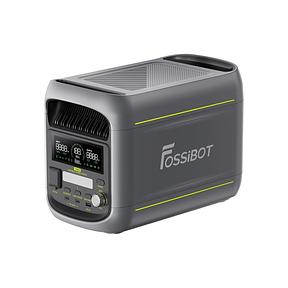
FOSSIBOT F1800 Tragbare Powerstation 1800W, 1024Wh LiFePO4 Solargenerator
View at AmazonAffiliate link. Buying through it earns us a commission; the price stays the same for you.
Closing thought
The source material is clearer than the debate around it. LFP lowers the risk without removing it, and the expert bodies apply identical precautions to every lithium chemistry. Four things cost you almost nothing and work immediately: a smoke alarm in the charging room, the unit on a non-flammable surface, the original power supply, and a spot that is off your escape route.
And if you happen to be choosing a unit right now, the cell chemistry is in the datasheet. Worth a look before you go straight to the watt-hours.
All products from this post
The ones we named above are marked; the rest are alternatives in the same category.
Jackery E100 Plus Tragbare Powerstation, 99Wh LiFePO4-Akku
Affiliate notice: As an Amazon Associate, we earn from qualifying purchases. Product prices and availability are subject to change.
Frequently Asked Questions
Can a power station explode indoors?
A cell in thermal runaway vents its contents under pressure, it does not detonate like an explosive charge. Per DGUV FBFHB-018 (dated 19.06.2020) the cell surface can reach up to 800 °C, and the reaction can spread to neighbouring cells. In practice that means a fierce fire with toxic smoke rather than an explosion. For anyone in the building, the difference matters less than it sounds.
Are LiFePO4 batteries really safer than other lithium batteries?
Safer yes, safe no. vfdb Merkblatt 10-17 (July 2025) describes LFP cathodes as particularly suited to applications where safety and longevity matter more than maximum energy density. The DGUV still applies its storage and charging rules to every lithium-ion chemistry equally. And the March 2025 fire in a LiFePO4 balcony battery shows that chemistry alone is no guarantee.
Where should I store a power station at home?
Cool, dry, on a non-flammable surface, and away from combustible material such as cardboard or solvents. That is the DGUV guidance in FBFHB-018, in substance. Two practical additions: a smoke alarm in the same room, and a spot that is not on your escape route. Hallways and stairwells are unsuitable for that reason.
Which fire extinguisher works on a burning lithium battery?
Per bvfa and the DGUV (dated 22.09.2021), agents with a high cooling effect are suitable, water especially. Explicitly unsuitable: CO2, ABC and BC powder, and metal fire powder. Minimum distance with a portable spray jet extinguisher is 1 metre. Where several or larger batteries are involved, only the fire service should extinguish.
Can I charge a power station unattended overnight?
Nothing forbids it. The IFS Report 1/2024 advises against charging batteries completely unsupervised, though, because three out of four battery fires it examined began during charging. It recommends a smoke alarm in the charging room and somebody able to react to the alarm. Overnight in a bedroom is the least favourable option of all.
What should I do if the battery swells?
Stop charging it and stop using it. The DGUV counts a swollen or deformed battery as being in a disturbed condition and calls for immediate storage in a location free of combustibles. Move the unit outdoors onto a non-flammable surface, clear of walls and vehicles. And leave it there, because per vfdb the reaction can arrive with a delay.
Sources
- DGUV's guidance on workplace fire protection for lithium-ion batteries publikationen.dguv.de
- vfdb Merkblatt 10-17 vfdb.de
- cited on TÜV SÜD's fire protection portal de-brandschutz-informationsportal.tuvsud.com
- pv magazine Deutschland reported on 31.03.2025 pv-magazine.de
- IFS Report 1/2024 ifs-ev.org
- bvfa and the DGUV on extinguishing lithium-ion batteries dguv.de