Lead in Power Banks: Why the EU Pulls Cheap Models Off the Market
 8 min read
As of 06.08.2026 · Status: IN FORCE
Two different lead limits apply to a power bank in the EU, and they sit in two different pieces of law. One covers the cell, the other covers everything around it — the housing, the board, the solder joints, the cable. Know only one of them and you know half the rules.
The stricter of the two is recent: it has applied since 18 August 2024. And it lands on a product group that already shows up above average in EU market surveillance.
Two limits, one device
| Part | Legal basis | Lead limit | Applies since |
|---|---|---|---|
| The cell (portable battery) | Regulation (EU) 2023/1542, Annex I entry 3 | 0.01% by weight | 18.08.2024 |
| Housing, board, solder joints, cable | RoHS, Directive 2011/65/EU, German § 3 ElektroStoffV | 0.1% per homogeneous material | since RoHS, unchanged |
| Cell: cadmium | Regulation (EU) 2023/1542, Annex I entry 2 | 0.002% by weight | 18.02.2024 |
| Cell: mercury | Regulation (EU) 2023/1542, Annex I entry 1 | 0.0005% by weight | 18.02.2024 |
That a power bank cell falls under the stricter figure is not an interpretation. The Regulation defines a portable battery as one that is sealed, weighs 5 kg or less, is not designed specifically for industrial use, and is neither an electric-vehicle, LV nor starter battery. The lead limit then applies expressly whether or not the battery is built into an appliance.
There is exactly one exemption, and it helps no power bank: zinc-air button cells are exempt until 18.08.2028. Nothing else is.
Why lead specifically
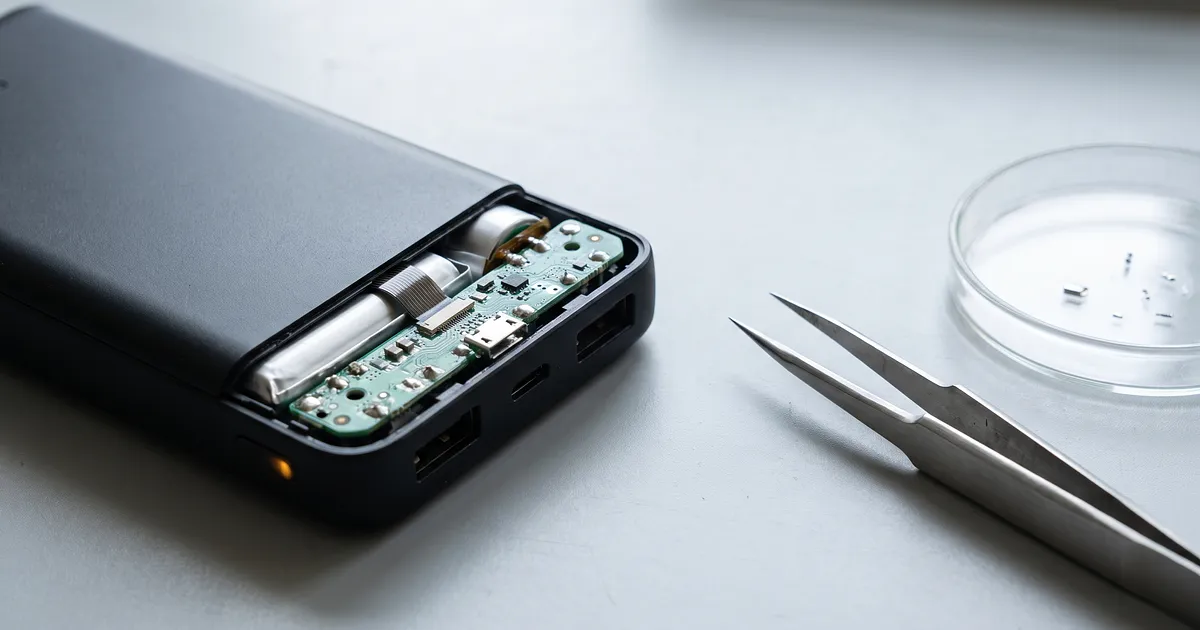
In a cheap device, lead rarely sits in the cell. It sits in the solder. Leaded solder melts lower, is more forgiving on a fast production line and costs less than lead-free alloy — the number in the alloy name Sn63Pb37 is the lead share in percent. Measured against a limit of 0.1% per homogeneous material, a joint like that is not marginally over. It is over by orders of magnitude.
This is not speculation. It is in the European Commission's own annual report. The Safety Gate Report 2025 lists lead among the dangerous chemicals most often found in electronic devices: "Lead is very often found on solders."
How the EU actually removes a model from the market
The mechanism is Safety Gate, the EU rapid alert system for dangerous non-food products. When one national authority notifies a product, the alert circulates to every participating country, and the follow-up measures range from withdrawal from the market through a stop at the border to ordering an online marketplace to delete the listing.
The 2025 figures, published on 05.03.2026:
| 2025 metric | Value |
|---|---|
| Alerts notified in Safety Gate | 4,671 (highest since 2003, +13% vs 2024) |
| Follow-up actions | 5,794 (+35% vs 2024) |
| Share of alerts citing chemical risk | 53% |
| Share for "electrical appliances and equipment" | 11% |
| URLs inspected by the eSurveillance crawler | more than 1.6 million |
| Of those, carrying already-notified products | more than 20,800 |
That last row explains the "cheap models" in the headline better than any guess about manufacturing cost. The crawler searches online listings for products that are already in Safety Gate and are still being sold anyway. Structurally, it hits the marketplace listing with no settled manufacturer behind it, not the branded article with an importer's address on the box.
What the statistics do not say: how many of those alerts concerned power banks, and how many of those were about lead. The annual report does not break it down that far. There is nothing solid to cite, so no number goes here. To check individual cases, search the Safety Gate database directly.
What you can read off the device itself
Three things, no lab required:
- The chemical symbol under the crossed-out wheelie bin. Annex VI Part A(5) of the Regulation requires it: a battery containing more than 0.004% lead or more than 0.002% cadmium carries the symbol for that metal — Pb or Cd — printed below the separate-collection symbol, at least a quarter of its size. So a "Pb" on a power bank bought in 2026 means somewhere between 0.004% and the 0.01% ceiling. Anything above that simply may not be sold.
- A named address inside the EU. A CE mark on its own says little; it is the manufacturer's own declaration. What matters is whether a manufacturer or importer with a real postal address appears on the device and the packaging — that is where a market surveillance authority sends its request for the EU declaration of conformity.
- From 18.02.2027, a QR code. Annex VI Part C then requires one on every battery, making the mandatory information machine-readable. That is the next known deadline in this file.
Models with a traceable manufacturer
None of the power banks below has been measured for lead here, and nobody else has published such a measurement either. The selection therefore follows a different criterion: manufacturers with stable model lines, a named EU distributor, and a review history that does not restart from zero every three months. Prices and ratings: as of 06.08.2026, per amazon.de.
Anker Zolo Power Bank, 10,000 mAh 30 W High-Speed Portable Charger with Integrated USB-C Cable, Quick Charge Battery Pack for iPhone 15 Models, MacBook, Galaxy, iPad and More, 10,000 mAh and roughly 37 Wh, is the compact option and the cheapest entry point here.
INIU 45W Power Bank, Ultra Klein 20000mAh covers the 20,000 mAh, 45 W price bracket where the no-name listings normally sit.
Anker Zolo Powerbank 20.000 mAh, 45 W Max carries two built-in USB-C cables, which is one cable fewer in the bag.
UGREEN Nexode Power Bank 20000mAh 45W mit integriertem USB-C Kabel charges bidirectionally at 45 W and adds two USB-C ports plus one USB-A.
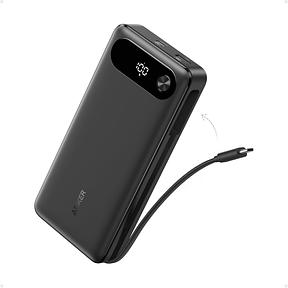
Anker Powerbank, 20.000mAh tragbares Ladegerät mit integriertem USB-C-Kabel, 87W Max Schnellladung, kompatibel mit MacBook, iPhone, Samsung und mehr is the only one on this list that meaningfully recharges a MacBook Pro, at 87 W.
For scale: 20,000 mAh at the usual 3.7 V cell voltage is roughly 74 Wh — not the 100 Wh implied by the 5 V on the USB port. The full conversion is in our piece on mAh and Wh.
Not available in your region — closest match
View at Amazon (as of Aug 15)Affiliate link. Buying through it earns us a commission; the price stays the same for you.
Not available in your region — closest match
View at Amazon (as of Aug 15)Affiliate link. Buying through it earns us a commission; the price stays the same for you.
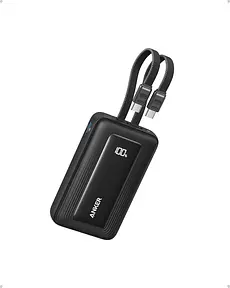
Anker Zolo Powerbank 20.000 mAh, 45 W Max
View at Amazon (as of Aug 11)Affiliate link. Buying through it earns us a commission; the price stays the same for you.
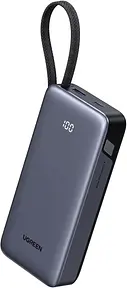
UGREEN Nexode Power Bank 20000mAh 45W mit integriertem USB-C Kabel
View at Amazon (as of Aug 11)Affiliate link. Buying through it earns us a commission; the price stays the same for you.
Affiliate link. Buying through it earns us a commission; the price stays the same for you.
Bottom line
The rule itself is unglamorous and still gets quoted wrong: 0.01% lead in the cell since 18.08.2024, 0.1% per homogeneous material in the electronics. What turns it into market pressure is not the limit but the enforcement — 5,794 follow-up actions in one year and a crawler sweeping 1.6 million addresses for listings that were already flagged. A Pb under the wheelie bin and a real company address on the packaging cost you ten seconds and tell you more than any CE logo.
All products from this post
The ones we named above are marked; the rest are alternatives in the same category.
Not available in your region — closest match
Anker Powerbank, 20.000mAh tragbares Ladegerät mit integriertem USB-C-Kabel, 87W Max Schnellladung, kompatibel mit MacBook, iPhone, Samsung und mehr
View at Amazon (as of Aug 15)
Not available in your region — closest match
Anker Powerbank, 20.000mAh tragbares Ladegerät mit integriertem USB-C-Kabel, 87W Max Schnellladung, kompatibel mit MacBook, iPhone, Samsung und mehr
View at Amazon (as of Aug 15)Affiliate notice: As an Amazon Associate, we earn from qualifying purchases. Product prices and availability are subject to change.
Frequently Asked Questions
Is a power bank carrying a Pb mark illegal?
No. The mark only means the battery holds more than 0.004% lead. It becomes illegal above 0.01% by weight, and that limit has applied to portable batteries since 18.08.2024 under Annex I entry 3 of Regulation (EU) 2023/1542. Between 0.004% and 0.01% the battery must be labelled and may still be sold.
Why do the cell and the electronics have different limits?
Because two instruments apply. The Batteries Regulation governs the battery and sets 0.01% by weight. The RoHS rules, implemented in Germany as § 3 ElektroStoffV, govern electrical and electronic equipment and set 0.1% per homogeneous material. A power bank is both things at once, so both limits apply side by side.
Do I have to dispose of an older power bank now?
No. The limit binds the act of placing a product on the market, not ownership. It is addressed to manufacturers, importers and distributors, and it covers batteries placed on the market from 18.08.2024 onward. A device bought before that date can still be used.
How do I find out whether a specific model was notified?
Through the European Commission's Safety Gate database. Alerts can be searched by product, risk type and country, including the measures national authorities took. Searching by brand and model designation is the fastest route.
What changes next?
18.02.2027. From that date every battery must carry a QR code under Annex VI Part C of Regulation (EU) 2023/1542, making the required information machine-readable.