How Fast Does a Power Station Charge? HyperFlash and X-Stream Decoded
 4 min read
As of: 02.09.2026
Two power stations, same capacity, one takes twice as long to fill. The answer to how fast a power station actually charges isn't in the Wh figure. It's in the charging power at the AC input, and that's the number manufacturers bury behind brand names.
HyperFlash and X-Stream: which name belongs to whom
This gets mixed up constantly, AI answers included. HyperFlash belongs to Anker Solix, not EcoFlow. According to Anker Solix, the C1000 series charges from 0 to 100% in 49 minutes at up to 1,540 watts. That's a manufacturer spec, not an independent measurement, though notebookcheck reported the same figure independently on 19.08.2025.
Anker SOLIX C1000 Gen 2 Tragbare Powerstation, 1024Wh LiFePO4, 2000W Solargenerator
EcoFlow's counterpart is called X-Stream, which adjusts voltage, charging current and cell temperature in real time. "Turbo Charging" isn't a third technology, by the way. Anker uses "Turbo" for output power, not for charging. Beyond raw charging power, it's worth checking what independent tests say about Anker, EcoFlow, Bluetti and Jackery before marketing terms make the buying decision for you.
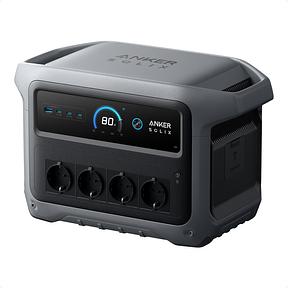
Anker SOLIX C1000 Gen 2 Tragbare Powerstation, 1024Wh LiFePO4, 2000W Solargenerator
View at Amazon (as of Aug 27)Affiliate link. Buying through it earns us a commission; the price stays the same for you.
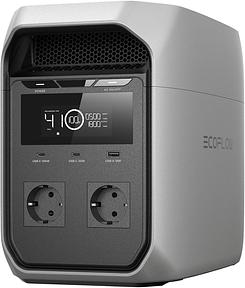
EF ECOFLOW DELTA 3 Classic Tragbare Powerstation 1024 Wh
View at AmazonAffiliate link. Buying through it earns us a commission; the price stays the same for you.
Wh ÷ W = hours: work out your power station's charging time
Capacity in watt-hours divided by charging power in watts. That's the whole formula, and it's really all you need to know how fast a power station charges. You'll need that same Wh figure when sizing your power station too, not just for charging, but for real runtime on the job.
512 Wh at 500 watts comes out at roughly an hour, which matches the manufacturer spec for the EcoFlow RIVER 2 Max Powerstation 512Wh closely enough.
But that estimate runs optimistic. As heise describes for the Delta 3 Max Plus, the electronics deliberately throttle to 1.2 kW once the pack hits 80%. That's why every spec sheet quotes "0 to 80%" and almost never 0 to 100%. It's also worth understanding why the standard Warentest-style comparison hits its limits here before you trust a single test score.
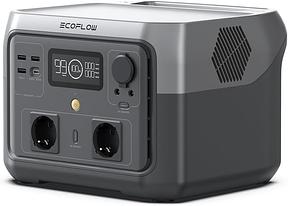
EcoFlow RIVER 2 Max Powerstation 512Wh
View at AmazonAffiliate link. Buying through it earns us a commission; the price stays the same for you.
Does power station fast charging damage the battery?
Short version: not while you stay inside the manufacturer's spec.
Epoch Batteries puts heat far ahead of everything else as an aging factor. Every 10°C above the recommended range speeds up the chemical reactions noticeably, and sustained operation above 45°C is where it gets damaging. Charge speed itself reads as unproblematic there, as long as the rated charge current isn't exceeded.
Older advice pages disagree. A widely cited piece on solar-generatoren.de, dated 21.04.2023, warns off fast charging across the board, but it leans on EV battery studies rather than the LiFePO4 cells modern power stations use. No public measurement series exists for this device class specifically, so there's no lifespan number here.
The inversion is the interesting part. The thermal management both brands sell as a headline feature is exactly the protection the old warning is asking for. So how fast does a power station charge, really? Read the watt figure at the AC input. Everything ahead of it is marketing. The same logic applies to fast charging power banks over USB-C PD and PPS: there too, it's the watt figure that decides, not the brand name.
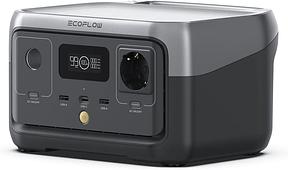
All products from this post
The ones we named above are marked; the rest are alternatives in the same category.
Affiliate notice: As an Amazon Associate, we earn from qualifying purchases. Product prices and availability are subject to change.
Frequently Asked Questions
How fast does a power station charge on average?
At 1,000 watts of charging power and 1,024 Wh of capacity, roughly an hour. An older unit at 200 watts needs about five hours for the same capacity. Charging power decides this, not pack size.
Does fast charging damage a power station battery?
Not within manufacturer specs. Per Epoch Batteries, heat is the driving factor, not speed. It turns damaging when the rated charge current is exceeded or the unit charges in high ambient heat.
What's the difference between HyperFlash and X-Stream?
Mostly the brand name. HyperFlash is Anker Solix, X-Stream is EcoFlow. Both raise AC input power while continuously regulating voltage, current and cell temperature.
Why do manufacturers always quote 0 to 80%?
Because the last 20% is slow on purpose. heise describes a throttle down to 1.2 kW past 80% state of charge on the Delta 3 Max Plus.