
How Many Watts Does a Power Bank Need? Watts, PD and PPS in Three Questions
 4 min read
In power bank fast charging, watts and watt-hours sit on the same box and mean completely different things. So how many watts does a power bank need? That depends entirely on the device you plug in. Watts are speed. Watt-hours are supply. The mAh figure on the box is a different number again, covered separately in how to convert mAh to Wh.
Question 1: How many watts does your device actually need?
A device takes only what it negotiates. A 100 W power bank charges a 20 W tablet at 20 W.
| Device | Sensible watts | PD version | PPS needed? |
|---|---|---|---|
| Phone | 20–45 W | PD 3.0 | Galaxy S25+/Ultra only |
| Tablet | 20–30 W | PD 3.0 | no |
| Laptop | 65–140 W | PD 3.0 to 100 W, PD 3.1 above | no |
The iPhone 16 charges at up to 45 watts according to AppleInsider. The 16-inch MacBook Pro, by contrast, needs a 140-watt adapter for Apple's full fast-charge rate, per Apple Support.
Question 2: PD 3.0 or PD 3.1?
PD (USB-C Power Delivery) tops out at 100 watts. Above that it becomes a spec question: with PD 3.1, the Extended Power Range lifts the limit to 240 watts.
For a phone or a tablet, none of this matters. For a 140-watt laptop it does. If the pack advertises a three-digit wattage, PD 3.1 EPR should be in the spec sheet. For picking a 100-watt laptop power bank, see our power bank guide for laptops. Example: UGREEN Nexode Power Bank 25000mAh 145W, 2X USB-C+1x USB-A lists PD 3.1 and PPS explicitly.
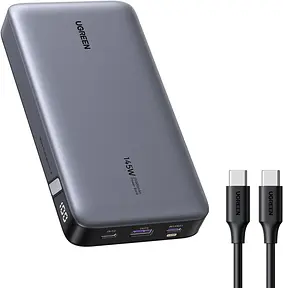
UGREEN Nexode Power Bank 25000mAh 145W, 2X USB-C+1x USB-A
View at Amazon (as of Aug 10)Affiliate link. Buying through it earns us a commission; the price stays the same for you.
Question 3: Does PPS do anything for you?
PPS is an optional extension of PD 3.0, not a standard of its own. The USB-IF specification sets the step size at 20 mV, across a range of 3.3 to 21 volts. Belkin names the payoff as lower conversion loss, so less heat. Not more watts.
The one case: according to manufacturer specs, a Galaxy S25+ or S25 Ultra reaches its full 45 watts of Super Fast Charging 2.0 only with a PPS-capable charger and a certified 5 A cable.
Which makes PPS the most over-read acronym on the box. If you want a PPS power bank anyway: CUKTECH 10 Powerbank 10000mAh 100W states PD 3.0 with PPS up to 60 watts.
How many watts does a power bank need in the end? Only as many as the device draws. And at the airport? Wattage isn't the number that counts there. Watt-hours are, and the limits sit in our power bank flight rules.
Wattages above are per the linked manufacturer sources, not our own measurement. As of 27.08.2026.
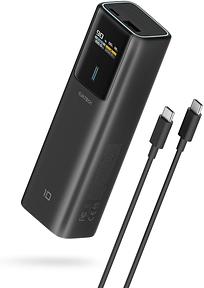
CUKTECH 10 Powerbank 10000mAh 100W
View at Amazon (as of Aug 27)Affiliate link. Buying through it earns us a commission; the price stays the same for you.
All products from this post
The ones we named above are marked; the rest are alternatives in the same category.
Affiliate notice: As an Amazon Associate, we earn from qualifying purchases. Product prices and availability are subject to change.
Frequently Asked Questions
How many watts does a power bank need for a phone, tablet or laptop?
Phone 20 to 45 watts, tablet 20 to 30 watts, laptop 65 to 140 watts. A power bank can supply more, the device just won't draw it.
Will a 100-watt power bank damage my phone?
No. The wattage is a ceiling, not an instruction. Both sides negotiate over USB-C how much actually flows: a 25-watt phone still draws only its 25 watts from a 100-watt power bank. More watts on the spec sheet never hurts, it just does nothing beyond the exact device and cable pairing that needs it.
Do I need PD 3.1, or is PD 3.0 enough?
PD 3.0 covers you up to 100 watts. Only above that, meaning laptops that draw 140 watts, do you need PD 3.1 with Extended Power Range. For a phone or a tablet, the PD version makes no difference.