Battery Returns 2026: What Germany's New BattDG Means for Your Power Bank
 9 min read
Germany has had a new battery law since 7 October 2025. The Batterierecht-Durchführungsgesetz (BattDG) replaced the 2009 Batteriegesetz (BattG), and almost every summary of it carries the same line: retailers must now take back waste batteries free of charge, with no purchase required. That line is correct. It just does not cover your power bank.
The reason sits in a single subordinate clause of § 14 BattDG that hardly any summary quotes. It decides whether you drop a dead device into the battery collection box by the supermarket door or hand it in somewhere else entirely — and for a power bank, somewhere else is the more dependable route.
Status: IN FORCE since 07/10/2025. All figures in this article as of 07/08/2026.
What the BattDG changed on 7 October 2025
Its full title is the Act implementing Regulation (EU) 2023/1542 concerning batteries and waste batteries. It was promulgated on 6 October 2025 in the Federal Law Gazette, BGBl. 2025 I No. 233 and entered into force the following day. The German Environment Agency (UBA) confirmed entry into force on 22 October 2025 and renewed stiftung ear's appointment as the register in the same notice.
The part that matters to an end user is § 14 BattDG. Paragraph 1, sentence 1 obliges every retailer to take back waste portable batteries and waste LMT batteries free of charge, "regardless of their chemical composition, brand, origin, size and condition". No minimum sales floor, no purchase. The duty is limited to the battery categories the retailer stocks or once stocked, and to household quantities. Distance sellers must, under paragraph 2, set up "suitable return options within a reasonable distance" of the end user.
The sentence that excludes power banks
The restriction that explains the rest of this article follows immediately:
"Sentence 1 does not extend to products with built-in waste batteries; the Electrical and Electronic Equipment Act and the End-of-Life Vehicles Ordinance remain unaffected."
— § 14 (1) sentence 3 BattDG, in force since 07/10/2025 (translated from the German original)
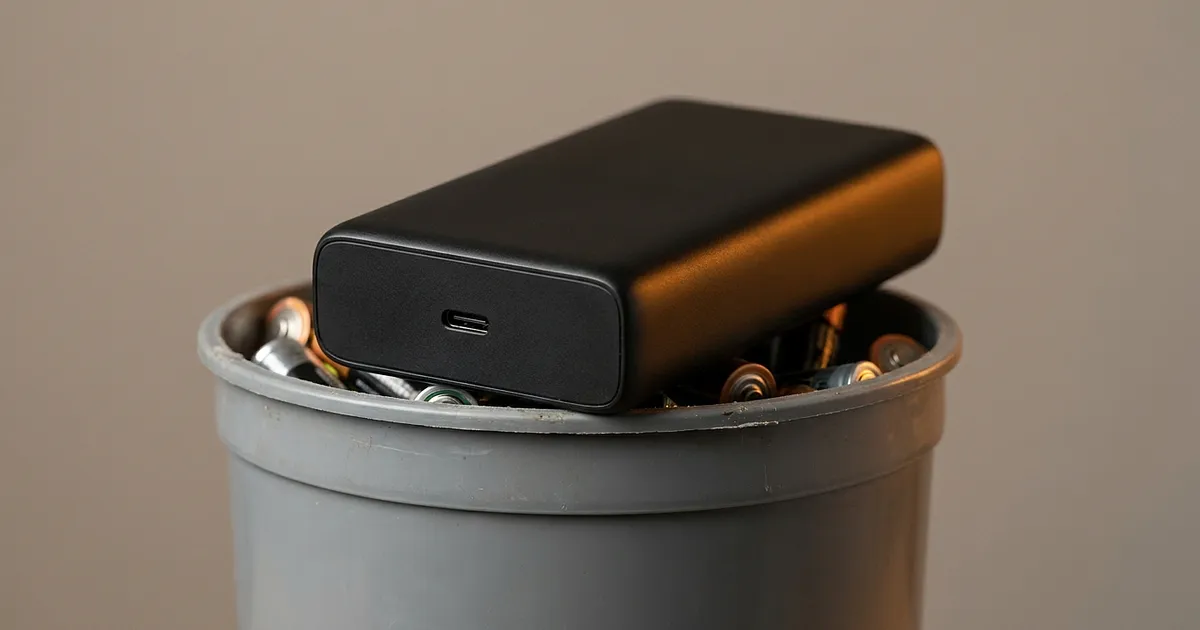
A power bank is not a battery you can pull out and hand over on its own. It is a device with a permanently installed cell — a product with a built-in waste battery. The § 14 take-back duty therefore does not reach it.
This is not a harmless technicality. It means you have no entitlement to use the battery collection box for a power bank. Whether a given collection container accepts one is the operator's decision, not § 14's. What you can insist on sits in a different act.
The ElektroG applies instead — and it is the stronger rule here
§ 17 ElektroG governs retail take-back of waste electrical equipment:
| Where | Floor-area threshold | What you can hand in | Purchase required? |
|---|---|---|---|
| Electrical retailer | from 400 m² of sales floor for electrical and electronic equipment | waste devices no larger than 25 cm in any external dimension — max. three per device category | no |
| Food retailer | from 800 m² of total sales floor | the same devices under 25 cm — max. three per device category | no |
| Both, larger devices | as above | one waste device of the same device type | yes, 1:1 on purchase |
A pocket-sized power bank stays well under 25 cm in every dimension, which puts it in the first row: free, no purchase, up to three units. A power station does not — it exceeds 25 cm in at least one dimension, so the 1:1-on-purchase rule applies to it.
On balance the ElektroG route is broader for a power bank than the BattDG route would have been: it does not depend on whether the retailer ever stocked that particular battery category.
What comes next
The deadlines the German Federal Environment Ministry lists for the EU Battery Regulation (page as of 09/12/2025), plus the one change the UBA has announced for 2026:
| Date | What applies | Source |
|---|---|---|
| 01/01/2026 | e-bike and e-scooter batteries can be handed in at municipal recycling centres | UBA notice on the BattDG, 22/10/2025 |
| 18/02/2027 | the digital battery passport becomes mandatory | Ministry, as of 09/12/2025 |
| by end of 2027 | collection rate for portable batteries: 63% | Ministry, as of 09/12/2025 |
| by end of 2030 | collection rate for portable batteries: 73% | Ministry, as of 09/12/2025 |
Two figures that circulate elsewhere on this topic are deliberately absent here:
The date for removability and replaceability of portable batteries. The duty itself is not in dispute — end users are to be able to remove and replace cells themselves. But two different dates circulate for it (18 February 2027 and 18 August 2027), and no official source reachable for this article commits to either. So no date appears here.
The date for capacity labelling under Article 13 of the EU Battery Regulation. 18 August 2026 is the figure quoted; whether the Commission implementing act it depends on exists could not be confirmed on any official source.
Whether a power bank falls under the removability duty at all is also open: the Regulation provides for exemptions, including where a permanent connection is necessary for safety reasons. The figure goes in here as soon as it can be confirmed officially.
What to do now
A power bank never belongs in household waste. The workable route is an electrical retailer from 400 m², a large food retailer from 800 m², or the municipal recycling centre. Hand the device in at the till or at the acceptance point, and say so if the cell is swollen or damaged.
Which of those routes fits your case is covered in how to dispose of a power bank. If your model is subject to a recall, check it first against the 2025/2026 recall list — a recalled unit often has its own free return path to the manufacturer. And if you want to know why the EU is tightening up on the materials themselves: lead in power banks.
Sources for this article: § 14 BattDG and § 17 ElektroG in full text on gesetze-im-internet.de, BGBl. 2025 I No. 233, the German Environment Agency notice of 22/10/2025, and the Federal Environment Ministry's deadline overview for Regulation (EU) 2023/1542 (page as of 09/12/2025). German statutory wording quoted here is translated; the German text is authoritative. This is journalistic explanation, not legal advice. As of 07/08/2026.
Frequently Asked Questions
Does the new BattDG take-back duty cover power banks?
No. § 14 (1) sentence 3 BattDG explicitly excludes products with built-in waste batteries from the take-back duty and points to the Electrical and Electronic Equipment Act instead. A power bank has a permanently installed cell, which makes it waste electrical equipment rather than a waste portable battery under § 14. You can still return it — through the ElektroG rules rather than the battery collection box.
Since when has the BattDG applied?
Since 7 October 2025. It was promulgated on 6 October 2025 in the Federal Law Gazette (BGBl. 2025 I No. 233) and replaced the 2009 Batteriegesetz (BattG). The German Environment Agency confirmed entry into force in a notice dated 22 October 2025.
Do I have to buy something to hand in my power bank?
No, as long as the device is no larger than 25 cm in any external dimension. § 17 ElektroG obliges electrical retailers from 400 m² of sales floor and food retailers from 800 m² of total sales floor to accept such waste devices free of charge and without any purchase, up to three units per device category. Larger devices fall under the 1:1-on-purchase rule.
What applies to online retailers?
§ 14 (2) BattDG obliges retailers selling portable and LMT batteries at a distance to set up suitable return options within a reasonable distance of the end user. That duty does not reach a power bank, because of paragraph 1 sentence 3 — it is a product with a built-in battery. The dependable route stays bricks-and-mortar retail or the municipal recycling centre.
Can I drop my power bank into the battery collection box at the supermarket?
You have no entitlement to. The § 14 BattDG take-back duty those boxes rest on covers waste portable batteries, not products with a built-in waste battery. Whether a particular container accepts a power bank anyway is its operator's decision. The dependable route is handing it in as waste electrical equipment at a retailer or a municipal recycling centre.
What changes in 2027?
The digital battery passport becomes mandatory on 18 February 2027, and a 63% collection rate for portable batteries applies by the end of 2027 (Federal Environment Ministry, page as of 09/12/2025). For the duty to make portable batteries removable and replaceable, two different dates circulate, so this article names none.