Balcony Solar Permit in Germany 2026: Who Actually Decides?
 9 min read
As of: 03.09.2026
Almost everyone hunting for a balcony solar permit pictures the same building: the town hall. A planning office, a form, a stamp, a wait, eventually a decision letter. That picture stopped being accurate when Solarpaket I came into force. For a normally sized plug-in solar device, no municipal permit procedure exists in Germany at all. What exists is a federal registration. What also exists is private-law consent from your landlord or your owners' association. And yes, the municipality can appear, but only in three narrow situations.
That sounds like hair-splitting. It isn't. Ask the wrong office and you'll wait for an answer nobody there is allowed to give you.
The wave nobody had to approve
For scale: according to GFK Solar, roughly 1,327,000 plug-in solar devices were listed in the Marktstammdatenregister in May 2026, adding up to about 1,381 MWp.
The pace? In 2025, Energyload counted a new system going live every 73 seconds on average, up 23 percent on the year before.
One figure is completely missing from that statistic: the number of municipal permits. Because there aren't any.
The federal level decides, but it doesn't approve
The Bundesnetzagentur, Germany's federal network regulator, asks for exactly one thing: registration in the Marktstammdatenregister, its national plant register. Free, online, no substantive review. Since Solarpaket I took effect on 16 May 2024, plug-in devices within the power limits don't even have to be reported to the grid operator any more.
The distinction the whole misunderstanding hangs on is put about as tightly as it can be by balkon-kraft-werke.de: the Marktstammdatenregister "ist ein Meldregister, kein Genehmigungsverfahren", a notification register, not a permit procedure. You report what you built. Nobody decides in advance whether you may.
The thresholds sit in § 8 Abs. 5a EEG: 2,000 watts of module power and 800 volt-amperes of inverter power at most, counted cumulatively per grid connection point. Below that, the simplified regime applies. Above it, your plug-in device becomes an ordinary PV installation with everything that comes attached.
So the 800 mark isn't an arbitrary manufacturer choice. Balcony storage units like the Anker SOLIX 2 Plus Solarbank + 2x 500W Topcon Solarpanel or the considerably cheaper Growatt NOAH 2000 Balkonkraftwerk-Speicher 2048 Wh mit 800 W Ausgangsleistung are capped at exactly that output according to their manufacturers, not because an authority checks it, but because a different rulebook starts one watt above.
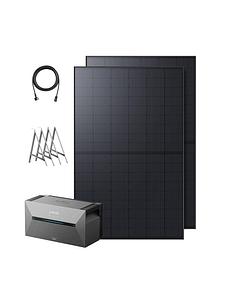
Anker SOLIX 2 Plus Solarbank + 2x 500W Topcon Solarpanel
View at AmazonAffiliate link. Buying through it earns us a commission; the price stays the same for you.
Not available in your region — closest match
View at Amazon (as of Aug 15)Affiliate link. Buying through it earns us a commission; the price stays the same for you.
Landlords and Owners' Associations: Who Decides on Your Balcony Solar Permit
This is where it gets real, because this is where the actual obstacle to your balcony solar permit sits.
Since 17 October 2024, tenants have had a statutory claim to their landlord's consent under § 554 BGB, as Haufe sets out. Owners inside a Wohnungseigentümergemeinschaft, a German owners' association, have a parallel claim under § 20 Abs. 2 Nr. 5 WEG. A blanket refusal is off the table.
What remains is specifications. Landlords and associations may regulate:
how the thing is mounted and wired
how it reads from the street
What they may not do is draw those specifications so tightly that the statutory claim is gutted in the process.
When it comes to a fight, civil courts settle it. Not a planning office, and definitely not a mayor.
In July 2025 the Bundesgerichtshof, Germany's federal civil supreme court, sided with an owners' association (case V ZR 29/24). Not because balcony solar is prohibited, as Haufe's case-law roundup makes clear: the owner had mounted nine modules across the full length of his balcony without first obtaining a resolution from the owners' meeting. The right existed. The procedure was skipped.
It went the other way in Hamburg. On 2 December 2025 the Amtsgericht Hamburg-Wandsbek (case 714 C 160/25) threw out a housing cooperative's blanket objections to a temporary installation, and explicitly allowed the standard household socket connection the cooperative had complained about.
Then there's Vonovia, Germany's largest residential landlord, which had demanded things like wind-load calculations from a tenant. In December 2025 it dropped those demands mid-hearing at the Amtsgericht Aachen, and in January 2026 said it would approve plug-in solar devices "vorbehaltlos", unconditionally, from then on.
Every one of those disputes ended in a civil court. None of them involved a municipal authority at any point.
The Exception: When Your Municipality Decides on Your Balcony Solar Permit
Those cases exist. They're just narrower than the search term suggests. Three situations where an authority genuinely gets a say:
Heritage protection, if the building is listed
Sondernutzung, when shared property in an owners' association is affected
Above the thresholds, once the system exceeds 800 volt-amperes or 2,000 watts
Heritage protection
Heritage protection is state law in Germany, set at Bundesland level, and Solarpaket I left it untouched. The competent body is the untere Denkmalschutzbehörde, the lower heritage authority, usually organised at city or county level, and it looks at two things case by case: visibility, and interference with the historic building fabric.
Here's the part that matters for the jurisdiction question. That authority sits locally, but it executes state law. It is not inventing a municipal rule. Which is exactly why "the city decided" is the wrong description here, even though it feels like the right one.
Sondernutzung inside an owners' association
The second case gets confused with the first constantly: Sondernutzung, special-use rights over shared building elements such as a balcony railing or the facade. That is private law, internal to the owners' association.
It has nothing to do with a municipal Sondernutzungserlaubnis, the permit a city issues for using public space. Same word, different branch of law, different people deciding.
Above the thresholds
Which leaves the third case: a system that busts the § 8 Abs. 5a EEG figures. Above 800 volt-amperes of inverter power or 2,000 watts of module power it stops being a privileged plug-in device and becomes a regular PV installation. At that point the Landesbauordnung, the building code of your particular state, applies, and whether a building permit follows depends on which state you're in. Most states exempt small PV outright, though not all of them in the same way. There is no single nationwide answer to give.
How often heritage rules or building law actually stop an installation, honestly, nobody knows. No reliable statistic exists, so no number appears here.
What happens if you skip the registration
The only genuine obligation anywhere near a balcony solar permit is the registration. And that isn't enforced municipally either.
Failing to register is a regulatory offence under § 95 EnWG, with a maximum fine of 50,000 euros on paper. The bodies responsible are the Bundesnetzagentur and the grid operators, not your local Ordnungsamt. And according to the Bundesnetzagentur, registering late is normally sanction-free in practice.
That's not an invitation to skip it. It's a note on how that number gets used in guides: as a scare figure, with the second half of the sentence left off.
Conclusion
The honest answer to the balcony solar permit question is: nobody approves it. The federal level only wants to know it exists. Landlords and owners' associations get a say in how it looks, but since October 2024 they no longer get a say in whether it may hang there at all. And your municipality only enters the picture if a listed building is involved, or the system falls out of the privileged class.
So if you want to call exactly one office before you buy, it isn't the town hall. It's your property manager.
All products from this post
The ones we named above are marked; the rest are alternatives in the same category.
Not available in your region — closest match
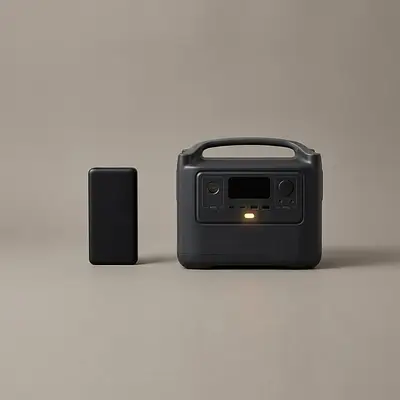
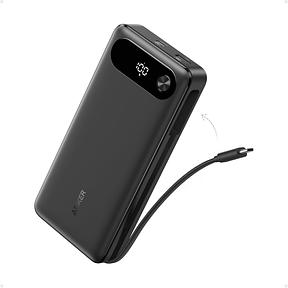
Anker Powerbank, 20.000mAh tragbares Ladegerät mit integriertem USB-C-Kabel, 87W Max Schnellladung, kompatibel mit MacBook, iPhone, Samsung und mehr
View at Amazon (as of Aug 15)Affiliate notice: As an Amazon Associate, we earn from qualifying purchases. Product prices and availability are subject to change.
Frequently Asked Questions
Do I need to register my balcony solar system with the planning office?
No. For a plug-in device up to 800 volt-amperes of inverter power and 2,000 watts of module power, no planning office is involved. The only official duty is free registration in the Marktstammdatenregister, run by the Bundesnetzagentur. A building application only becomes relevant once the system exceeds those thresholds and legally turns into an ordinary PV installation.
Can my city ban my balcony solar system?
Only in narrow exceptions. No general municipal ban exists. If the building is heritage-listed, the lower heritage authority decides under state law, weighing visibility and interference with the building fabric. Above the power thresholds, a building permit may become necessary depending on your state's building code. Both are case-by-case assessments, not local bylaws aimed at balcony solar.
What is the difference between registration and a permit?
A permit decides in advance whether you are allowed to do something. A registration records what already exists. The Marktstammdatenregister is a notification register: it does not review, it does not clear, it does not reject. So "balcony solar permit" is strictly the wrong term for the normal case, even though it is what almost everyone searches for.
Can my landlord refuse consent?
Since 17 October 2024, only in narrowly limited exceptional cases. § 554 BGB gives tenants a claim to consent, and the burden of justification sits with the landlord. He may still specify how the system is mounted and wired, but those specifications must not gut the claim itself. Blanket concerns about appearance or liability were rejected by German courts several times in 2025.
What happens if I do not register my balcony solar system?
Failing to register is a regulatory offence under § 95 EnWG, with a fine ceiling of 50,000 euros. Enforcement sits with the Bundesnetzagentur and the grid operators, not with a local authority. Registering after the fact normally stays sanction-free according to the Bundesnetzagentur. The risk is real, but it is a different risk than the 50,000 euro figure implies.
What balcony solar rules apply in 2026?
Balcony solar rules in 2026 work on three levels: the federal government only requires free registration in the Marktstammdatenregister, landlords and owners' associations have only had a say in how it's mounted since October 2024, not whether it happens at all, and your municipality gets involved only for heritage protection or once you cross the 800 volt-ampere threshold.